Hump Day Open Thread

As today is my husbands 63 and 5 months birthday celebration we’re taking the day off, JK. We’re always looking for an excuse for a holiday.

A few links to keep us going.

I found this headline from the NY Times amusing.

Europe Nears Agreement on Bailout Fund That May Be Inadequate

By the time the entire process is finished, about mid-October if all goes well, Europe’s leaders will have a newly expanded European Financial Stability Facility that most analysts say will be, at $600 billion, grossly inadequate to extinguish the crisis, since it lacks the means to cope with the larger economies of Italy and Spain.
It seems another example of too little, too late on the part of the leaders of the 17-nation euro zone. But it is also another example of sharply differing analyses of the core problem of the euro, making a solution hard to reach.


And from the Left Coast Desk
Gov. Chris Christie was here at the Reagan Library. I guess he’s still not running.

The video, on the Politico website, represented his “answers back to back to back together on the question of running for the presidency,” he told hundreds of Republicans gathered at the Ronald Reagan Presidential Library in Simi Valley — several of whom asked him to run.

Among the responses on the video: “I’m 100% certain I’m not going to run,” “I don’t want to run” and “I don’t feel ready in my heart to be president.”


And my favorite DFH David Dayen points to this. Apparently the USPS is required to pre-fund future retiree benefits of postal workers who aren’t even born yet.


The USPS economic crisis is the result of a provision of the Postal Accountability and Enhancement Act of 2006 that requires the Postal Service to pre-fund the health care benefits of future retirees—a burden no other government agency or private company bears.


The legislation requires the USPS to fund a 75-year liability over a 10-year period, and that requirement costs the USPS more than $5.5 billion per year. Guffey also pointed out that “the federal government is holding billions of dollars in postal overpayments to its pension accounts.” 


All of the USPS losses over the past four years come from this mandate. You cannot find another organization in the world, AFAIK, that pre-funds 75 years of benefits over a 10-year period. And it’s not just the overpayments, it’s the opportunity costs of having to hold that much reserve capital that cannot be used when times are tough, or to invest in more attractive services. This results from a 2006 law that was one of the last time bombs of the Denny Hastert-Bill Frist Congress. That needs to change.

— LM


Apropos of nothing: Using a 3D Printer to print food. That’s cool, but I saw a talk (I think it was a TED talk) where the guy talked about using the same sort of technology in laser printers to print nutritious wafers. Couldn’t find that, but that also sounded exciting. Not quite to the point of having Star Trek food replicators. But close. — KW

Illinois likely to appeal dismissal of charges against man facing 75 years for “eavesdropping” by recording a public official. – NoVA. They want to throw him in jail essentially for life.

She is a disturbed child

Why do doctors make so much? Why is medical care so expensive?

It is the law of supply and demand: The AMA restricts the supply of doctors. 

The best article that I came across is: old.  More recent and an established history of the practice..

But, why? Why on earth would you restrict access to health care, a necessity for all people; young, old, middle-aged, fat, thin, tall, short……..WHY?

I don’t buy that medical practioners are that much smarter than the rest of us.

So, is it to make it more simple to regulate practitioners? Or just up the salary? Or is an ego thing?

Does it disturb you? Why?

Flat tax vs. fair tax

This topic came up in a bit of back and forth recently, so I thought I’d hold forth and dodge a few soft tomatoes. Sauce!

There seem to be two sharp divisions between conservatives and liberals on taxation. The first of these is what kind of taxes people should pay. I have heard the refrain from conservative economists that taxes such as capital gains and estate taxes are the worst and consumption taxes are the best. I’m sure it’s pure coincidence that the wealthy pay the former taxes whereas lower wage earners are hit more heavily by the latter. I see this division as a philosophical one. I support taxing capital gains as ordinary income with indexing for inflation. Or perhaps a rate lowered by the inflation rate.

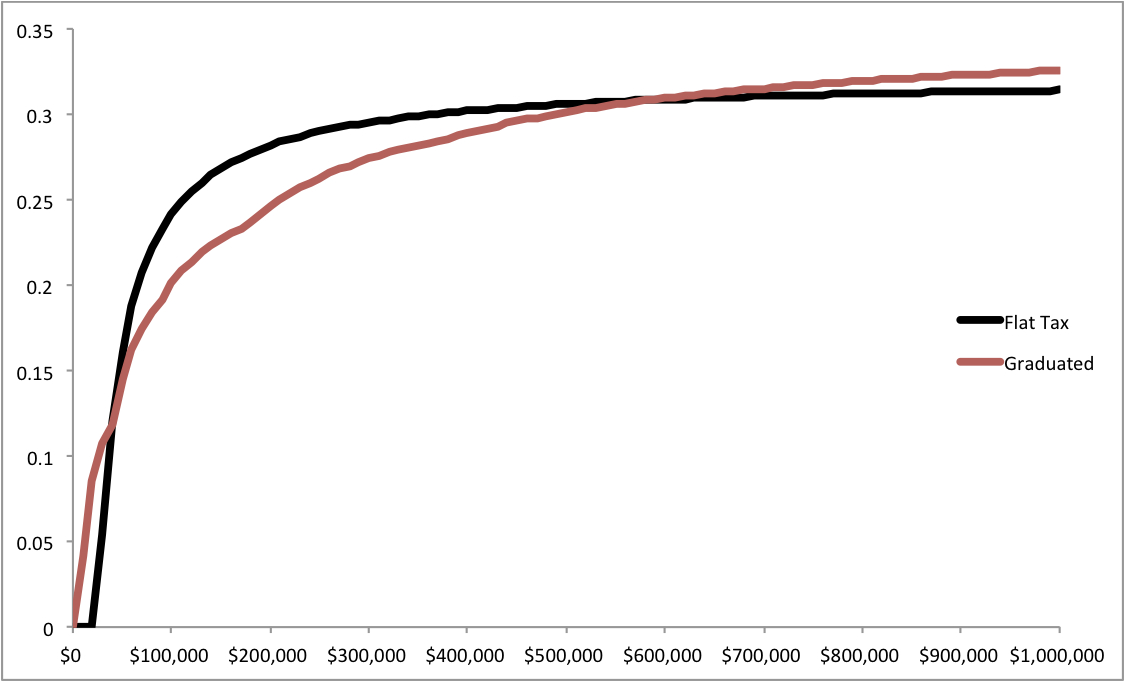
The flat tax vs. graduated rates is more interesting to me. As it has been proposed, the flat income tax is reasonably progressive due to the large personal exemption that is attached to it. But how do they compare? I took as a proposition to compare the current tax rates with a hypothetical flat tax. I put in a significant exemption for the flat tax and required it to raise roughly the same revenue as the current system. I even went to the census to get the income distribution. It’s a little tricky as 26% of households earn $100k or more and that wasn’t broken out. I assumed a gradually falling fraction from $100K upwards (using a Lorentzian distribution). It misses those earning $1M+, but I’ve heard enough times that this is a small fraction of the total. Anyway, this is a thought experiment, so my theoretical America has an income cap of $1M.

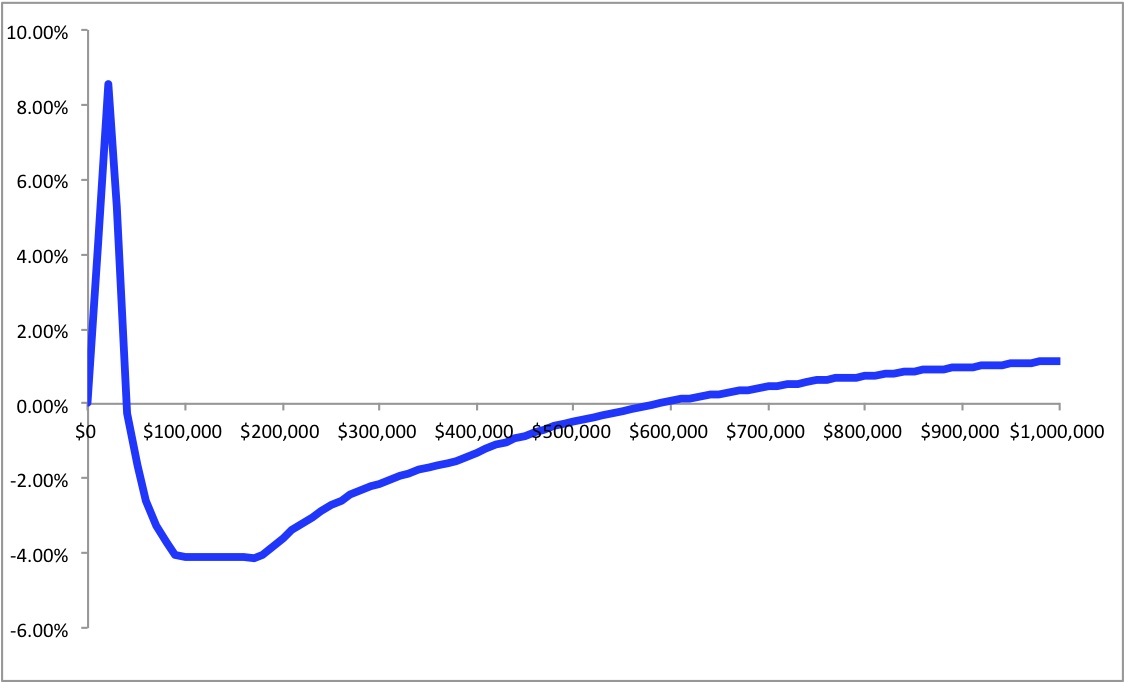
The requirements on my flat tax are that it has a $25K personal exemption and must raise the same amount as the current system. Turns out that you need a 32% rate. Here’s the plot of the two rates compared and the difference.

My flat tax is a little more progressive for incomes under $40K, though neither system generates much income from that portion of the electorate. The real story is that the upper middle class, roughly the 50% to 90% percentile, will see a rise in their effective rates of a few percent and those in the top 10% pay somewhat reduced rates. Now, there’s lots missing. Households have more than one person and there’s plenty of exemptions. So, this should really be a case of the taxation for net income after deductions, but I don’t have the demographics on that one.
Both sides are proposing a progressive system, so what’s the point? The main effect of a flat tax reform will be to redistribute the tax burden more evenly across the top half of the income spectrum. True, a flat tax is simpler to administrate, but so would a graduated system with several brackets. One can look that information up in a table anyway.
BB

Bits & Pieces (Tuesday Evening Open Mic)

Well, wouldja look at that. Reapportioning the congressional districts in order to improve governance. . . nice to know that at least one person who gets paid to blog has the same idea that I do!

. . . My preferred solution, which is plenty dreamy enough, is reapportion reform. If independent agents redrew the election districts in the states with the mandate to minimize the number of safe seats for either party, and to maximize the number that would be competitive, most of the extremism that characterizes our politics today would disappear. Both Democratic and Republican candidates would have to compete for the big middle. All views would still get aired, and the hardcore elements of both parties would still have influence. But no longer would they be able to shut down the political process as the GOP did during the debt ceiling issue.

Is this idea too dreamy? Not really. Fair play is a core American value, and instinctively we repel against the most extreme of the gerrymandered districts, regardless of which party we favor. Moreover, increasing competition is a neat market solution is an inherently comprehensible path to take in a country that likes market solutions to problems. This is a path that would open up with only a little pushing. Already California has moved in this direction, and as California usually goes, so goes the nation. It’s too late to do anything about reapportionment this time, but reform should be advanced now, while the concept is fresh in the public’s mind.

— Michigoose


This strikes me as just a little bit odd. Financial traders are more reckless that psychopaths??? Really??? [I thought they were about equally reckless; surprised to find out they are more reckless – KW]

A new study from a Swiss University finds that financial traders are more uncooperative than psychopaths, and also that they have a greater tendency for lying and risk-taking.

As part of their executive MBA thesis at the University of St. Gallen in Switzerland, forensic psychiatrist Thomas Noll, a chief administrator at the Pöschwies prison near Zurich, and co-author Pascal Scherrer studied the behavior of 28 financial traders in a decision-making game, comparing their performances with those of people who were diagnosed as psychopaths.


They expected to find that, like the psychopaths, the traders would be uncooperative with others, but that they’d perform better at the game because, as Mr. Noll said, traders “are supposed to be good at making money. In social interactions, they’re supposed to be good at performing.”


But the two authors were shocked to discover that the traders were actually more uncooperative and egocentric than psychopaths when playing a prisoner’s dilemma game — a type of gaming scenario where participants can choose to cooperate or betray each other.

Moreover, even though the traders lied and took risks more than their psychopathic counterparts, their performance at the game was about the same as the control group. This means the traders not only didn’t play well with others, they also didn’t do any better at the game than regular Joes.

— Michigoose


Maybe this was discussed over the weekend, but the media ran amuck with stories about Obama criticizing his base following his speech in front of the Congressional Black Caucus. I thought this was in interesting take from an interestingly named blog that turned the usual “liberal media” perspective on its head. — Ashot


The floor is yours, kids!

Is This Premise Valid?

This article is making the rounds in the rightwing blogosphere. Short version, “White liberals are abandoning Obama because of racism.”

This speaks more about the victim politics of the author than of reality.

What do those on the left think?

http://www.thenation.com/article/163544/black-president-double-standard-why-white-liberals-are-abandoning-obama

–Troll

Four Boxes of Liberty: Power of the Jury

I’m sure everyone here is familiar with the saying regarding the “four boxes” of liberty: soap, ballot, jury and ammo. I’ve been thinking a lot about number 3 and how it’s an under-utilized way to check government power. In fact, I think it might even be the best way. I’m specifically talking about the idea of jury nullification. The refusal of one’s peers to convict a fellow citizen if the law is unjust or the government abused its powers.

Obviously, the government doesn’t like this and is going everything it can to keep the idea from spreading, including dismissing from jury duty those who would question the law and arresting those who would distribute leaflets on jury rights. (I’ll edit this later with links).

I’m curious as to what others would do. If advocacy is ineffective and you’ve failed at the ballot box, to what extent should the jury box be used? Personally, absent violence, I’m not voting to convict someone on a drug possession charge. You can go beyond the war on drugs too. Prosecutors are bringing wire-tapping and related charges against those who record police officers. The only way around that, as I see it, is a string of acquittals, as no politician is going to run on a platform that is perceived to be “soft” on crime.

See more at Fully Informed Jury Association.

Tuesday Open Thread

It looks like some of the big money boys aren’t all that happy with the current GOP field. They’re still urging Gov. Christie to enter the race.

Several dozen potential Christie backers attended a meeting in July convened by Mr. Langone to introduce the governor to top-shelf Republican donors, many of them on the sidelines so far in the 2012 campaign. Others saw him in action in June, when Mr. Christie quietly flew to Colorado to speak at a private retreat hosted by Mr. Koch and his brother, Charles, another prominent Republican donor.

And while Mr. Christie has so far resisted their entreaties, he is facing a renewed effort in recent days following stumbles by Gov. Rick Perry of Texas, whose debate performances and stances on Social Security, immigration and other issues have left many major donors looking again for someone they think can take on Mr. Obama next year.


I’m going to put this in as a link because I still haven’t quite figured out how to put up a video. This guy talks about the looming market crash and Greek default on the BBC.

This is not an entertaining Rick Santelli-style rant, it’s a cool assessment of how the Euromarket crisis is likely to end, which he thinks is very badly. The flummoxed reaction of the BBC host suggests that the trader, Alessio Rastani, was a booking mistake.


And it looks like we dodged the shutdown bullet again.

UPDATE No. 3: Looks like we can all rest easy — at least for the next six weeks.

Senate leaders announced a short-term deal Monday evening that appears likely to avert the partial government shutdown that was set to begin this weekend. The emergency funding in the deal is in line with what the House has already approved, Politico reports.

The reason that Republicans and Democrats were able to compromise is because the major sticking point — whether to offset an increase in emergency funding in fiscal 2011 with cuts elsewhere — is more or less moot now that FEMA has said it will likely have enough cash on hand to continue to hand out relief money through Friday, when the government’s fiscal year ends.

What Have I Been Saying?

Form the WSJ this morning, A Short History of the Income Tax:

Unfortunately the corporate income tax, originally intended as only a stopgap measure, was left in place unchanged. As a result, for the last 98 years we have had two completely separate and uncoordinated income taxes. It’s a bit as if corporations were owned by Martians, otherwise untaxed, instead of by their very earthly—and taxed—stockholders.

This has had two deeply pernicious effects. One, it allowed the very rich to avoid taxes by playing the two systems against each other. When the top personal income tax rate soared to 75% in World War I, for instance, thousands of the rich simply incorporated their holdings in order to pay the much lower corporate tax rate.

There has since been a sort of evolutionary arms race, as tax lawyers and accountants came up with ever new ways to game the system, and Congress endlessly added to the tax code to forbid or regulate the new strategies. The income tax act of 1913 had been 14 pages long. The Revenue Act of 1942 was 208 pages long, 78% of them devoted to closing or defining loopholes. It has only gotten worse.

The other pernicious consequence of the separate corporate and personal income taxes has been a field day for demagogues and the misguided to claim that the rich are not paying their “fair share.” Warren Buffett recently claimed that he had paid only $6.9 million in taxes last year. But Berkshire Hathaway, of which Mr. Buffett owns 30%, paid $5.6 billion in corporate income taxes. Were Berkshire Hathaway a Subchapter S corporation and exempt from corporate income taxes, Mr. Buffett’s personal tax bill would have been 231 times higher, at $1.6 billion.

So which is Buffet…misguided or a demagogue?

Derivatives, CDOs, and 2008

Apologies for the length of this post.

Since 2008, the term “derivative” with regard to the finance industry has become much maligned and has been regularly used, both in the press (which loves a simple story) and among politicians (who love to see someone else blamed for problems) as the all purpose villain in the story of our economic collapse of that year.  And this notion of “derivatives” as somehow to blame for our troubles has largely been absorbed by a public that in fact knows next to nothing about what a derivative actually is, much less the part they might have played in fueling the crisis which came in 2008.  So perhaps an explanation of what derivatives are and the role they play might serve to dispel some of the misinformation that our politicians and the press are happy to leave lingering in the public mind. 

First of all, the term “derivative” is a generic term that refers to any product or contract the value of which is based upon, or derived from, the value of another product.  What does this mean?  Well, consider perhaps the easiest to explain, a simple commodity derivative, or what is more commonly know as a commodity swap.  The current price of a barrel of oil is about $85, but we have no idea what the price will be in 6 months. Imagine a contract between you and I in which I agree to pay you $85 a barrel for 100 barrels of oil in 6 months, and you agree to pay me whatever the actual price is in that day, also for 100 barrels.  Now since we are each buying and selling the same number of barrels of oil to each other, there is no actual exchange of oil.  All that will be exchanged, or “swapped”, in 6 months is a cash flow.  I pay you $8,500 (85 times 100) and you pay me X  times 100 where X equals the price in 6 months.   The value of our contract is derived from the price of oil, even though neither of us is actually buying oil.  Hence, it is a derivative.  

How, you might be wondering, could such a contract have precipitated the demise of the housing market in 2008?  It couldn’t. And didn’t. In fact there are all kinds of different derivative markets…fixed income derivatives, equity derivatives, credit derivatives, commodity derivatives, etc.  These are all very distinct  markets, and most of them had nothing whatsoever to do with the collapse in the market in 2008.  

There was one financial innovation in particular which did contribute to the problems in 2008, the CDO, or collateralized debt obligation.  These were groups of mortgages packaged together as a single security and sold to investors. How did this contribute to the problems of 2008?  The demand for CDO’s greatly increased the amount of money available to mortgage borrowers, resulting in easy borrowing and thus helped fuel the buildup of the housing bubble.  The thing is, CDO’s are not derivatives.  They are securities. 

Now, there are, derivatives on CDOs, called synthetic CDOs, and as you might have guessed, are contracts that derive their value from underlying packages of mortgages.  They are essentially a form of credit derivative, wherein one party buys protection from the other contracting party regarding some underlying credit event. In a typical credit derivative, the underlying credit event is usually the default of a given company on a given piece of debt.  The buyer of protection will pay a monthly or quarterly premium to the seller, and the seller agrees to pay the difference between par and value of the referenced debt in the event of default.  In a synthetic CDO, the referenced credit event is the default on a package of referenced mortgages.  

It was these synthetic CDOs that were the subject of the infamous congressional inquiries which featured testimony from several Goldman Sachs employees, including Lloyd Blankfein.  Now, there are definitely some interesting ethical issues involved in creating these synthetic CDOs, because if the buyer of protection does not actually own the referenced credit risks, his purchase is little more than a bet that the referenced credits will default, and the sooner the defaults occur, the bigger the payoff for the buyer. So in a synthetic CDO, the buyer has an incentive to include the riskiest possible mortgages.  The seller, of course, wants the safest ones.  Generally speaking, this wouldn’t be a problem, as both sides have to do their own analysis of the mortgages involved, and they both must agree for a deal to get done.  But what if the seller is relying on the advice of the arranger, Goldman Sachs, and GS fails to advise them that the buyer does not actually own the underlying credit risks, and is therefore selecting the underlying credits based on the likelihood of default?  This was the nub of the criticism aimed at GS during it’s congressional testimony.  

But whatever you think of the ethical issues involved, these types of derivatives did not really contribute to the underlying conditions that led to the collapse of 2008.  Remember that, as derivatives, they weren’t actually adding money to the mortgage market, as regular CDOs did.  They were nothing more than either hedges as protection against the default of mortgages that were already owned, or they were bets against the performance of already written loans. And there is even a reasonable argument to be made that, had more people been willing to buy naked protection sooner (ie bet against the performance of mortgages), it would have been a signal that the real estate market was over heating and may have burst the bubble sooner.   

The one way in which derivatives can be said to have contributed to events is that they compounded the liquidity issues faced by financial institutions in the fall of 2008.  Most derivative contracts between market participants are collateralized, which means that, as the value of the contract changes, collateral must be posted on a daily basis to cover that value.  As markets became tumultuous in 2008, a lot of these contracts required larger and larger postings of collateral, at exactly the time that it was becoming more and more expensive, and in some cases impossible, to borrow short term money.  This is precisely what happened to AIG. It couldn’t borrow the money to meet its increasing  margin and collateral obligations. 

In any event, the point here is basically that the demonization of derivatives is much too overblown. While there are certainly legitimate questions to be raised regarding the structuring of certain kinds of derivatives, most derivatives played virtually no role in the collapse of the economy in 2008, and certainly were not responsible for the wider economic conditions in the nation, the consequences of which we are are still living with today. 

Bits & Pieces (Monday Evening Bag of Randomness)

This a whole page from The Daily, but I’m mainly pointing you at Dull But Significant at the bottom. Basically, there’s been a study that shows talking about politics makes you cranky. If the subject is politics, everybody is automatically angrier. Hmmm.

Our backgrounds and perspectives prompt us to look at the world in different ways. Kitteh sees fish different than babeh. There’s a lesson there.

Paypal now processing over $315 million in payments per day. I dunno, this just sounds dangerous and worrisome to me. Hey, you kids get off my lawn!

Do you remember The Five Man Electrical Band? You know, “signs, signs, everywhere a sign”? They had a song called “Werewolf” that I listened to hundreds of times as an impressionable 6-7 year old. It only made #64 on the Hot 100, but was featured on K-Tel’s 1974 compilation 8-track tape, Dynamic Sound. I remember listening to some of the songs a lot–some of those other songs, I don’t remember at all.

(someone, please go get this image for me and post it here: Dynamic Sound (8 Track) | Flickr – Photo Sharing!) . . . I cannot, alas. And it’s really important.

I’m having a nostalgia-gasm right now, because I’m listening to “Hearbeat (It’s a Love Beat)” by the DeFranco Family, a song I probably haven’t heard since I was 7 years old, yet it sounds deeply, deeply familiar. Strange how the brain works. BTW, that link is to the DeFranco’s appearance on the Jack Benny show. God, I’m old. 😉

This is the cover to my 2009 album, Two-Fisted Tales of True Romance:

Although I picked those images up off the interwebz, at one point in time I actually had each of those comic books.

Which of my once vast comic collection do I still have? I have a lot of Richie Rich.

I always loved Richie Rich. No wonder I’m a Republican! — KW


Kevin, you’re scaring me now!

JK (I think).
Deep question for the day: now that living people can be put on postage stamps, who would you put on one (and why)? — Michigoose