Morning Report

Vital Statistics:

Last Change Percent
S&P Futures 1368.0 0.7 0.05%
Eurostoxx Index 2503.2 -9.9 -0.39%
Oil (WTI) 108.16 -0.4 -0.37%
LIBOR 0.4875 -0.002 -0.33%
US Dollar Index (DXY) 78.411 -0.123 -0.16%
10 Year Govt Bond Yield 1.91% -0.02%

Markets gave back most of their earlier gains on the back of a disappointing Durable Goods report. January Durable goods orders dropped 4% and durables ex-transportation dropped 3.2%. Cap goods were also weaker than expected.

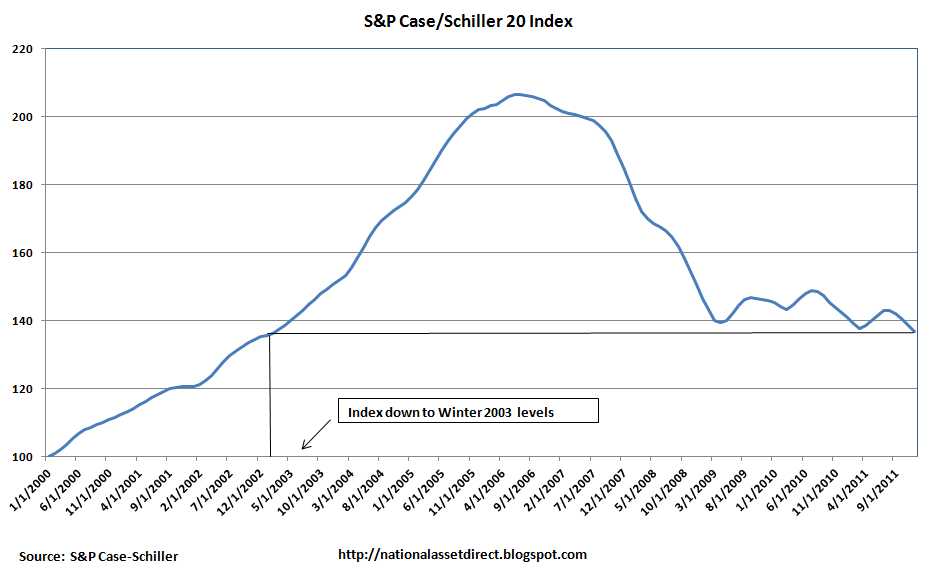
S&P / Case-Schiller for December came in down 4% YOY. Atlanta showed the biggest decline, while Detroit showed the biggest gains. A couple of highlights from the report:

“After a prior three years of accelerated decline, the past two years has been a story of a housing market that is bottoming out but has not yet stabilized. Up until today’s report we had believed the crisis lows for the composites were behind us, with the 10-City Composite originally hitting a low in April 2009 and the 20-City Composite in March 2011. Now it looks like neither was the case, as both hit new record lows in December 2011. The National Composite fell by 3.8% in the fourth quarter alone, and is down 33.8% from its 2nd quarter 2006 peak. It also recorded a new record low.”

“In general, most of the regions also posted weak data in December. Eighteen of the cities saw average home prices fall in December over November. Seventeen of the cities have seen monthly declines for at least three consecutive months. In addition to both monthly composites, 10 of the cities saw home prices fall by more than 1.0% during the month of December. The pick-up in the economy has simply not been strong enough to keep home prices stabilized. If anything it looks like we might have reentered a period of decline as we begin 2012.”

Yesterday, we got Warren Buffet’s letter to shareholders; today we get Bill Gross’s investment outlook. The theme is defensive investing, which makes sense for a bond guy when interest rates are as low as they can go. Since the early 80s, the Fed has been printing money and providing bond guys like Gross built-in capital gains in addition to income. Bill’s punch line:  “Recognize zero bound limits and systemic debt risk in global financial markets. Accept financial repression but avoid its impact when and where possible.”

The FHA has released some details on the pilot REO-to-Rental program for the Hardest-Hit Areas. They are auctioning of 320MM of properties in 8 MSAs.  The FHA is recognizing the recent strength in rental prices as well as the glut of foreclosed properties and attempting to solve two problems at once. We’ll see if this gets any traction.

Chart:  S&P Case-Schiller Index:
How do you solve a problem like Santorum?

jnc posted these links in the open thread last night, but in light of today’s primary in Michigan, I thought they were worthy of their own post.

For those who haven’t seen this, it’s worth a read:

“Goodbye to Goldwater
Rick Santorum’s Republican crusade for big government.”

Jonathan Rauch from the December 2005 issue

The rise of Rick Santorum does not make a whole lot of sense to me and the article makes it even more baffling. My only theory is that he seems to speak honestly and people recognize and appreciate it (either that or Republicans really just don’t think much of Romney). While I disagree with a whole lot of what Santorum says, I do appreciate that he generally just says what he thinks and avoids non-answers that we here from most other candidates, Republican and Democrat alike. I’ll admit I have not watched the Republican primaries all that closely, so maybe my perception is incorrect. However, even having said the above, as a Democrat I am at a bit of a loss to understand Santorum’s rise, any insight from our conservative brethren would be appreciated.

Health Care Update

Just a collection of recent health care news.   Posting it now before it gets stale.

Great essay from a hospitalist on end-of-life care in last weekend’s Washington Post Outlook section.    What was really interesting was the idea that advances in modern medicine are not the driver of the improvement in life expectancy.  According to the the CDC, “a person who made it to 65 in 1900 could expect to live an average of 12 more years; if she made it to 85, she could expect to go another four years. In 2007, a 65-year-old American could expect to live, on average, another 19 years; if he made it to 85, he could expect to go another six years.”  The increase in life expectancy was caused by a vast improvement in the child mortality rate that was the result of improved sanitation, nutrition and advances in delivery.   He makes the point that interventions are really so family members can say “we did everything we could” when, instead they should be saying “we sure put Dad through the wringer those last few months.”  Particularly damning was a quote from a retired nurse: “I am so glad I don’t have to hurt old people any more.”

(Another essay worth reading by a doctor on how doctors die. — Mike)

RAND is out with a study on the individual mandate.  Dropping it would not cause a “death spiral” according to the report.  Instead about 12 million would not be covered an premiums would go up about 9.3 percent.  However, when you look at premiums by age group, the increase is only 2.4 percent.   Also, there’s another group that’s opposed to the mandate:  Single Payer Action, a physicians organization that opposes it on policy grounds that the mandate is not needed to regulate health care, filed a brief with SCOTUS.   “It is not necessary to force Americans to buy private health insurance to achieve universal coverage,” said Russell Mokhiber of Single Payer Action. “There is a proven alternative that Congress didn’t seriously consider, and that alternative is a single payer national health insurance system.”

GAO is reporting that just because Medicare covers a preventive service, doesn’t mean that beneficiaries are using them.  “Despite Medicare’s expanded coverage and the removal of financial barriers for certain preventive services, research suggests that use of some preventive services may not be optimal.”

KHN and WaPo on the last trend at the ER.  Show up at the ER with a non-emergent problem?  It might be like some gas stations.  Pay first.   Usual suspects trot out usual complaints about barriers to care.

The HHS budget-in-brief is a great way to get an overview of what Obama has planned for FY 2013 for the department.  You can read by agency.

Bits & Pieces (Monday Night Open Mic)

Flying Pintos! What will they think of next?

Flying Pintos! What will they think of next?

One of the first flying cars. 

Have a great night! — KW

RIGHTS

The word “rights” has been used to describe both liberties and claims against others (including “entitlements”). We rebelled against a monarchy that made broad claims of entitlement for itself, and we had run away from established churches that made claims of entitlement for themselves. We understood the limits of government to require the establishment of liberties, and not entitlements, as a natural result of our seminal experience(s).

 
We have attempted to expand liberties and encroach on entitlements by increments, notably including the freeing of the slaves and the expansion of the voting franchise.

 
We have also created entitlements, most notably SS and Medicare. To the extent these were modeled on insurance schemes, they were either intended to, or disguised to appear to, create common quid pro quo legal claims. Common quid pro quo legal claims are often spoken of as “rights”, as well. When I provide you a legal service that you requested, typically I am “entitled” to be paid for it. Thus we have words with mixed usages and should be careful in this conversation to be clear.

 
I concede that a society could adopt a quid pro quo entitlement in which all were charged for a service through a tax and all were entitled to receive it upon reasonable demand.  We have certainly done so in our nation’s history and I think we would find that all free countries have done so in modern times.

 
At this point in my monologue I pause to say that while I understand and can accept “entitlements” of various sorts, I do not place these on the same plane as liberties. I consider entitlements and claims to be less worthy than liberties, although we often permit entitlements to trump liberties. Life, liberty, and property can actually be taken by the state – with due process. The fact that Congress is “entitled” to tax, and the understanding that a government can levy taxes as an inherent power, limits our property rights. That Congress is “entitled” to call us to serve in time of war or national emergency limits our liberty rights. Examples abound.

 
Phrased in the rough manner that I have laid out, “liberties” and “entitlements” are always bound to be in conflict. I accept more in the way of “entitlements” than QB would and I may claim more in the way of “liberties” than he would, based on my reading of QB over time. But I would be just as adamant as he on the general proposition that “liberty” is the higher form of “right”, and while I am comfortable with calling many statutory claims “entitlements”, and many legal claims “claims of right”, I personally have reserved the word “rights” to describe our claims as citizens of a free state to life, liberty, and property.  Recognizing that these rights are bounded and that we can choose to limit them in other ways by creating entitlements is linguistically clearer to me than trying to equate entitlements with liberties.


I believe the UN Declaration cited by Yjkt incorporates aspirations for a post WW2 world in ruins.  It is an attempt to invoke the myth of Phoenix rising from the ashes.  As such, it is beautiful.  There is no form of government possible that could deliver on that entire Declaration because of the internal conflicts, and because of the fact of scarcity.  It is better to preserve the liberty rights while attempting whatever limited aspirations we can afford, in the world of limited resources.  Or so Mark opines.


I anticipate some here may argue that there are entitlements that are as important as liberty interests, and that some may argue that liberty interests must trump aspirations at every turn.  That debate would be more productive than trying to call everything we might want a “right”.

Morning Report

Vital Statistics:

Last Change Percent
S&P Futures 1356.2 -7.1 -0.52%
Eurostoxx Index 2493.5 -30.2 -1.20%
Oil (WTI) 108.64 -1.1 -1.03%
LIBOR 0.4891 -0.002 -0.31%
US Dollar Index (DXY) 78.594 0.194 0.25%
10 Year Govt Bond Yield 1.92% -0.06%

Markets are weaker this morning after the G20 nations refused to increase support for the IMF. Oil is taking a breather after being on a tear for the last 3 weeks. Bond futures and mortgage backed securities are firmer this morning.

For people interested in the World According to Warren, here is his annual letter to shareholders. This annual letter, along with Bill Gross of PIMCO’s letters, are pretty much required reading on the Street. Buffetpalooza (the annual Berkshire Hathaway shareholder meeting) is May 5 which is when all of his admirers descend upon Omaha and paint the town red. Warren’s annual report gives you all the tips on the best shopping and root beer floats in Omaha. Don’t miss the newspaper toss.

Speaking of letters, Paul Singer (of Elliott Associates FD: my old boss) tends to pontificate on his view of politics and the economy.  Dealbook has the juicy parts.

Rick Santorum’s economic plan.  Cut taxes, cut spending.  Krugman must be tearing his hair out.

Lots of economic data this week.  Pending Home Sales and Dallas Fed are later today.

Is ATiM conservative?

On today’s earlier thread, ashot posed what seemed to me to be an intriguing question. In the face of lms’ hopefully only temporary departure, he asked:

So this is going to become a boys club and a largely conservative one at that?

The perception that ATiM is or would become a largely conservative place struck me as very odd. I don’t feel that way at all, so I was compelled to do a bit of accounting.

By my count, we have 17 people who comment on a fairly regular basis. Having been reading them all for at least a year now and in many instance a lot longer, I think they can be sensibly distributed across 6 general political classifications: conservative, moderately conservative, moderate, moderately liberal, liberal, and libertarian. Right now, I’d say that we have 4 conservatives, 1 moderate conservative, 2 moderates, 1 moderate liberals, 7 progressives, and 2 libertarians. This is my distribution.

Cons – quarterback, McWing, Brent, myself
Mod Cons – Kevin
Mods – Mark, Bannedagain
Mod Lib – ashot,
Lib – lmsinca, Michigoose, okiegirl, bsimon, Fairlingtonblade, yelljkt, msjs0315
Libertarian – novahockey, jnc4p

There is, of course, room for dispute. I’m not entirely sure about a couple of these classifications, for example msjs. Would she call herself a moderate liberal or liberal? And maybe a couple more of those classified as liberals would object and declare themselves moderate liberals. But that is more a question of degree, not kind. Banned, since he generally only comments on the markets, is tough to judge too. But I think this generally gives a good sense of where we all fall politically.

So if my accounting is accurate, we’ve currently got 5 conservatives, 8 liberals, 2 moderates, and 2 libertarians, which seems fairly balanced with a slight lean to the left. Even if we throw the libertarians in with the conservatives (which, I suspect, both the cons and the liberts would object to in principle), we get rid of the slight lean, but maintain the overall balance. If we start to include the less frequent posters (ruk, mcurtis, abc, mike), then we most definitely start to lean left.

So I think ATiM has achieved a pretty good balance across the political spectrum, and in any event is certainly not “largely conservative”. Am I wrong? Have I offended anyone by classifying them as a liberal?

Hiatus

I’m trying to decide if my continued participation here is necessary or even valuable for the blog in general or for me personally.  As one of the founders of the blog this is an important question for me but in the overall scheme of my life and interests it’s actually pretty minor.  In other words, it wouldn’t be that difficult to just walk away.  I have other projects waiting in the wings and as someone on the edge of becoming a senior citizen (yikes), I’m beginning to feel the increased value of time well spent.

I don’t want anyone to get the impression that I’m being thin skinned or overly sensitive to disagreement or intense questioning of my opinions, it’s actually a little more of a respect issue for me.  Perhaps I’ve simply over estimated my value as a dissenting voice and a woman’s perspective, I really can’t tell.  I’m not generally confused by stuff like this, but for now I haven’t been able to work through it, so I’m going to be on hiatus a little longer until I figure it out.

I have two issues, one is that during the last big ATiM kerfuffle, or the “thread that shall not be named”, I worked very hard publicly and privately, behind the scenes, to help  save the blog and keep “all” participants on board.  I swallowed a lot of pride and nearly prostrated myself at the feet of others in order to resolve our differences.  I didn’t mind too much, but it was difficult as I didn’t necessarily believe it was all about mistakes I had made.   It’s fine, we moved on and I think became better for it in the long run.  ****A number of us across the political divide worked together to bridge our differences rather than assigning blame.  I think I’m surprised there hasn’t been the same reciprocal effort in this case.  After reading the comments there appears to be a hardening of positions rather than the opposite which fosters further understanding.

In the thread regarding the VA legislation there was one issue the three of us, Michi, Okie and myself, couldn’t get the men to respond to, the issue of coercion/ invasion of personal space.  Mark and ashot were the only two who seemed to even respond to it or recognize it for a legitimate concern.  There was a lot of dancing around other issues which I don’t want to rehash, some were valid and some weren’t IMO, but as someone who raised five teenagers one of our major focuses here as parents was the distinction in sexual matters between force/coercion and free will.  I wouldn’t expect everyone else to agree that this legislation crossed those boundaries but I do believe recognition that this was the primary issue for some of us was in order, and yes we did feel summarily dismissed on this.

And so, I’m continuing my hiatus while I assess my value here and whether the blog is still valuable to me.  I’m honestly not looking for a lot of discussion, I just felt a certain responsibility as someone who dragged so many people over here with me to give you all an explanation of my thoughts on this, and then continue to work through it on my own.

____________________________________________________

UPDATE:  Regardless of anything else I will be here for the discussion of ABC’s book on the weekend of April 13th.  This is an ATiM feature I was excited about on several levels, so I do hope some of you are reading the book.

****Post edited slightly

TGIF! Silly songs from my childhood

My dad had a couple of Tom Lehrer albums that were off limits to the kids.  Naturally, I memorized the lot by age 6.


Imagine a 5-year-old singing this to a group of her parents’ friends at a cocktail party.

http://www.youtube.com/watch?v=GTfuGeKPsZM


Or skipping in the park singing this one:

http://www.youtube.com/watch?v=hf-eIgFJg4w&feature=related


And what parents wouldn’t be proud of their youngin singing this one in Sunday school:

http://www.youtube.com/watch?v=EDeRYmB4t6Q


Enjoy the weekend!

Intent and Murder Charges

There’s a localish murder trial that’s been getting a lot of attention due to the nature of the crime and those involved.

Basically, an on-again, off-again relationship between two rich attractive UVA athletes ended with him beating her to death.

You can read about the trail here.

He was convicted of 2nd degree murder and I’m pissed about it.  The jury decided that he didn’t mean to beat her to death.  Just beat her.   He received 25 years for the murder charge and 1 year for stealing her laptop after the fact.  (I don’t remember why he did that).   They opted for 2nd degree instead of 1st degree (life in prison) because of the intent.   Granted, I was following this mostly through radio broadcast updates when the alarm when off in the morning or on the ride home from work, so I don’t know all the details.   But my concern is more general anyway.

How is kicking in a door and beating your girlfriend to death, if you went there just to rough her up, any different that waiting for a shot at 500 yards with a scoped rifle?

In my opinion, there isn’t one.  Not any meaningful one anyway.  He wanted to hurt her and his actions resulted in her death.    I don’t understand why his intent is somehow a mitigating factor.   The intent was to cause harm.

I’m sure I’m missing something here.