Morning Report – all about the FOMC minutes this week.10/6/13

Markets are higher on election results in Brazil, which is putting a bid under emerging markets. Bonds and MBS are down small.

This week has very little economic data to worry about (typical for the week after the jobs report). The most important event will be the FOMC minutes on Wednesday.

The banking system is loading up on Treasuries. They have all this cash that they are not putting to work. Of course all of the lawsuits and buyback demands isn’t helping things. Another interesting data point – S&P 500 companies are spending 95% of their profits on buybacks. This speaks to the lack of investment opportunities that companies see. It is the quintessential vote of economic pessimism.

A marriage of right and left – a new 15 year mortgage that uses the downpayment to buy down the rate closer to zero. A pilot program is already up and running. Interesting idea.

Last week’s decision on Fannie and Fred left investors with a bruising. The plaintiffs vow to continue the fight, however understand that Fannie and Fred common stock is a litigation lottery ticket. The only way it is worth any money is if a court overturns the legislation forming the FHFA.

Morning Report – Jobs data dump 10/3/14

Markets are higher after a better-than-expected employment report. Bonds and MBS are down

Data dump from the jobs report:

  • Nonfarm payrolls + 248k (+215k expected)
  • Two month revision: + 69k (this is a good number)
  • Unemployment rate 5.9% (6.1% expected)
  • Labor force participation rate new low at 62.7%
  • Average hourly earnings flat
  • Average weekly hours increase to 34.6

The last time the labor force participation rate was this low was late 1977. This presents a dilemma for the Fed – will the labor force participation rate continue its decline? If so, then there is less slack in the labor market than we think. FWIW, I don’t see the Fed doing anything dramatic until we start seeing wage growth, and that is still nowhere to be found.

The ISM services index fell to 58.6 from 59.6 in August. This was slightly above the Street estimate of 58.5.

I know credit is tight, but what does it say when the Godfather of QE can’t refi? I guess the CFPB wants to make sure the Bernank doesn’t get a “predatory” loan.

Morning Report – Rental Vacancies Rising 10/2/14

Markets are flat as ECB President Mario Draghi speaks. Bonds and MBS are lower.

Initial Jobless Claims fell to 287k, as we continue to have boom – time levels in the first time unemployed. Separately, announced job cuts fell by 24% according to outplacement firm Challenger, Gray, and Christmas. Employers are beginning to hang onto their employees – the big question is what happens next? Do they get start bidding up for talent (i.e. increasing wages) or do they start to tap the long-term unemployed? The answer to that question will determine the Fed’s posture going forward.

Auto sales were strong in September. The average age of a car in the US is something like 11.4 years, which is a record.

The ISM New York rose from 57.1 to 63.7

Hiring has slowed, however. Small businesses are hiring at a slower pace than over the summer.

Completed foreclosures increased to 45,000 in August, according to Corelogic.They are up 1.1% compared to July, but down 22% year-over-year. The national foreclosure inventory is down 33% YOY, to 1.6% of mortgaged homes.

All of the new multi-fam construction and REO-to-rental supply has finally caught up to the market. The vacancy rate for apartments rose to 4.2% in the third quarter, the first increase since 2009. Apartment developers are going to complete the most units this year since 1999. The divergence between multi-fam and SFR is striking. The punch line is that some of these professional investors are going to start to think about letting some supply go, which should finally give the first time homebuyer a chance to get in, which is good for the economy and also the mortgage banking business.

Morning Report – Construction Spending down 10/1/14

Markets are lower this morning on Euro-area weakness. Bonds and MBS are rallying.

Mortgage Applications fell .2% last week, according to the MBA. Purchases were flat, while refis dropped .3%. Contract interest rates for the 30 year fixed rate mortgage fell from 4.39% to 4.33%.

Construction spending fell .8% month-over-month in August, and is up 5% year-over-year. Private resi was down .1%, while non-residential was down 1.2%.

The ADP Employment change is predicting 213k private sector jobs for this Friday’s jobs report. The Street is at 210k.

The ISM Manufacturing Index fell from 59 to 56.5, while prices paid rose from 58 to 59.5.

Fannie Mae investors lost a court ruling that threw out two lawsuits regarding Fannie’s profits, which go 100% to the government. The stock is down a buck (or about 38%) on the open. It traded as low as 97 cents pre-open. The stock is more or less a litigation lottery ticket, and this Administration is bound and determined to see to it that shareholders are wiped out.

The CFPB slapped down Flagstar in its first servicing enforcement. They were fined $27.5 million and given a tongue-lashing by Cordray. Their sin was was failure to devote sufficient resources to administering loss mitigation programs for distressed borrowers. Note that if Republicans take the Senate, one of the first orders of business will be to introduce legislation to tame the CFPB.

Epic “fat finger” trade on the TSE last night – $617 billion worth of orders were voided after a data error caused someone tried to trade 57% of the float in Toyota.

The Fed is worried about leveraged loans. Excessively low interest rates have the unintended consequence of encouraging investors to reach for risk in order to hit return targets. I have been saying for some time that the stock market is assigning a 100% probability that the Fed can start hiking rates without someone blowing up.

Morning Report – Big drop in consumer confidence 9/30/14

Markets are higher this morning on no real news. Bonds and MBS are down.

House Prices fell .5% month over month, the third consecutive monthly decline according to Case-Shiller. On a year-over-year basis, they are still up 6.75%.

Consumer confidence dropped markedly in in September, according to the Conference Board. It fell from an upward-revised 93.4 to 86. The present situation index fell from 93.9 to 89.4 and the Expectations index fell from 93.1 to 83.7.

The ISM Milwaukee Index came in at 63.18, better than the street expectations of 61. The Chicago Purchasing Manager Index came in at 60.5, below expectations as well.

Dallas Fed President Richard Fisher would raise rates in the Spring of next year instead of waiting until the summer. Regardless, it is looking like the first rate hike will be at the June 2015 FOMC meeting, provided things continue on the same economic course. Note that the Fed Funds Futures are predicting the Fed will be less aggressive than advertised in the dot graphs.

Note that inflationary pressures are moderating courtesy of a bear market in commodities, driven by a stronger dollar and slower Chinese growth. The PCE Price Index (the preferred inflation measure for the Fed) rose by only 1.5% last month, which is well below the Fed’s target.

Speaking of commodities, the US is set to become the world’s largest producer of liquid petroleum, passing Saudi Arabia for the first time since 1991. Cheap energy is going to be the basis for the next big boom in the US as manufacturing relocates back to the U.S.

A new paper from Brookings says the Fed and the Treasury should coordinate policies more.

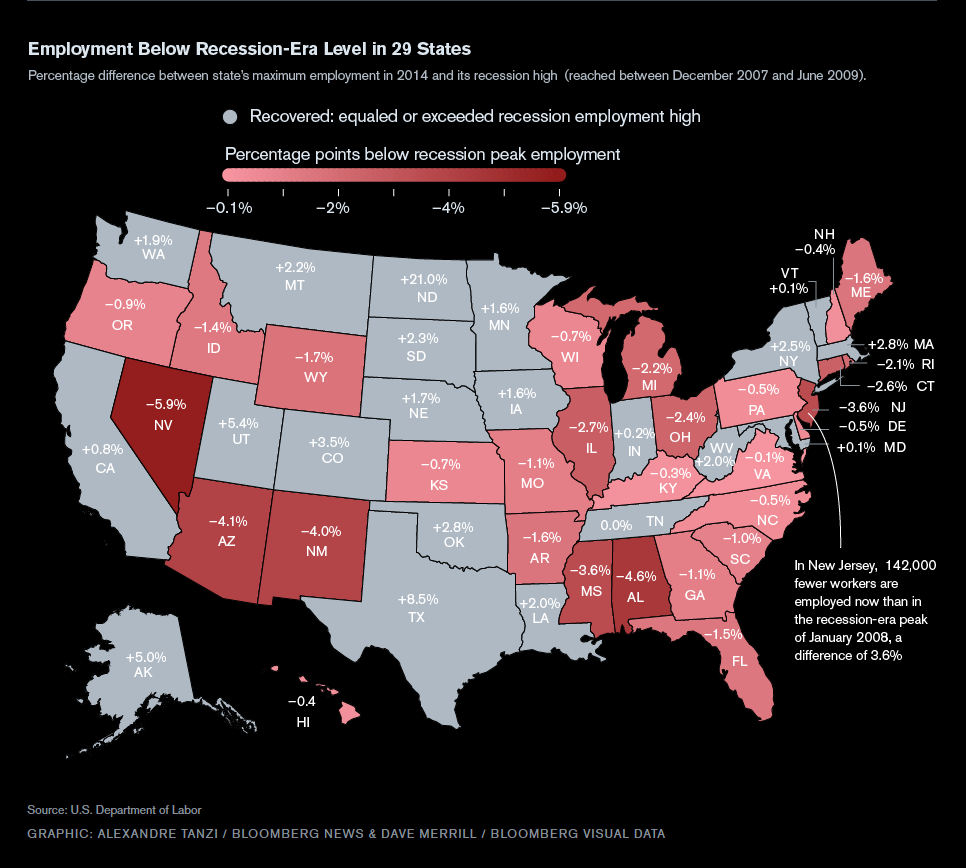
Employment has crawled back to peak levels in parts of the country, but 29 out of 50 states are still below that level. The states hit the hardest in the real estate bust – Nevada, Arizona, and Florida – are furthest from peak levels.

Morning Report – Big Week Ahead 9/29/14

Stocks are lower this morning on the demonstrations in Hong Kong. Bonds and MBS are up.

This is a big week data-wise. We will get the ISM report, construction spending, Case-Shiller, and then the jobs report on Friday. Given that bonds again seem to be driven by overseas events, I think the jobs report will probably be a non-event for the bond market unless it is exceptionally strong or exceptionally weak.

Pending Home Sales fell 1% in August after rising 3.2% in July. The West was up 2.6%, while the rest of the US was down.

Bill Gross is out at PIMCO and has joined Janus Capital. This follows record outflows at the flagship Total Return Fund, which Gross ran. PIMCO anticipates another $10 billion will leave on the news.

Personal Incomes rose .3% in August, while Personal spending rose .5%. The PCE Core rate (the inflation measure the Fed prefers to use) rose 1.5% year-over-year, below their 2% target rate.

Freddie Mac’s Chief Economist told the New England Mortgage Banking Conference that 2015 could be the best year for home sales since 2007. They are forecasting mortgage rates to be around 5% by the end of 2015.

Morning Report – Could Fair Lending Laws be getting a review? 9/25/14

Markets are lower this morning on no real news. Bonds and MBS are up.

Initial Jobless Claims came in below 300k again, which is a number associated with booming economic times. People that have jobs aren’t losing them, however the long term unemployed continue to sit on the sidelines.

Durable Goods orders fell 18.2% in August after rising 22.5% in July. They normally aren’t that volatile. Transportation orders tend to be lumpy and that explains the huge jumps. Ex-transportation, they rose .7%.

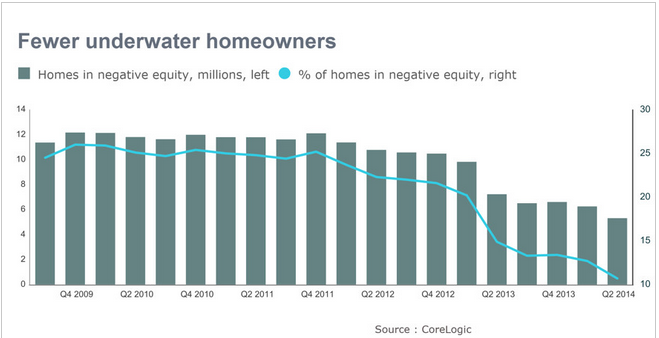
Almost a million homes regained positive equity in the second quarter, according to Corelogic. The share of mortgaged homes with negative equity fell to 10.7% compared to 12.7% in the first quarter and 14.9% last year. Negative equity percent peaked around 25% in 2009. This should help increase existing home sales and home supply as more and more people become able to move, which should be an incremental positive for the mortgage banking business.

Fair lending laws might be getting a review at the Supreme Court level. For decades, bankers could be found guilty of discrimination even if they did not intend to discriminate. Lending patterns could be enough to prove discrimination. Now, this could be headed to the Supreme Court after Texas officials ruled the disparate impact standard is too loose. The Roberts Court overturned provisions of the Voting Rights Act, and advocates on both sides suspect that the majority will rule for the narrower standard. If that happens, then life could get a lot easier for mortgage bankers, who are caught between the QM and the fair lending laws.

Morning Report – New Home Sales hit post – bubble highs 9/24/14

Markets are higher this morning as Europe rallies. Bonds and MBS are down small.

Mortgage Applications fell 4.1% last week. Purchases dropped .3% while refis fell 7%. After ignoring the rally in bonds all summer, mortgage rates are increasing as bond yields increase. It seemed like the 30 year fixed rate mortgage was stuck at 4.25%, even as the 10 year yield approached 2.3%. Now that rates are increasing, mortgage rates are increasing in lockstep. Note that MBA has the average 30 year fixed rate mortgage at 4.39%, while Bankrate has it at 4.18%.

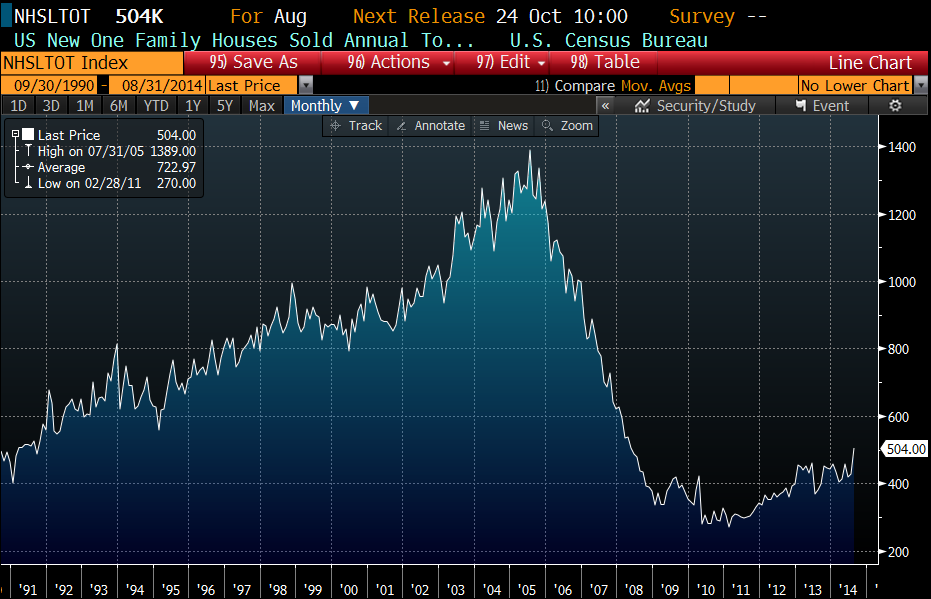
New Home Sales increased to 504k, the highest level since May of 2008. That said, half a million is still well below “normalcy” of 800k or so, or even the peak in 2005 at 1.4 million. Again, further evidence of just how much housing has been absent from this recovery, and also how much pent-up demand we have.

Chart: New Home Sales 1990 – Present

Homebuilder KB Home missed earnings expectations in a big way, with eps coming in at $0.28 vs expectations of $0.41 and revenues of $589 million vs expectations of $646 million. Revenues increased 7% driven by a 9% increase in ASPs and 2% drop in orders. ASPs were up 21% (!) on the West Coast. KB’s mortgage banking JV with Nationstar began during the quarter. Gross margins continue to improve. The company noted an “appreciable uptick” in traffic levels which they saw as “strong evidence of the pent-up demand for new housing.” The stock is down about a buck and a half pre-open.

Soon after Jack Lew and Obama released their new plans on corporate inversions and declared companies that pursue such strategies “unpatriotic,” that old triangulator Bill Clinton refused to go there and instead talked about tax inversion. I guess Bill will be floating all of Hill’s trial balloons, and acting as Obama’s back-seat driver for the rest his term. Obama’s gotta love that. FWIW, the Street doesn’t seem to be taking this too seriously – Burger King (which is in the process of buying Tim Horton) said that it will continue to with its merger regardless, as did Medtronic. The COV / MDT spread didn’t even move.

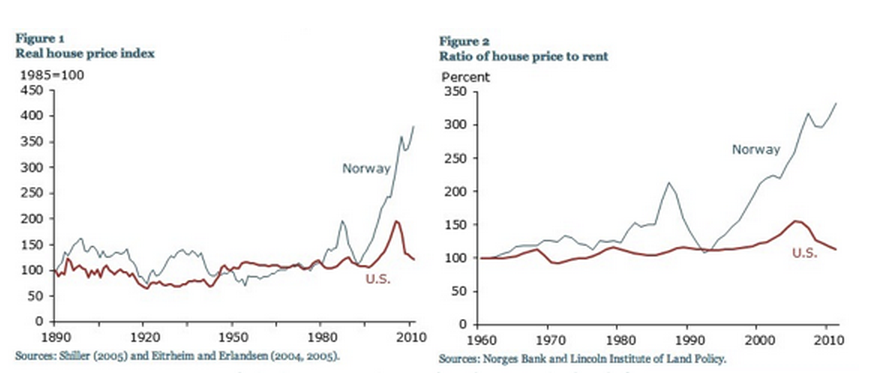
The biggest foreign buyer of U.S. real estate is Canada, but who do you think is #2? Hint: It isn’t China. It is Norway. For those that don’t know, Norway (which has a population smaller than NYC) has a real estate bubble that has defied gravity for years. Foreign purchases of US real estate assets tends to accompany bubbles in their home countries, and China, Canada, and Norway all are in the midst of real estate bubbles. While this probably affects commercial more than resi, I could see some pressure at the high end as these bubbles burst.

Chart: Norwegian Home Prices

Lending to minorities is at a 14 year low. I guess buyback risk has gotten everyone so spooked, they aren’t interested in doing FHA and low income lending, except as needed to keep their fair lending numbers in the acceptable range. Anyway, lenders should expect some sort of response from the Administration, and fair lending enforcement is probably going to be stepped up.

Morning Report – Inversions and the Fed 9/23/14

Markets are down on no real news. Bonds and MBS are up.

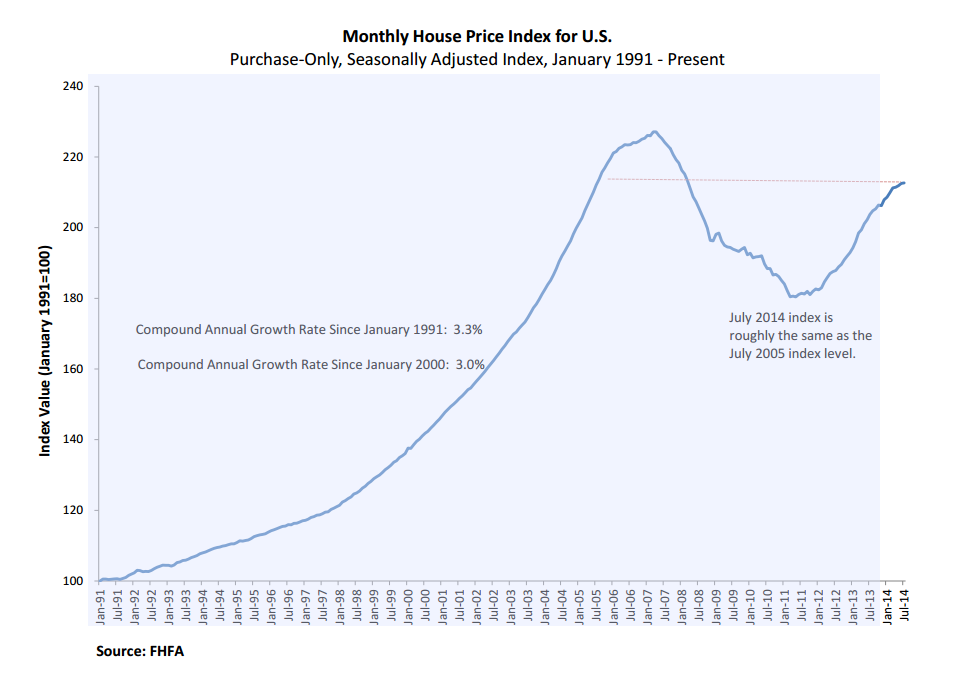
Home Prices increased .1% on a seasonally adjusted basis in July, according to the FHFA. On a year-over-year basis, prices are up 4.4% and the index is 6.4% below its April 2007 peak.

I wanted to mention something from yesterday’s existing home sales report. All cash sales have dropped to 23% of all purchases, down from nearly 29% a month ago. It seems like professional investors are not chasing properties at these levels, which is opening the door for more traditional homebuyers. In terms of how this affects mortgage bankers, consider this – as cash percentages drop, that means the number of sales with a mortgage is increasing. So even though existing home sales fell from 5.14 million to 5.05 million from July to August, the number of homes with a mortgage (in other words, gettable business) actually increased about 6.5%.

The White House has taken action on corporate inversions, not by banning them, but by trying to make them less financially attractive. The rules are not finalized, so it is too early to say whether the Administration’s plans are even legal. Corporate tax reform is needed, and the left will have to trade lower rates for closing loopholes. This is an attempt to steal a freebie. Also, the administration is hoping that by bringing that point up, Republicans can be branded as “pro-corporate deserters.” Corporate Inversion arb spreads are wider this morning.

Goldman is calling for a 4% 10 year bond yield within the next year as QE ends and the Fed starts hiking rates. Lately, the correlation between Treasuries and mortgages has broken down, so it is unclear how much mortgage rates will rise as a result.

Citi is out with a note discussing what happens to corporate bond yields when rates start increasing. Historically, rate increases have been a benign event, however we are in uncharted waters here, and Citi is advising caution.

Note that the Fed is about to get significantly more dovish as two hawks – Philly Fed President Charles Plosser and Richard Fisher, Dallas Fed President retire. They weren’t going to be voting members next year at any rate, however the Fed is losing some important hawkish voices. The Fed could now be running the risk of groupthink.

Morning Report – All cash transactions drop to lowest level since 2009 9/14/22

Vital Statistics:

Last Change Percent
S&P Futures 1997.0 -6.8 -0.34%
Eurostoxx Index 3266.5 -6.8 -0.21%
Oil (WTI) 92.14 -0.3 -0.29%
LIBOR 0.233 0.000 0.00%
US Dollar Index (DXY) 84.67 -0.063 -0.07%
10 Year Govt Bond Yield 2.56% -0.01%
Current Coupon Ginnie Mae TBA 105.9 0.1
Current Coupon Fannie Mae TBA 105.2 0.1
BankRate 30 Year Fixed Rate Mortgage 4.23
Markets are higher this morning on no real news. Bonds and MBS are up.
Merger Monday continues apace, with a few big deals – Merck Kga is buying chemical giant Sigma-Aldrich, and Siemens agreed to buy Dresser-Rand.
Existing Home Sales came in at 5.05 million units, according to NAR. This is a 5.3% drop year-over-year. The median house price increased to $219,800 which is up 4.8%. All cash sales dropped to 23% of all transactions in August and represents the lowest share since December 2009. So, there is at least some good news for mortgage bankers. It looks like investors are stepping away from the market, which should pave the way for the first time homebuyer, who has been shut out due to bidding wars and the advantages of a cash buyer.
The Alibaba IPO went swimmingly, with $25 billion worth of stock being sold and the stock trading up 38% on the first day. The company now sports a valuation of $231 billion, which puts it in the same territory as JP Morgan and Chevron. Note that Chevron throws off about 10 times the EBITDA that BABA does.
The Chicago Fed National Activity Index slipped in August to -.21, We saw from the industrial production data that the auto sector had a huge July followed by a weak August.
Kansas’ state unemployment rate came in at 4.9%, well below the national average. For those who haven’t been following closely, Kansas has been quite the ideological football lately. The left has been assiduously trying to paint Kansas’s tax cut package as a dismal failure. Of course the idea was to attract companies to relocate to Kansas and that won’t happen overnight. Needless to say, there is an election coming up, and control of the Senate may hinge on Kansas.
We all know the housing sector continues to punch below its weight. One reason is student loan debt, which has the effect of depressing home sales by 8%, according to a new paper. That equates to about $83 billion in lost activity. We have discussed before the misconceptions regarding how to qualify for a mortgage. Separately, FHA loans fell 19% compared to a year ago as bankers pull away following an avalanche of lawsuits and buybacks. In fact, JP Morgan CEO Jamie Dimon said on his second quarter earnings conference call that the bank is wondering whether to be in the FHA business at all. Housing advocates are pushing for more low-income lending and are vexed that the banks are making less loans. now.