Morning Report

Vital Statistics:

Last Change Percent
S&P Futures 1334.5 11.8 0.89%
Eurostoxx Index 2498.3 20.2 0.81%
Oil (WTI) 96.86 0.5 0.52%
LIBOR 0.527 -0.004 -0.68%
US Dollar Index (DXY) 79.144 0.166 0.21%
10 Year Govt Bond Yield 1.90% 0.08%

Stocks are jumping on the payroll numbers. Nonfarm payrolls increased 243k vs 140k expectations and the unemployment rate dropped from 8.5% to 8.3%.  The payroll estimates were 100k lower, so it is a substantial surprise. The good weather played a part in the number.  206,000 workers were unable to work due to bad weather, which 224,000 below the average for January. The SPUs jumped 12 points on the number.  Bonds got clobbered, with the 10 year futures contract dropping  2 handles. The dollar rallied.

I had expected unemployment to stay steady or increase as the long-term unemployed re-enter the labor force.  These numbers seem to imply the recently laid-off are finding jobs and the long-term unemployed still aren’t looking.  The labor force participation rate has been steadily declining over the past 6 months, falling from 64.2% to 63.7%.

This report makes the bearish tone of the FOMC report even stranger. Given that the Fed’s view of the economy seemed at odds with the general economic indicators coming out of the government and the tone of business, I guess QEIII is coming whether you like it or not.  The Fed is almost paying you to borrow money. Refinance your mortgage.  When inflation returns you will look back at that 3.75% 30 year mortgage as the best financial decision you ever made.

Edit:

For those interested in where the financial markets see real estate pricing, Radar Logic (RPX) futures began trading yesterday on the CBOE Futures Exchange.  The Radar Logic index measures the price of real estate nationally using a complicated algorithm (much different than Case-Schiller).  The index number represents the price per square foot.  The following chart shows where the market is predicting real estate prices 5 years out.  Note:  the jagged behavior is due to the fact that Radar Logic does not seasonally adjust their data and the summer season is stronger than winter.

Chart:  RPX Index futures curve:
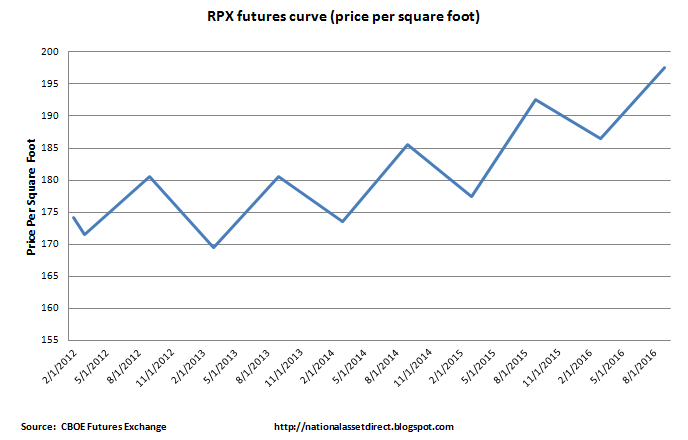
It looks like someone put up a calendar spread today (buying March ’13,  selling Sep ’15).


Word of the day: Pettifog

George Will cracked open his thesaurus again. Seems 
like a good word for the occasional comment thread.

pet·ti·fog/ˈpetēˌfôg/

1. Quibble about petty points
2. Practice legal deception or trickery.

That is all.

Citizens United? The Social Security Act is How you Buy Votes


Nothing new, but Medicare, Social Security and other so-called mandatory spending are busting the budget.  But that spending makes for a sizeable re-election war chest. 


Morning Report

Vital Statistics:

Last Change Percent
S&P Futures 1315.7 6.8 0.52%
Eurostoxx Index 2434 29.330 1.22%
Oil (WTI) 101.03 2.250 2.28%
LIBOR 0.5424 -0.005 -0.82%
US Dollar Index (DXY) 78.888 -0.237 -0.30%
10 Year Govt Bond Yield 1.85% 0.01%

Markets are stronger this morning on progress in Europe. The Portuguese long bond is up a point and the Euro is strengthening.  In earnings, Exxon missed, Eli Lilly beat.  People are waiting anxiously to see the red herring for Facebook’s IPO.  Certainly the other social media stocks have not been shooting the lights out, but leaders always trade rich to also-rans.  Watching Linked-In or Groupon may not turn out to be the best comp.

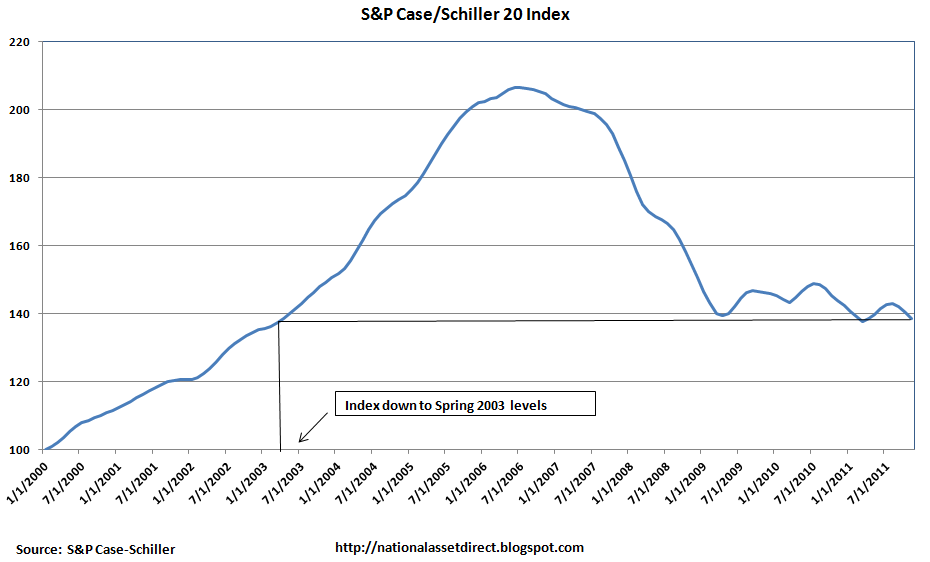
The employment cost index came in at .4%, in line with expectations. Case-Schiller was also released this morning, with a 70 basis point decline MOM and 3.67% decline YOY.  This puts the index back to April 2003 levels.  Case-Schiller is a very lagged indicator and this number covers the 3 month average ending in November, so it is a snapshot of how the real estate market looked last fall.  Anecdotally, I am hearing things are improving in my neck of the woods, NYC metro.

Chart:  Case-Schiller

Another sign that the inventory of foreclosed homes is moving – the professional investor is getting involved.  Bloomberg has a story this morning on how private equity is getting involved in the Administration’s REO-to-Rental program.   These funds are looking at spending billions.  Still, the absolute numbers are staggering.  “About 7.5 million homes with a current market value of $1 trillion will be liquidated through foreclosures or other distressed sales by 2016” according to Morgan Stanley.

$1 trillion in distressed sales.  Wow.

Open Thread

The WSJ demonstrates again the seemingly bottomless hypocrisy of Warren Buffett. It cannot be said enough…this man is a charlatan. – SC

Admin note:  Above is from Scott.  I was working on something to add to it but was having trouble with editing…….so this is it.   (lms)

FOMC Minutes

Statement

Economic Projections

Longer Run Policy Considerations

Big Picture:  The Fed is on hold until late 2014. Previously they anticipated low interest rates through mid-2013.   Inflation target is 2%.  The Fed will continue to re-roll its investments into mortgage backed debt.  Operation Twist will continue.

In this new age of transparency, the Fed is giving investors more of a look at their thinking.

More granular stuff:  The Fed has taken down its forecast for GDP growth in 2012 and 2013.  In November, they projected 2.5% – 2.9% GDP growth for 2012 and 3.0% to 3.5% for 2013.  They now expect 2.2% to 2.7% growth for 2012 and 2.8% to 3.2% for 2013.  So, while the general tenor of most observers seems to be more optimistic, the Fed is going in the opposite direction.

However, they took down their unemployment estimates from November, so that is a positive.  What is interesting is that they stated the “normal rate of unemployment” range was 5.2% to 6.0%.  Which means that once unemployment gets in the mid 5-s, the Fed will start tightening. At least that is how I interpret it.  Don’t expect to see long-term unemployment rates similar to the ones Clinton (5.19%) and Bush (5.27%) enjoyed.  6 is the new 5. The Fed is at least paying lip service to the idea of preventing future bubbles.

The Fed introduced an inflation target of 2%.  Note the 10 year is yielding 2%.  Get the message?  Nope, the 10 year rallied hard on the announcement.  Stocks also rallied.

Policing the policemen

So, now that this weekend’s brouhaha is largely past us and the postmortem recriminations have been played out, complete with after-the-fact play by play and color commentary, I thought I would add my own observations about something that has heretofore been unremarked upon, and that is how third parties react to a perceived instance of a breach in ATiM etiquette.

I for one am very reluctant to play moderator or referee in the midst of a heated conversation between two other people, particularly by calling someone out, and especially as a public matter.  (Ignore, for now, the fact that I am usually a participant and rarely a third party observer in such conversations.)  Both personal experience and observation suggests to me that it rarely ends up being helpful, and often makes things worse, embroiling yet more people in the heat rather than cooling things down as intended.  Perhaps a private e-mail, or brief “Come on, people” from a third party might be useful.  But if that doesn’t work, I think letting things play out and having a postmortem later is likely to be less damaging than trying to intervene by taking people to task on the board.

This is a self-moderated blog, and in the first instance it means exactly that- each of us is expected to moderate ourselves individually, according to the rules that we all know.  And I can say from personal experience that, having determined to one’s own satisfaction that one hasn’t done anything wrong, to see the repeated insinuation from third parties that one is out of bounds can be extremely grating, even if, in retrospect, there may be a point.  This simply dials up, rather than alleviates, the heat of the situation.

Letting an inflamed situation play out is not the end of the world.  What makes our discussion standards notable here is what we are striving to achieve, not the fact that we always and everywhere achieve it.  If, in a given instance, we fail, then we fail.  On to the next one and try again.  And an after-the-fact discussion about it may well prove more valuable, or at least less damaging, than a heat-of-the-battle attempt to stop it.  Active third-party moderation is not always, and perhaps not even often, the best approach.

My two cents.

Morning Report

Vital Statistics:

Last Change Percent
S&P Futures 1304.6 -6.5 -0.50%
Eurostoxx Index 2410.3 -31.180 -1.28%
Oil (WTI) 99.26 -0.320 -0.32%
LIBOR 0.5591 -0.001 -0.18%
US Dollar Index (DXY) 79.989 0.191 0.24%
10 Year Govt Bond Yield 2.05% 0.00%


Stocks are lower on brinkmanship over the Greek settlement talks.  In spite of Greek worries, EURIBOR / OIS (a measure of stress in the  banking system that is watched closely by professionals) has been in steady decline for a month now.  It is currently 80 basis points lower than its post-crisis peak of 100 basis points in early December.


The Washington Post has an article on the potential robo-signing settlement with the large banks.  The size of the settlement is said to be around $25 billion and liberals want it larger.  It will supposedly include additional regulations on loan servicers, which could create loads of unintended consequences.  Mortgage Servicing Rights are already pretty much worthless, and the big banks are exiting the business.  Ocwen is refusing to advance principal and interest payments to bondholders until it recoups its advancements.  The administration could end up shooting itself in the foot if it goes overboard with the servicers.


Diamondback is settling with the SEC for $9 million.  Diamondback is a $2.5 billion hedge fund in Stamford CT and is run by ex SAC traders.  It will be interesting to see if the Feds get info that leads back to Stevie Cohen.


Japan is running a trade deficit?   Apparently, yes.  Part of it is due to the nuclear disaster and the earthquake, but it is also due to a strong currency and an aging population.  Japanese companies are succumbing to the same globalization forces we are and are moving production overseas.  The yen has been strengthening for 30 years, bottoming out at 277 in 1982.  It is now 77.


No major economic news today.  Apple will report after the close.

The Effect of Eliminating AFDC 1996-2010, a history lesson

AFDC was a part of the original SS program that we older folks knew as “welfare”.  It was assailed by folks from all directions.  The late Patrick Moynihan decried the incentive to have more children on welfare because the checks were sized based on the # of children.  The Nobel winning physicist Shockley thought it encouraged the spawning of poor black kids who he wrote were inferior.  I think he called it a dysgenic effect, but I may have that word not quite right.  This was in the sixties.

Rs and some Ds pointed to the building of a permanent underclass. 

It was in 1992 that WJC campaigned to get rid of welfare as we knew it. Ds in Congress opposed him. He finally found an ally in Newt.  In 1996, AFDC was replaced by Temporary Assistance to Needy Families. Assistance is limited to two years, and not a lifetime. Work retraining or schooling is a requirement.  Here is how the numbers dropped:

Year Average monthly TANF recipients US Population (%) Poverty rate (%) Annual unemployment rate (%)
Average monthly TANF recipients, percent of U.S. families in poverty and unemployment rate
1996 12,320,970 (see note) 4.6 11.0 5.4
1997 10,375,993 3.9 10.3 4.9
1998 8,347,136 3.1 10.0 4.5
1999 6,824,347 2.5 9.3 4.2
2000 5,778,034 1.4 8.7 4.0
2001 5,359,180 1.9 9.2 4.7
2002 5,069,010 1.8 9.6 5.8
2003 4,928,878 1.7 10.0 6.0
2004 4,748,115 1.6 10.2 5.5
2005 4,471,393 1.5 9.9 5.1
2006 4,166,659 1.4 9.8 4.6
2007 3,895,407 1.3 9.8 4.5
2008 3,795,007 1.2 10.3 5.4
2009 4,154,366 1.4 11.1 8.1
2010 4,375,022 1.4 11.7 8.6
       

 Many Euro countries still have permanent welfare, and thus have %s on welfare like we had on AFDC.  I thought the move from AFDC to TANF was long overdue and I thought it put a big crimp in whatever “culture of dependency” had been created.  I would oppose deleting TANF.  I still think the public believes we have the old AFDC system, but I may be wrong.  I offer this in the spirit of historical information, just in case it is new to some of you. 

Morning Report

Vital Statistics:
Last Change Percent
S&P Futures 1311 0.2 0.02%
Eurostoxx Index 2442.2 15.200 0.63%
Oil (WTI) 98.97 0.640 0.65%
LIBOR 0.5601 -0.001 -0.18%
US Dollar Index (DXY) 79.746 -0.410 -0.51%
10 Year Govt Bond Yield 2.06% 0.04%
Congrats to the Pats and G-Men.
Markets are slightly higher this morning as Greek bondholders have made their best and final offer to the EU and IMF. Much of Asia was closed overnight in observance of the Lunar New Year.
Even Krugman is figuring out the economy is improving. He notes that housing has been a drag on the economy, but six years into the bust, it is becoming less and less of a drag as the excesses have been largely worked off. If housing becomes a positive, it could finally set the stage for the virtuous economic cycle we have been waiting for.
Of course Krugman takes shots at Obama for “giving into Republican demands that he slash spending” and at Bernake for giving in to Republican demands that it tighten money, positing that we wouldn’t be on the slow road to recovery if we had simply listened to him. He also goes on to slay the Bush dragon and the ECB dragon as well. The Fed tightened? Obama slashed spending? Whatever, Paul. I used to like Krugman when he was just an economist, now he is more of left wing Larry Kudlow.
Earnings Season continues this week with a ton of reports. The biggest names will be Apple, Boeing, and McDonalds, but there are a lot of industrials and energy names reporting as well. In economic data, we have the FOMC decision this week (will be interesting to see if the recent economic strength is noted in the statement). Durable Goods and Leading Economic indicators will be good data points this week.