Morning Report

Vital Statistics:

Last Change Percent
S&P Futures 1355.9 0.0 0.00%
Eurostoxx Index 2513.0 -6.0 -0.24%
Oil (WTI) 106.31 0.0 0.03%
LIBOR 0.4906 -0.001 -0.20%
US Dollar Index (DXY) 78.971 -0.254 -0.32%
10 Year Govt Bond Yield 2.03% 0.02%

Markets are flat on a better than expected jobs report. Initial Jobless claims were 351k vs 355k expected, and continuing claims dropped to 3,392k vs 3,455k expected. The FHFA House Price Index will be released at 10:00 am and the Kansas City Fed Manufacturing Activity Index will be released at 11:00. Bonds and MBS are flat-to-slightly lower.

Freddie Mac released its February Economic Outlook yesterday. Punch line: Housing is recovering gradually. Interesting statistic from the report regarding affordability:  “At the end of 2011, a family earning the median family income had almost double the income necessary to qualify for a conventional loan covering 80% of a median-priced existing singly-family home.” Mortgage applications rose by 4.1% in January, and 80% of those were for refinancings. We are entering a seasonally strong period for house prices – it will be interesting to see if low rates and low prices finally pull people off the sidelines.

For a glass-half empty view, look here. Mark Hanson makes a very good point – that when a stock doesn’t do what it is supposed to do in response to news or events traders will key on that and position accordingly. A market darling that “beats” earnings expectations but doesn’t go up is a great short candidate. Mark makes the same point with housing – we have record low interest rates and affordability, yet housing isn’t going up. Which means it is going lower.

A few years ago, everyone was talking about the yen carry trade. Japanese companies would borrow yen for basically nothing and invest in higher yielding assets overseas, typically in Europe. Traders would watch the Euro / Yen cross rate like hawks, and every time the euro weakened against the yen, world markets would roll over. After the financial crisis drove everyone into Treasuries, people have been wondering when the dollar carry trade would take over. Well, it looks like that day has come. J.P. Morgan has been picking up European MBS to find some yield. While a $72 billion bet on foreign MBS is a drop in the bucket, if JPM is doing it, so is everyone else.


Bits & Pieces (Wednesday Night Open Mic)

An Actress of Rare Beauty, Gladys Frazin, from the days of more modest covers of National Police Gazette.

Looking for evidence that we are indeed moving forward as a society, and humanity is progressing nicely? Then, look to the past and National Police Gazette, and contemplate the fact that it finally stopped publishing in 1977. Progress, people. Progress.

Citizen’s United II

Tom Goldstein at SCOTUSblog posted over the weekend about the upcoming challenge to the Montana SC decision upholding a ban on corporate expenditures in state elections. While the case itself is likely not going to be all that exciting (the Citizens United majority will assuredly reverse the MT SC), the inside baseball look that Goldstein provides on Ginsburg/Breyer’s grant staying the MT SC decision is very interesting.

An excerpt:

What, then, does Justice Ginsburg’s statement tell us? First, these two Justices at this stage recognize a square conflict between the Montana Supreme Court’s decision and Citizens United. They “vote[d] to grant the stay” because the state supreme court was “bound to follow this Court’s decisions” – ipso facto, the state court’s ruling did not follow Citizens United. If these two strong opponents of Citizens United see that conflict, then presumably the Citizens United majority does as well. That means that the state’s argument that its law is distinguishable because it “imposes far different obligations” than did the statute in Citizens United has no traction for a potential majority as a ground for distinction, though perhaps it could be a basis on which Citizens United could be “modified.”

Second, look to what Justice Ginsburg does not say. The statement indicates no sympathy for the claim that this case does not present an appropriate opportunity to consider the question presented. So there is no interest in the state’s contention that, with respect to these petitioners, “the Act operates as no more than a disclosure law of the sort this Court has long upheld.” As a result, the state has to work from the understanding that certiorari is certain to be granted, and the case is going to present the question whether Citizens United should be overruled or modified.

Third, and most important, the statement seemingly identifies the argument that Justices Ginsburg and Breyer think has the best chance: “whether, in light of the huge sums currently deployed to buy candidates’ allegiance, Citizens United should continue to hold sway” or instead should be “withdrawn or modified.” That argument should be based on the practical evidence of “Montana’s experience, and experience elsewhere.”

Since It’s The Weekend. . .

And a long one at that, I’ve got a philosophical question to throw out there. I’ve been thinking about this, tangentially, as I’ve been working through my women’s health piece that I still intend to post, as well as other reading I’ve been doing lately.  To include Scott’s piece tonight on higher education costs.  So here’s the question:

At what age does one become an adult?

The context for my wondering about this is that I think that the most commonly legally accepted answer in the US–18–is an artifact of our educational system.  But is that really the age at which one becomes an adult?  Jewish tradition as I understand it says it’s 13 (Mormon tradition mimics that, at least for males).  Historically for girls it was the age of menarche.  Drivers’ licenses are issued at 16.  Drinking age (which also used to be the voting age, until the Vietnam war threw a monkey wrench into the thing) is 21.   What do you guys think (and why)?

OT even before I post:  talk about a war on women: the auto-correct dictionary doesn’t recognize the word “menarche”

Inflation for me, but not for thee

So the reason I have been largely absent from ATiM for the last week is because I started the ritual college visits with my oldest daughter, who will be graduating from high school next year.  It has been quite an eye opening experience.  

QB has frequently commented here about the left-wing academic atmosphere that is pervasive on most college campuses.  What struck me during my visits, however, was the degree to which left-wing ideology has taken over the financial aspect of college admissions.  College tuition inflation has been the topic of much discussion in recent years, but after this trip I have come to believe that the levels of inflation are hugely exaggerated, and largely a function of a marketing strategy which masks the socialist reality of college fees.

This is perfectly exemplified by the information I was given at the University of Richmond, in Virginia, although this was by no means atypical. For the current school year, tuition, room and board comes to just over $52,000.  That is quite a daunting number on it’s face.  However, as the university boasts in its info material, 47% of its students qualify for some kind of needs -based financial aid, and that aid (again, as the university itself brags) averages over $38,000 per recipient.  So that means that nearly 50% of students are actually paying on average a mere $14k for what is purported to be a $52k education.  

This, BTW, includes only needs based financial aid.  When students who receive sports or academic merit scholarships are included, a full 70% of students are receiving some form of tuition break, averaging $32,000 in aid per student.  So, to sum up, the average cost to the vast majority of students, 70%, is just $20k, while for a select 30%, the cost is over 150% higher at $52k.

How is the “needs based” aid doled out?  Here is where the leftist ideology gets quite explicit.  At most universities (certainly all of them I visited this past week) the admissions process is proudly proclaimed to be “needs blind”, meaning that ability to pay is not a consideration in the admissions process.  Once accepted, parents of the students are then required to submit tax returns, and, based on these returns, the university itself will decide how much the applicant can afford, and the tuition bill to the student will reflect this cost. So in fact the existence of a headline tuition price tag is a complete and utter fabrication, designed to mask the actual system that is in place. There is no actual tuition price tag.  Tuition is strictly a function of one’s perceived ability to pay it, or, more accurately, one’s parents perceived ability to pay.  It is a system designed so that a select few, in the case of UoR 30%, are used to subsidize/finance the vast majority.  It is a classically leftist utopian system. 

(One thing I will say in defense of Richmond is that at least it still does offer academic merit scholarships.  At Georgetown, I was explicitly told that no such merit scholarships are offered, and only “needs-based” tuition breaks were available.  Only my daughter’s stern look telling me to shut up prevented me from sarcastically inquiring whether their sports scholarships were also offered only on strictly a “need” basis.)

Of course, it is no surprise, then, that the headline price tag for tuition (which so few actually pay) continues to rise into the stratosphere.  Since ability to pay is no longer necessary to gain access to the product, demand naturally will rise and that demand will derive precisely from those least able to pay.  So those who actually are carrying the cost load will necessarily have to pay more and more in order to support this increasing population of non-paying/low-paying demand.  Tuition inflation, it seems, is largely a myth for most people, and exists primarily just for a small group of high income earners.

BTW, this whole model seems to be based on the premise that wealthy parents are ready and willing to pay almost any cost to send their kids to college.  But suppose a parent simply refuses to?  Does an 18 year old with a wealthy but stubborn father have less “right” to financial aid than someone from a low income household?  It’s hard to imagine why that would be the case.  A father can’t force his 18 year old to vote Republican. He can’t prevent his 18 yr old from getting an abortion.  In fact, I am reliably informed that a father cannot even call and get information about his 18 year old from the very university to which he is paying tens of thousands of dollars a year in tuition without his 18 yr old’s consent.  In other words, an 18 year old is, in virtually all relevant ways, considered to be an independent adult capable of making and responsible for his own decisions.  So on what warped reasoning ought an 18 yr old’s cost for a given product be dependent upon his parents’ ability to pay for it?  

The whole system seems ripe for an Atlas Shrugged II, in which high income people begin to refuse to pay for their children’s tuition, thus forcing them to apply based on their own income.  Since that income will be zero, they certainly ought to qualify for even more aid than anyone else.  And the whole despicable system will collapse of it’s own weight.

Morning Report

Vital Statistics:

Last Change Percent
S&P Futures 1356.5 1.7 0.13%
Eurostoxx Index 2522.1 32.8 1.32%
Oil (WTI) 102.95 0.6 0.63%
LIBOR 0.4931 0.000 0.00%
US Dollar Index (DXY) 79.214 -0.165 -0.21%
10 Year Govt Bond Yield 2.02% 0.04%

World stock markets are rising this morning on optimism of a Greek deal and tame inflation numbers.  The Consumer Price Index showed a 2.9% rise year on year, indicating inflation (at least as measured by the CPI) remains in check. Leading Economic Indicators comes out at 10:00 this morning.  The Street is looking for a .5% increase. Bonds and mortgage backed securities are lower.

For those who follow technicals, the S&P 500 is right at resistance.  Expect large intraday volatility as stops get triggered.

The CFPB wants to regulate debt collectors and credit reporting agencies. This would extend from payday lenders to the large credit reporting agencies like Fair Issac, home of the FICO score.

Slow news day ahead of a 3 day weekend.


Health Care Report

Here is the first of what I hope to be a weekly post on Health Care.  This will be largely oriented towards the legal side of the health care world because that is the information I get on a daily basis.  But if anyone, especially, NoVa, wants to add links, please do so.

This is sort of not news because everyone knew it was going to to happen, but the scheduled 27% cut in Medicare fees for doctors is not going to happen. The “Doc Fix”, as it’s commonly known, is going to be part of the payroll tax deal. Maybe NoVa has heard differently, but I think hosptials and physicians know this dance can’t go on forever and that eventually reimbursement rates will be cut.

The administration was bragging about its success in fighting fraud. The DOJ attributes the success to city specific anti-fraud teams. As I’ve said before, a lot of the success is due to the spread of electronic health records.

This is a bit “inside baseball”, but CMS just issued a proposed rule regarding a provision in the ACA that requires providers to report overpayments within 60 days of “identifying” those overpayments. I don’t recommend reading the actual propose rule (unless you have trouble sleeping), but I mention this for several reason. First, it is a big deal for providers. Second, it’s an example of the (slow) legislative process. The ACA was passed 2 years ago and we are just now getting regulations on this aspect of the law. This is just the proposed rule after which people submit comments. After reviewing the comments, a final rule will be published. Lastly, it is an example of something posters have talked about here, where an unelected body (CMS) is, to a large extent, legislating. I don’t necessarily agree with some of the viewpoints expressed on that topic, but I think it can lead to an interesting discussion.  [Also of note is the look-back period.  CMS wants it to be 10 years, which is unheard of.  Currently, CMS can reopen a claim within 1 year of payment for for any reason and within 4 years is “good cause” is shown – NoVA]

According to CMS and HHS 86 million Americans took advantage of the “free” preventative services required by the ACA. The quotes around free are mine since I’m pretty sure we’re paying for these one way or another. As NoVa has pointed out several times, there is also a question as to the efficacy of these preventative treatments.

Speaking of preventative care, at least one insurer is increasing reimbursement for primary care doctors. According to the article, the plan is supposed to pay for itself through decreased ER visits and hospital admissions.

This focus on preventative care is part of a broader trend towards ephasizing wellness. In addition to cheaper and more efficient treatment of chronic and acute conditions, hospitals and doctors are going to try and keep people healthy. Why? Because under payment models like Accountable Care Organizations, hospitals well earn money if they get you out of the hospital faster or prevent complications from arising once you are in the hospital. But they will earn even more money if you never come to the hospital or doctor. While it’s nice to see the current incentives (more care = more money) turned on their head, there still seems to be incentives (other than good health) for health care consumers to buy into this. As things stand, providers will laregely be held responsible for patient non-compliance. Needless to say, that is a concern for hospitals and doctors.

A couple more random links: The Washington Times demagogues the daylights out of ACOs. I could spend a long time pointing out the errors in that article. Meanwhile, Forbes talks about how private insurers are adopting some of the payment models in the ACA.
____________________________

An article from the New England Journal of Medicine about the new American College of Physicians ethics manual guidelines of “parsimonious care” and how that relates to health care costs.
Mike
________________________________________

Here’s a link to the WSJ editorial QB referenced in his comment. I am familiar with the Center for Medicare and Medicaid Innovation, but not at all familiar with this task force. While I’m unlikely to see it as the menace QB does, I do appreciate being made aware of it.

Medic 206 is Out of Service


Happy Valentine’s Day!

I’ve never been a fan of Al Sharpton, but who knew the man had such a sense of humor?  This had me laughing out loud:

The Rev on romance.


And too bad Scott’s busy this week.  A Libertarian economist’s POV on why FOX’s Megan McArdle is wrong on why brick-and-mortar universities will go away:

Assortative mating works best when the cognitive elites are able to combine signaling behaviors for their superior genes, particularly for doing economics, with the physical proximity that supplies bonding behaviors and oxytocin and also the opportunity to sniff the pheromes.


Since we got onto a first dance wedding song kick (a bit) on Mark’s Funny Valentine post last night, I’ve been listening to Al Jarreau , so here’s another one of my favorites:

After All


And, while I don’t count myself amongst the bitter folks, I thought that this story on NPR about three anti-Valentine’s Day books was amusing.


Happy Valentine’s Day, all ATiM-ers!!

Funday Sunnies

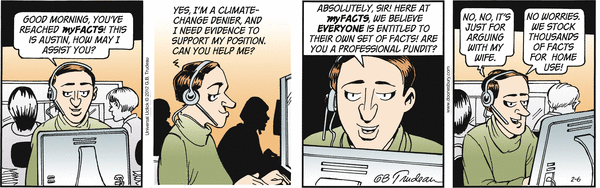
I don’t want to step on any toes, but here are some politically tinged comic strips which made me chuckle this week. Doonesbury ran with this concept all week, which kept getting funnier and funnier:

Doonesbury

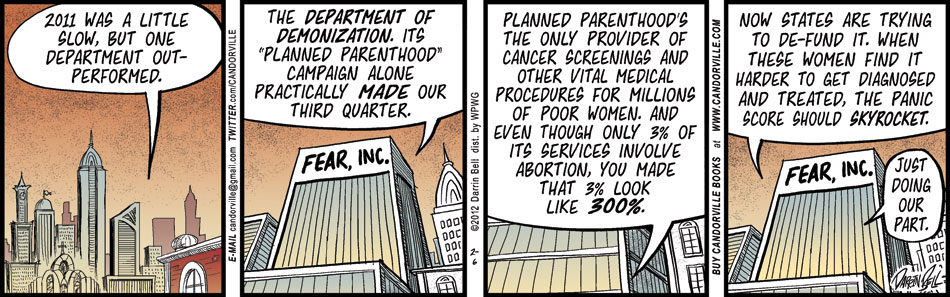
Given the lead time of newspaper comic strips, this one was rather presciently timed to coincide with the Komen Kerfuffle:

Candorville 2-10-2012

Candorville

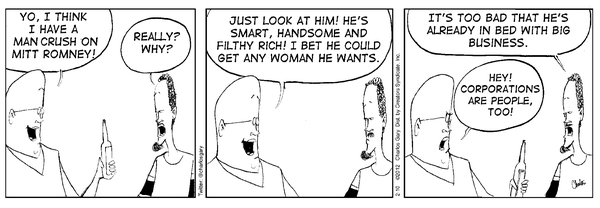
And that Mitt Romney is one handsome devil:

Cafe Con Leche 2/10/2012

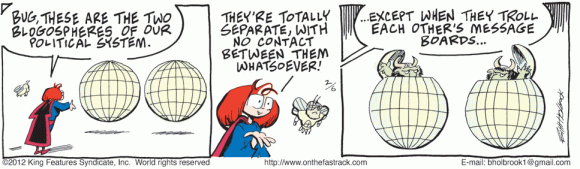
Finally, this one in particular seems to sum up what is wrong with the internet:

On The Fastrack 2/6/2012

On The Fastrack

See you in the funny papers.

(edited to increase image size and add hyperlinks)