The San Francisco Treat

I was in Japan six years ago when I was asked a simple question. What is my favorite rice? My response was idiotic. I was in a big phase of cooking Indian food and in love with Basmati rice. Japan is famously proud of its rice and justifiably so. My defense is that my sons were ten days old and I was a little short of sleep. If you’re in Japan and someone asks you about your favorite rice, say Japanese.

I understand the Japanese devotion to rice as I share it. We typically keep 4 – 6 types of rice on hand. Basmati rice for Indian dishes. Tilda is my favorite (when in doubt, ask your Indian grocer his or her favorite). A few spices and a little oil elevate boiled rice into pilau. Koshihikara rice for sushi. Tamaki Gold is amazing stuff. White rice is always good to have around, especially when I want to make some arroz con pollo. Brown rice for the occasional dish when I want to pretend to be healthy. When I can find it, I buy Carnaroli rice for my very favorite rice dish of all.

My love affair with risotto started ten years ago, right around the time my love affair started with my beloved wife. I think it started when we watched Big Night. It is my very favorite food movie of all time. The cast is amazing. Stanley Tucci as Secondo, the manager of a failing Italian restaurant. Tony Shaloub as Primo, the talented and temperamental chef. Also Secondo’s older brother. Marc Anthony (better known as a Latin pop star) in a minor role and a scene stealer. Ian Holm as the owner of a nearby successful restaurant (he also played Chef Skinner in Ratatouille and Bilbo Baggins in LotR). Allison Janney as Secondo’s girlfriend.

Risotto is almost a running gag through the movie. The restaurant finally has a couple of customers, one of whom orders a seafood risotto. Who then proceeds to order a side of spaghetti with meatballs. [She likes starch!] Later, Secondo suggests that they take risotto off the menu as it takes a lot of time and is expensive to make. Primo counters with the suggestion that they add hot dogs to the menu. Finally, in the most amazing meal on film (Babette has nothing on the feast of these guys), they present a tricolor risotto in the colors of the Italian flag. For my part, I’d make a basil/parsley risotto for green, scallop risotto for the white, and a beet risotto for the red.

Since then, I’ve made many risottos. My favorites would probably be the basil/parsley, lobster, and bolognese risottos. I do have one risotto to my name. On the Caribbean coast of Costa Rica, they make a lovely rice and beans. The key is using coconut milk and serving with chilero (spicy, pickled vegetables) on the side. We had some black beans at home and I was thinking of doing something along the lines of rice and beans. Then I remembered the Costa Rican variant. And so came forth my black and white risotto. It’s great with mango and pineapple on the side.

Black Bean Risotto

Ingredients

Brodo

4 cups chicken stock
1 cup coconut milk (2/3 of a can)
½ cup dry white wine (or more broth)
Soffritto
2 tablespoons butter
1 tablespoon vegetable oil
1/3 cup finley minced onion
Riso
1 ½ cups Arborio or California short grain rice
1 ½ cups cooked black beans or 1 can, drained and rinsed
Condimenti
½ cup coconut milk (1/3 can)
½ bunch cilantro, washed, thick stems removed, chopped to make ¼ – ½ cup
Queso duro or fresco, crumbled for garnish

Method

  1. Bring broth to a steady simmer in a saucepan on the stove. Add coconut milk and return to simmer.
  2. Heat the butter and oil in a heavy casserole or dutch oven over med. heat. Add the onion and sauté for 1 to 2 minutes until it softens.
  3. Add the rice to the soffrito, stir using a wooden spoon until the grains are thoroughly coated. Add the wine and stir until it is completely absorbed. Add the simmering broth, ½ cup at a time. Stir frequently until almost completely absorbed and add the next ½ cup.
  4. Add coconut milk and cilantro and remove from heat. Stir completely to combine with the rice. Add the black beans near the end of cooking.
  5. Put the risotto on serving dishes. Sprinkle with crumbled queso. Top with chilero or serve on the side.

Medical Costs and Transparency – from WSJ

Thanks to the hard work of those who founded this blog and for those who insisted on inviting me. I have only scorn for those who failed to do either of the above, particularly those who failed to do the later.

There was a commentary in today’s Wall Street Journal discussing improving transparency in our health care system by publicly releasing data contained in insurance claims which is required under the ACA. The title of the article is More Transparency, Better Health Care but it is behind a pay wall (although I managed to get the full text as part of a “free pass”).

The commentary is quiet short and superficial, but it had a few interesting highlights that may be worthy of additional thought and discussion:

Rates of preventable diseases, hospitalizations, complications and readmissions vary greatly among health-care providers.

This sort of addresses something NoVa raised at the PL a while ago (although not exactly the same) in that there are often large regional variations in treatment regimens that lead to disparate spending and outcomes. Some of this is understandable as population differences will impact treatment differences, but it seems to me that there should be fewer differences than presently exist. The question, of course, is how do decrease those differences. I wonder what role competition plays here. Competition between health care providers may decrease cooperation and sharing knowledge but should also spur innovation (although under the present system there is less incentive to prevent disease or prevent readmission).

Too often, unnecessary, redundant and needlessly expensive tests and treatments are prescribed.

Well, now we’re just stating the obvious in a very unhelpful way. The reasons these treatments are prescribed vary widely.

Controlling costs without compromising quality will require multiple scalpels rather than one blunt instrument. Public reporting of performances measure could provide those scalpels by allowing the public to compare doctors and hospitals based on cost and clinical results.

Now we get to the crux of the commentary and to an issue raised by other PL contributors. Would a more informed public make better decisions with their health care dollars? The authors answer in the affirmative, but fail to provide any real explanation as to how or how much. I think it would be hard to argue that making the data available is a bad thing (assuming the data is accurate) but I am skeptical that it would make too much of a difference. We often don’t have time to comparison shop and even if we are afforded the time to do so, would we take the time to do so and would the time we spend shopping really be time well spent? Perhaps more importantly, as long as we still have the same health insurance system, won’t people just choose the person with the best “stats” regardless of costs? This seem particularly true when we consider that most health care dollars are spent at the end of life and often those treatment decisions are made by spouses and children who are both emotionally invested and, with respect to children, not impacted financially (inheritance aside) by how much a given treatment decision costs.

I wish the article had been more informative, but I do think it is good starting point for a conversation.

The Fair thing? The Fair Thing!?!

Nancy: Well, if that’s your attitude, I think you should give me half the money and let me eat whatever I want and you can do what you want with your half. I think that’s the fair thing. 

David: The fair thing? The fair thing? I can’t believe it.  That’s it! I have been too controlled! What do you mean?  You took our nest egg and you broke all over the Desert Inn!

– Scene at the Hoover Dam from Lost In America, 1985

We hear a lot from President Obama, and the left in general, about the rich “paying their fair share” in taxes, the implication being, of course, that they don’t pay their “fair share”. But almost inevitably the charge comes without any serious consideration or offer of an actual objective measure of what fairness means. It is used simply as a populist cudgel to demonize the so-called rich. I think a true measure of “fairness” needs to be established in order to properly analyze whether this claim, that the “rich” aren’t paying their “fair share”, has any validity whatsoever. So what might such an objective measure be?


There has been one such measure offered recently, which is that people who earn an income from capital gains end up paying a lower rate of tax on their income than people who earn income from a salary. This, it is said (and seems at first glance) is objectively unfair. This particular measure is definitely worthy of consideration, and perhaps can be the subject of a future post. But for now I’d like to leave it aside, not only because of the complexity involved (one cannot talk about capital gains tax without also considering corporate taxation, nor the net effect of the progressivity and myriad of deductions allowed in the income tax), but also and primarily because I don’t think this is what people really mean when they speak of the rich not paying their “fair share”. If it were, then the claim would be used to bolster the notion only that capital gains tax should have the same structure and rates as the income tax, and it would be used against people making a certain kind of income, rather than being used to bolster the notion that rates should higher, and used against people making a certain amount of income.


And so, I would like to know by what objective standard can it be said that “the rich”, which I will define as those earning more than $250k per year, do not pay their fair share in taxes? When answering, please try to connect your answer to a) the share of taxes that this demographic actually does pay, and b) the services towards which taxes actually go.

Bits & Pieces (Monday Evening Open Thread)

Hyper-politicized hiring at the Obama DOJ continues.–QB


Some within the bowels of News Corp are hatching yet another nefarious plot: A cable channel that shows only epsiodes of the Simpsons.

Some within News Corp. have floated the idea of a cable channel that shows only episodes of the “The Simpsons.” Such a concept however is several years off as “The Simpsons” is still on the air and there’s several syndication deals in place that would likely be invalidated.


The show has been running since 1989, and it’s approaching its 500th episode. With commercials, it’s estimated the series could be run back to back for almost eleven days without a repeat.

There’s a red-band trailer out there for The Thing. Which is a prequel to John Carpenter’s 1982 version, but it is also a beat-by-beat remake in many ways, according to sources. And it’s also called The Thing, just like the 1982 version. Which is confusing. And a red-band trailer, if you don’t know, means the trailer itself is rated R.

You could do worse than watch/listen to this interview of Ray Kurzweil on Leo Laporte’s Triangulation. Has anyone else here seen Transcendent Man?

Finally, there hasn’t been any Hobbit movie news in weeks. I’m suffering from withdrawal. Show me the Hobbit! — KW


Should anyone be surprised at law schools sexing up their applicant and student LSAT scores and GPAs? The market for new law grads has been crushed post-2008, yet law school applications rose, and law schools are scrambling for market position.–QB (wish I knew how to type a real hyphen!)


Rant Rant Rant: 2 Ways to Trim Medicare a Bit

Number 1:

I never understood why, in this day and age, a doctor writes a new prescription for 30 days. For example, about a third of the new meds MrJS is prescribed he takes for 7-10 days, finds they aren’t to his liking and stops taking them. Yes, in some cases takes longer for the meds to kick in, but frequently one can make an assessment in two weeks or less. The upshot is that Medicare Part D pays for 20-23 days of meds that won’t ever be used. For many of us it’s no biggie to get a 14-day trial scrip (when appropriate) and then have the doc call in a 30-day if the results are promising.

So I wonder how many Medicare Part D patients experience this and what it costs the taxpayer.

Number 2:

True story—A woman on Medicare eats bad take-out food and gets violently ill. At 3am she gives up being stoic and, on her doctor’s advice, heads to a local ER (not where her doctor works). She’s put on an IV drip, gets a jolt of anti-nausea meds and some morphine, and starts to feel better (who wouldn’t?). The nurses draw the requisite blood and urine samples and announce that the woman may have a UTI. Before the test results are even back, the hospital attempts to admit the woman for a UTI ‘with complications.’

Note that UTI’s are routinely treated with antibiotics and rarely require any hospital stay. Yes, if the patient doesn’t improve in 3-5 days the doc may want a follow-up visit, but hospitalizations at the outset are outlier events. Note also that the ‘complications’ have nothing to do with the UTI and appear to be responding well to treatment.

So how many women in this or a similar situation would go ahead and allow themselves to be unnecessarily admitted?

BTW, the above describes my life since I signed off last evening. And I’m at home.

Don’t get me wrong. I am glad Medicare exists. But wasteful stuff like this can’t be happening just to me.

Also, I promise to catch up on the other threads. I just needed to vent. Thanks everyone for carrying on so brilliantly.

Tax Rates Part Quatre (?)

Any serious discussion of top tax rates should start with understanding top rates around the world.

http://en.wikipedia.org/wiki/Tax_rates_of_Europe
http://en.wikipedia.org/wiki/Tax_rates_around_the_world

I began this conversation on our first day with the suggestion that corporate tax rates peaked too high [39%] and too early, dropping off above $350K taxable income.  It has continued at times that I could not comment because life, as it were, interfered.  My corporate tax argument was based on both the irrationality of taxing small biz at a higher marginal rate than big biz, and at taxing it at a higher rate than our trade partners would.

The same argument applies to the personal tax.  There is some point where personal wealth would flee to invest in another nation where taxation was not as burdensome.
However, no matter how low taxes are in Albania, it will not go there.  We have experienced capital flight, so we know it does happen and we know what we are up against.  On the tax front, we probably need to worry only about western Europe, Japan, Canada, and Australia right now, but the field will expand, as other nations are viewed as safe, with protective judicial processes and as friendly to investment. Russia and China are out, for now.

So we can set our top personal tax rate at the low middle of our most similar competitors without fear of capital flight.

TMW, that would be the extent of my conservative argument here.  I suggest the following to you:

If the rate is not prohibitive, if it does not force capital flight to another country, then the highest such rate will not affect employment or decision making in a negative way.

Why?

1]  The tax is on net income only and does not affect pricing.  Net income is maximized for a competitive business at the same competitive price with or without the tax, although after tax profit is reduced across the board.

2]  The reduction of profit across the board could lead to less investment in a future year.  Again, as long as the worldwide comparison is favorable to us, we get more than our share of the future investment.  I would revisit this aspect if investment in America was stronger than in our trading partners, but we were all suffering from a shortage of private capital, that is, if an inordinate % of net income was replowed into expansion and R&D rather than sitting relatively idle.

3]  Think of high marginal tax rates [say, 40%] as high contributions from government for deductible expenses.  In other words, each new employee I hire when I am in the forty percent bracket is only 60% paid by me; each new Sec. 179 asset I buy is only paid 60% by me, etc.

TMW, I ask you to think about these points absent the bathtub theory that we can starve big government by removing its revenue stream.  About the Norquist theory: obviously, if the idea is to shrink the federal government across the board, that is one way to do it, in theory.  It has not worked in practice for reasons you and I have agreed upon before.  Both of our political parties are Free Lunchers.  They each want to be known to the voters as having supplied something for nothing.

A better plan for reigning in costs is a renewed Gramm-Rudman-Hollings statute.  At least it is better than arguing for tax cuts and wars at the same time.  It is also better than a constitutional amendment because were we to become fiscally responsible we would be balancing over a business cycle, not in both great years and bad years.  As it stands we only reached balance and surplus recently at the culmination of a boom in the late 90s.  Rather than either tax cuts or spending increases, we could have simply reduced the ND, knowing we might have to increase it in a bust.

Look at the world info and think of tax rates in that competitive light.  I suspect that will be an interesting exercise for each of you, whether you share your conclusions or not.

See y’all again rather late tonight, I fear.

The Monday Morning Opening

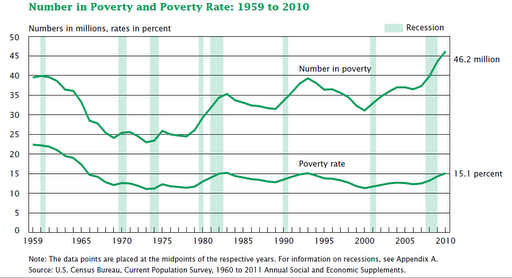
There were some interesting discussions of poverty in the US over the weekend and for some reason I thought it might be helpful to see the trajectory of poverty rates over the last 50 years. The chart also overlays the statistics over past recessions which I think is helpful. Content below is from EconMatters. (lmsinca)

By EconMatters

In yet another sign that the Great Recession cuts deep and long–the number of Americans living below the official poverty line reached 46.2 million, the highest in 52 years since the Census Bureau started tracking the figures in 1959.

The overall poverty rate also climbed to a 17-year high at 15.1%, which means 1 in 6 Americans are living below poverty line largely due to the high unemployment and underemployment rate. The official poverty line for 2010 is defined as an annual income of $22,314 for a family of four, and $11,139 for an individual.


Chart Source: The Census Bureau

The Census Bureau’s annual report released on Tuesday, Sept. 13 gives a very grim snapshot of American households in 2010. As the U.S. economy expanded 3% in 2010, and corporations reported good profits, the gains are not trickling down to workers. The median household income in 2010 dropped to $49,445, which is virtually unchanged from the level in 1997. Overall, household income has fallen by 6.4% since the recession began in December 2007. (Ok, who was the one declared that the recession “officially” ended in June 2009?)


Note from lmsinca

So we’re one week in and it has been interesting to say the least. The site is both stable and usable as a forum for discussions. We’ve attracted a great group of commenters and authors so far but I would suggest we need to at least double our list over the next couple of weeks to keep things interesting. There were some great posts with both controversial and non-controversial comments and even a few heated arguments……………welcome to blogging. We’ve already seen a few people leave or decide not to participate for various reasons, which I don’t find unusual in the least. We keep working, discussing and improving, building on success and learning from our mistakes. The more people take ownership of this space the more successful it will be. Are we having fun yet?

Welcome to week two.

(Posted Sunday night from the West Coast for East Coast early birds)

Testing, Testing


Here I shall insert an inbred cat:


And here is a video with a surprise ending:

http://www.youtube.com/get_player


And here is just a little bit of text so that I can see what it looks like.


line by lms

Sunday Morning Open Thread

I’ll throw this up to start the day since I happen to be up and about.

Kevin has an interesting piece up on the role of Robin Hood in modern life that he posted late in the day/early in the morning last night. You should go check it out in yesterday’s archive.
Yesterday’s college football games went well for all of us, since Mark’s ‘Horns trounced UCLA, okie’s Sooners crushed Florida, and the Utes won the Holy War with BYU quite handily. Oregon also won, but I don’t know if shrink or bernie care.
I hope to have the FAQ sheet ready to throw up as the end-of-the-day Bits & Pieces for you all to look at, discuss, and edit.
As Greg would say, what else is happening? And do you have a joke for us, Scott?
Update: Kevin! You sly dog, you–you’ve already created the tab for the FAQ! Look up there next to the “Rules of Engagement” tab, guys.

One Thing Is Needed to Ease Poverty . . .

Tax the rich.

Well, technically, says the author, they need more disposable income, which you will get for the poor by taxing the rich. At least I think that’s what he’s saying.
But the more interesting point (to me) that he makes is this: 

Yet most people I know don’t want to trade their slick smartphones for “Matrix”-era Motorolas. The people I know are happier now than they were in the ’90s. They do not see a 15.1 percent poverty rate as a cause for panic. Their wages are not lower than they were 14 years ago. Today’s high poverty rate is not, as far as I can tell, a mainstream concern. This is one of the reasons the American economy is in such trouble.  

The Great Recession found most of its victims among the least educated Americans. The unemployment rate for Americans who lack both high school and college degrees is 23.9 percent. But these are not the people you will typically hear from in the mainstream media; they’re not a major force in popular culture or in the policy world. Among people with bachelor’s degrees or higher, the unemployment rate is 4.3 percent — close to the number that the Federal Reserve would accept as “full employment” if it applied to the country as a whole. I hate to use the phrase “skilled labor,” as it seems like a pretty haughty thing for a guy with a degree in theater who can’t change a tire to say, but the truth is that the economy has been unforgiving to those who tried to go right from high school into a trade.  

The result is that we have 46 million people living below the poverty line — and for the most part, living there quietly.

And then he says: “America can’t afford 46 million poor without raising taxes on the rich.”

As many no doubt know, I’m open to more progressive taxation on the wealthy, and especially the super-duper-wealthy. But is wealth redistribution the answer to poverty? Could we ever, even in the most optimistic light, expect to be able to tax the wealthy enough to make up the gap, and bring the poor above the poverty line? Is a model that creates economic growth by taxing the wealthy, subsidizing the poor, and seeing economic growth proceed from there one that could possibly be sustainable?

I am very dubious. Not that I don’t think the rich can afford, and maybe should be paying, more money for more government projects, money to the space program, infrastructure, and maybe even expanding medicare or shoring up Social Security.

One more thing: I commonly argue that context matters, and that it’s a worthwhile thing to consider modern American poverty in the light of worldwide poverty, both present day and historically. The common response to this is the same one the author brings up. That is, yes, poverty in America may be much better than poverty in Nigeria, but “is ‘better than Nigeria’ really a standard we want to adopt in judging American economic conditions?”

Of course not. But if you never stop to appreciate what you have achieved, and what few successes you’ve won, how do you know you are making any progress at all? Moreover, what’s the point in trying to make progress? No point in fighting a war on poverty, because as long as anybody has less than anybody else, you’ve accomplished nothing.

I’m rambling. It’s late. I should go to bed. I just happened to read that Op-Ed in The Daily, and I thought I would share it.

Good night to all, and good morning to many.