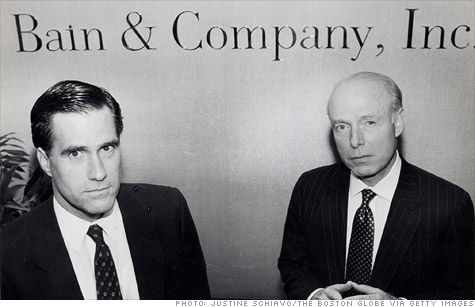
The Romney campaign understandably touts the activities of Bain Capital during Romney’s tenure there, and perhaps its activities in general, as beneficial. The argument, as I understand it, is that the country, presumably the economy in particular, is better off
than it would have been otherwise. We are, generally speaking, better off because of Bain Capital and, in particular, because of the activities of Bain Capital when Romney was in charge.
That a case for regarding Bain Capital as, ultimately, beneficial can be made. That such a case has been made is evidence for that and a presentation of that argument here would be redundant. Moreover, such a presentation is probably best left to others more knowledgeable
than I.
An argument for Bain Capital being, on the whole, a benefit is in danger of missing a crucial point, however.
Consider that there were costs, or pain, as a result of the activities of Bain Capital. I assume that is not controversial. Companies were eliminated, employees were laid off, lives were disrupted, individuals suffered financially and saw there opportunities diminished, and so forth, as a result, in part, of the activities of Bain Capital. Now grant, for the sake of argument, that the activities of Bain Capital resulted in more good than bad. Grant that the country, the economy, what one will, was ultimately improved by the activities of Bain Capital during Romney’s tenure. Furthermore, grant that the individuals harmed, the individuals who bore the costs, are now better off than they would have been without Bain Capital. Grant, that is, that those negatively affected by the activities are, at present, in a better financial situation, than they would have been if Bain Capital had not acted.
Even granting all that, the problem for Romney is that he, and a few others, evidently benefited immensely without sharing the pain and that he, and a few others, presumably benefited far, far more than those who suffered. Even if one looks at the activities of Bain Capital as activities that were, ultimately, beneficial for all concerned, even if one assumes that those who suffered as a result of said activities ultimately benefited, it seems clear that Romeny was willing to engage in business practices which, in the end, resulted in the concentration of tremendous wealth in the hands of himself and a few others and the concentration of the costs, and some benefits, in individuals other than himself and a few others.
Romney, and others, can argue, with some justification, that firms like Bain Capital, private
equity firms, are ultimately beneficial and necessary. That said, it is, arguably, not clear what answer should be given to the concerned individual who points out that Romney appears to have been comfortable with a process that distributed costs and benefits in a way that dramatically favored him and a few others.
If Romney’s argument is, in part, that he should be president because of what he accomplished at Bain Capital, then it seems reasonable to ask why the country favor a candidate who was, in his career in private industry, decidedly enthusiastic about concentrating benefits in the hands of a few and costs in the hands of others.
Note also that arguing that Romney behaved precisely as he should have, that he sought to maximize profits and that he had a fiduciary responsibility to do so, does not address the concern. One could take the position that Romeny’s activities were entirely acceptable, even
laudable, and look askance at a candidate who has, in the past, endeavored to ensure that
a few benefit tremendously and that others bear the costs.
Filed under: Uncategorized | 11 Comments »


 Brent Nyitray
 Fairlington Blade
 Let the mutherfuker burn!
 jnc4p
jnc4p Kevin S. Willis
 Michigoose
 lmsinca
 markinaustin
 Arcanaut
 novahockey
 quarterback
 ScottC
 yellojkt




 All Things in Moderation