Saturday Open Thread

Just thought I’d post an open thread so that folks can throw anything up. Shamelessly stolen from Ezra Klein’s Wonkblog:

    The Best Sentences We Read Today


— “I’m going to look them in the eye and say, ‘You must be confusing me with someone who gives a f— about your opinion.'”

I hope that link works. I had to google the sentence to get to the article from Wonkblog’s link.

— “So hang on tight because you are going to get some clear and true facts without rumor and innuendo, or any accompanying B.S. and mush.”

— “Chicken-sh— editors who wouldn’t touch stories like that, they love documents, so he changed the whole ball game.”

— “The Administration has had nearly two million minutes to implement this law.”

Lydia DePillis

What else do we have? Both MSU and UM have byes this week, so I don’t have much in the way of football to watch today.

Weekend Open Thread—Religion………yikes

I’m very interested in religion and religious views, although I’d prefer to read what others have to say than share my own thoughts……….hah.  Seriously, religion has always been a highly personal thing for me and I don’t generally discuss my views.  In some ways it’s because they’re always evolving so what I say today I may not actually agree with tomorrow and I don’t like to be held to a standard of consistency.  Consistency isn’t something I’m well known for anyway, just ask Scott (that’s a joke btw).

I guess if I were to describe myself religiously it would be as an agnostic who enjoys attending church, but only very specific types of churches and each one for very different selfish reasons.  I also consider agnosticism as a true cop out but there I sit nonetheless.  I’m neither an atheist nor a Christian but I found this article on atheists, and agnostics to a lesser extent, enlightening if you will.

What kind of atheist are you anyway?  I think everyone will recognize me right away but I’m curious about the rest of you atheists.  Number six was my favorite but it’s not me.

6. Ritual Atheist/Agnostic. While you might think the anti-theist is the non-believer type that scares Christians the most, it turns out that it may very well be the Ritual Atheist/Agnostic. This group, making up 12.5 percent of atheists, doesn’t really believe in the supernatural, but they do believe in the community aspects of their religious tradition enough to continue participating. We’re not just talking about atheists who happen to have a Christmas tree, but who tend to align themselves with a religious tradition even while professing no belief. “Such participation may be related to an ethnic identity (e.g. Jewish),” explain researchers, “or the perceived utility of such practices in making the individual a better person.” The  Christian Post clearly found this group most alarming, titling their coverage of this study “Researchers: ‘Ritual’ Atheists and Agnostics Could Be Sitting Next to You in Church,” and giving the first few paragraphs over to concern that people in your very own congregation may not actually believe in your god. The atheism, it seems, might be coming from inside the house (of God).

Another subject that interests me, and one I’ve been reading an awful lot about lately especially in the context of politics, is ageism.  I don’t agree with everything in this piece but I did find it thought provoking.  As a ‘B Word’ boomer it’s always in the back of my mind of course that a lot of us are much worse off financially that we imagined we’d be (not me necessarily) and that we’ve become so reviled (hopefully that’s too strong of a word) by younger generations.  Republicans, and even some Democrats, are certainly using Hillary as an example of someone who is too old to run for President and it’s becoming pretty pervasive so I’m wondering who agrees.  I’m not a Hillary fan, and I’ve stated publicly that I hope she doesn’t run, but it’s only partially because I’d prefer to see someone younger run.

Anyway, I thought this showed a unique perspective on us boomers and you millennials as well.  For the rest of you……meh.  And true to form for my posts, there’s obviously something for everyone to hate in this piece.

It’s corruption, stupid. Like the majority of ’60s radicals, who came from liberal families, millennials feel betrayed by their parents’ generation. Instead of placing the blame on the doorsteps of K Street lobbyists, many see government as the problem.

“Government has obviously become a place where opportunistic people go to get rich,” said a 32-year-old Internet entrepreneur. “Most millennials know only Bill Clinton, who seemed kind of cool until it turned out he was a shill for corporations and the banking lobby, and Bush, who was unabashedly awful as we all know. Then there’s Obama, who seemed great until he turned out to be a lying, spying, bailer-out who gets all his advice from the same lobbyists he promised over and over ‘will not work in my White House.’ ”

That disenchantment is emerging in voting numbers. In 2008, Barack Obama won the 18-29 vote by 34 points. But in 2012, as disappointment with his performance rose, Obama’s edge among these voters dropped to 23 percent. The erosion of support wasn’t lost on Republicans. Like Latinos, the millennials are considered up for grabs in 2016.

Although the feeling of betrayal is understandable, there is something regressive and childlike about ascribing so much power to your parents. Viewing history through the lens of a generation has its limits. Idealists are always flawed, and every generation has its complement of hustlers, toadies and arrivistes. Historical forces larger than the individual determine winners and losers: in this case, globalization, technology, and America’s rise and fall as an imperial power.

And just for fun:

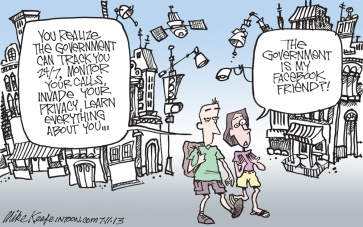
friend

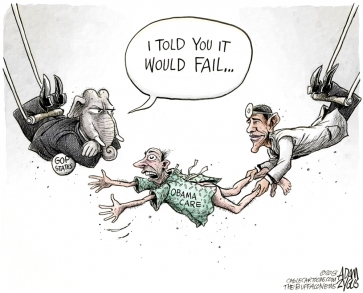
obamacare

Open Thread Wed. & Ben

I figure a change in subject is appropriate.  I think Brent is in and out again this week so I’ll put up my big economic news of the week.

Federal Reserve Chairman Ben Bernanke said Wednesday that the Fed’s easy-money policy is still necessary, throwing cold water on fresh market expectations that the Fed’s stimulus would soon be ended.

Bernanke told an audience of economists in Cambridge, Massachusetts, that the jobs market remains too weak and inflation remains too low for comfort.

He also warned that the full impact of steep government spending cuts initiated in March was yet to be seen.

Together, the evidence underscored the need for the Fed to keep in place its highly accommodative monetary policy, he said.

“Both the employment side and the inflation side are saying that we need to be more accommodating,” he said, answering questions after a speech.

“Moreover, the other portion of macroeconomic policy, fiscal policy, is now actually quite restrictive…. Put that all together, I think you can only conclude that highly accommodative monetary policy for the foreseeable future is what’s needed in the US economy.”

His comments came just hours after the release of the minutes from the June 18-19 meeting of the Fed’s policy board, the Federal Open Market Committee, which suggested the central bank would move more rapidly toward winding up its $85 billion a month stimulus program.


REPRINTED WITHOUT PERMISSION 7-2-13

Why They Fought
By DAVID BROOKS

Tuesday is the 150th anniversary of the second day of the Battle of Gettysburg. In his eloquent new account, “Gettysburg: the Last Invasion,” the historian Allen Guelzo describes the psychology of the fighters on that day.

A battlefield is “the lonesomest place which men share together,” a soldier once observed. At Gettysburg, the men were sometimes isolated within the rolling clouds of gun smoke and unnerved by what Guelzo calls “the weird harmonic ring of bullets striking fixed bayonets.” They were often terrified, of course, sometimes losing bladder and bowel control. (Aristophanes once called battle “the terrible one, the tough one, the one upon the legs.”)

But, as Guelzo notes, the Civil War was fought with “an amateurism of spirit and an innocence of intent, which would be touching if that same amateurism had not also contrived to make it so bloody.”

Discipline was loose. Civil War soldiers were not used to subordinating themselves within large organizations. One veteran observed that in battle “men standing in line got in paroxysms of laughter.” But many were motivated by the sense that they were living up to some high moral ideal. Words like “gallant,” “valor” and “chivalric” dot their descriptions of each other’s behavior. Upon being taken prisoner, one Union soldier shook his captors’ hands and congratulated them on the “most splendid charge of the war.”

Another officer remembered battle as a “supreme minute to you; you are in ecstasies.” A Union artillery officer confessed that throughout Gettysburg “somehow or other I felt a joyous exaltation, a perfect indifference to circumstances, through the whole of that three days’ fight, and I have seldom enjoyed three days more in my life.”

In our current era, as the saying goes, we take that which is lower to be more real. We generally believe that soldiers under the gritty harshness of war are not thinking about high ideals like gallantry. They are just trying to get through the day or protect their buddies. Since World War I, as Hemingway famously put it, abstract words like “honor” and “glory” and “courage” often seem obscene and pretentious. Studies of letters sent home by soldiers in World War II suggest that grand ideas were remote from their daily concerns.

But Civil War soldiers were different. In his 1997 book “For Cause and Comrades,” James M. McPherson looked at the private letters Civil War soldiers sent to their loved ones. As McPherson noted, they ring with “patriotism, ideology, concepts of duty, honor, manhood and community.”

The soldiers were intensely political. Newspapers were desperately sought after in camp. Between battles, several regiments held formal debates on subjects like the constitutional issues raised by the war. “Ideological motifs almost leap from many pages of these documents,” McPherson reports. “It is government against anarchy, law against disorder,” a Philadelphia printer wrote, explaining his desire to fight.

The letters were also explicitly moralistic. “The consciousness of duty was pervasive in Victorian America,” McPherson writes. The letters were studded with the language of personal honor, and, above all, a desire to sacrifice, as one soldier put it, “personal feelings and inclinations to … my duty in the hour of danger.”

One of the most famous letters was written not at Gettysburg but on July 14, 1861, on the eve of the First Battle of Bull Run. It was written by Sullivan Ballou, an officer from Rhode Island. Ballou had lost his own parents when he was young and, having known “the bitter fruit of orphanage myself,” he declared himself loath to die in battle and leave his small children fatherless.

“My love for you is deathless,” he wrote to his wife. “It seems to bind me to you with mighty cables that nothing but Omnipotence could break; yet my love of country comes over me like a strong wind and bears me irresistibly on with all these chains to the battlefield.”

It’s not just love of country that impels him, but a feeling of indebtedness to the past: “I know how strongly American Civilization now leans upon the triumph of the Government, and how great a debt we owe to those who went before us through the blood and suffering of the Revolution. And I am willing — perfectly willing — to lay down all my joys in this life, to help maintain this Government, and to pay that debt.”

These letter writers, and many of the men at Gettysburg, were not just different than most of us today because their language was more high flown and earnest. There was probably also a greater covenantal consciousness, a belief that they were born in a state of indebtedness to an ongoing project, and they would inevitably be called upon to pay these debts, to come square with the country, even at the cost of their lives.

Makes today’s special interest politics look kind of pathetic.

Friday Morning Open Thread

Brent’s away, so no morning report.

Father’s Day WEEKEND Open Thread

That’s right, we celebrate the whole weekend at our house.  But then we celebrate our birthdays for at least a week (sometimes longer) and Christmas for at least two.  And since this place is heavily populated by men I would be remiss if I didn’t wish all of you Dad’s a Happy Father’s Day.

I lost my dad when I was 56 and I miss him every day.  I think I’ve mentioned before that we had a pretty rocky relationship while I was in my 20’s but we found our way back to each other  and a big part of the reason we were able to do so is because he was my best friend when I was a child.  He worked really hard and very long hours but nearly every free moment he had was spent with his girls and we loved it.  He always knew I was a little sponge and so he filled me up with values and lessons that are still a huge part of me to this day.

And luckily for me I’m also blessed with a terrific husband who could easily win a “Best Father of the Year” award.  So I appreciate fatherhood and hope y’all have a great weekend with your kids if they’re around or at least that you are acknowledged gratefully by them if you’re separated by some miles.

****************************************************************************************************************

And a few links for those of you who check in……………….feel free to add your own.

Income inequality in the United States—already well above that experienced in other advanced economies—has surpassed Gilded Age levels, and the Great Recession and ongoing jobs crisis will exacerbate this trend until full employment is restored. While market forces are the primary driver of rising inequality, recent economic research suggests that tax policy has contributed as well, both by exacerbating after-tax income inequality since the late 1970s and by spurring a shift of pretax income toward high-income households.

Facebook became the first to release aggregate numbers of requests, saying in a blog post that it received between 9,000 and 10,000 requests for user data in the second half of 2012, covering 18,000 to 19,000 of its users’ accounts.

Warningdon’t read this if you’re eating, prone to sudden bouts of queasiness or unable to even think about Un Chien Andalou without simultaneously bursting into tears and dry-heaving. Believe me, I’m speaking from experience here.

And last but not least:

Comic

Morning Non-Report Open Thread 05/07/13

Brent’s away. Nothing else to say.

Open Thread – 4/16/2013

Open Thread since MR is MIA.

Katrina vanden Heuvel has a good piece on whistleblowers.

http://www.washingtonpost.com/opinions/katrina-vanden-heuvel-dont-confuse-truth-tellers-with-traitors/2013/04/15/3c8e7016-a5e3-11e2-8302-3c7e0ea97057_story.html

I found the linked piece with the original My Lai articles interesting as well.

http://pierretristam.com/Bobst/library/wf-200.htm

Easter Weekend Open Thread

Feel free to add content here, including pictures of Easter Bunnies, egg hunts and/or puppies. The ladies can also post pictures of Stompy Easter Boots!

Happy Easter to all!

Sorry. Really.

Look, I’m sorry. But this was on the radio yesterday morning, it’s been on a loop in my head since then. And the only way to get it out is to give to someone else.