Morning Report

Vital Statistics:

Last Change Percent
S&P Futures 1413.8 -1.3 -0.09%
Eurostoxx Index 2543.8 3.9 0.15%
Oil (WTI) 107.1 0.1 0.07%
LIBOR 0.4707 -0.002 -0.42%
US Dollar Index (DXY) 79.023 0.041 0.05%
10 Year Govt Bond Yield 2.23% -0.02%
RPX Composite 169.62 -0.2

Markets are largely maintaining their gains after yesterday’s huge rally. Bonds and MBS are up slightly.

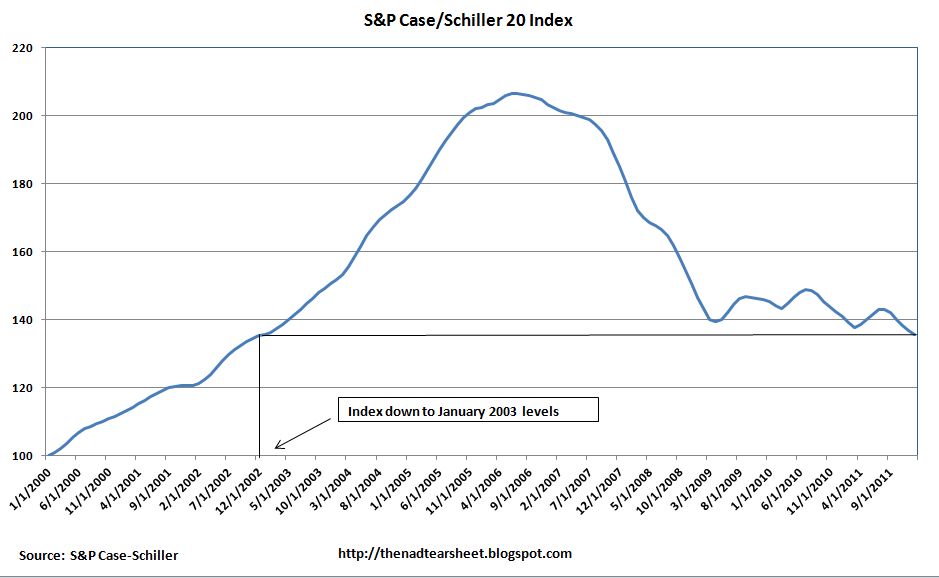
The S&P / Case-Schiller index showed a 3.8% decline year over year. Only Miami, Phoenix, and Washington DC reported increases. Atlanta was the outlier on the downside, with a nearly 15% decline YOY. Note that these are January numbers – Case-Schiller has a couple month lag.

Bloomberg has a story about bidding wars for homes in some parts of the US. While I had heard about bidding wars in the usual places – NYC and DC, this is the first I have heard about bidding wars in places like Seattle. The big question will be whether this is a permanent or temporary phenomenon. Supposedly the settlement with the State AGs ended foreclosure moratoriums, which means more supply is going to be dumped on the market. That said, I am hearing anecdotes of bidding wars in hard hit areas like Phoenix, at least in the $80k – $120k range.

On the other side of the coin, the Campbell / Inside Mortgage Finance survey notes that investors purchases are becoming a larger proportion of home sales, particularly short sales. This is being driven by the long financing timeline. Their Distressed Property Index shows that nearly half of home sales are distressed.

Chart:  S&P / Case-Schiller Composite Index
Morning Report

Vital Statistics:

Last Change Percent
S&P Futures 1403.7 9.6 0.69%
Eurostoxx Index 2537.3 11.9 0.47%
Oil (WTI) 107.2 0.3 0.31%
LIBOR 0.4727 -0.001 -0.11%
US Dollar Index (DXY) 79.272 -0.073 -0.09%
10 Year Govt Bond Yield 2.27% 0.04%
RPX Composite 169.79 0.1
Markets are generally higher this morning on no real news. Bonds and MBS are weaker as risk aversion continues to wane. Commodities are slightly higher.
The Chicago Fed National Activity Index came in  at -.09 in Feb, down from +.33 in Jan and below expectations. Essentially the index tells you whether the economy is growing above trend (positive number) or below trend (negative number).  It takes into account 85 different economic indicators. The biggest positive contributor was employment, while consumption and housing were the biggest negatives.
Meanwhile, Ben Bernake is saying the job market remains weak and the recent drops in unemployment are unlikely to continue.
Speaking of housing, KB Homes released numbers on Friday and the stock was pummeled, as the street was spooked by the lower new orders numbers. KB was blaming the number on their preferred lender (Met Life) exiting the market. Overall, the tone of the conference call was constructive, with the company noting several signs that the housing market is steadily improving.

Morning Report

Vital Statistics:

Last Change Percent
S&P Futures 1387.6 -1.3 -0.09%
Eurostoxx Index 2510.8 -19.5 -0.77%
Oil (WTI) 105.76 0.4 0.39%
LIBOR 0.4732 -0.001 -0.11%
US Dollar Index (DXY) 79.483 -0.253 -0.32%
10 Year Govt Bond Yield 2.25% -0.03%
RPX Composite Real Estate Index 169.74 0.0

Markets are flat this morning on a lack of news. Bonds and MBS continue to retrace their large move downward after the FOMC statement. New Home Sales are due at 10:00 am.

Radar Logic released their Monthly Housing Report yesterday, noting that price declines are slowing, but we are not at a bottom. Distressed sales declined 21.8%, although the settlement between the State AGs and the 5 big banks means that foreclosures are going to pick up again. Interestingly, while Radar Logic has the opinion that housing has yet to bottom, the Radar Logic futures indicate that real estate will stay flat in 2012 and 2013 and then start increasing. The RPX futures are very illiquid, so take what they say with a grain of salt, but still…

Bank of America is launching a pilot program for distressed homeowners, where they follow a Deed In Lieu process to turn over the title to the bank and then rent at sub-market rates for up to 3 years. Bank of America would then sell the properties to outside investors. Speaking of which, we should be hearing the results of the FHFA’s REO-to-Rental program soon. In my opinion, the government made it very difficult for investors to take a look, (you have to pay $250,000 just to find out basic information) which I found surprising.

In the “because I said so” category, Ben Bernake said the Fed’s easy monetary policy after the stock market bubble burst wasn’t responsible for the housing bubble.

As I noted yesterday, the homebuilders have quietly put in a huge rally since last fall. (Note to the business press:  there are more stocks in the US than Apple) Is the move over?  Perhaps.  KB Homes reported disappointing Q1 earnings and the stock is down 14% pre-open.

Etch-a-Sketch-gate was actually market-moving, believe it or not. Yesterday, shares of little Ohio Art (NASDAQ – OART) more than doubled on the prospect that Democrats will be buying Etch-a-Sketches en masse as props for upcoming election. The stock trades by appointment and has a miniscule market cap ($8.6 million), but there you go.

Morning Report

Vital Statistics:

Last Change Percent
S&P Futures 1389.6 -7.9 -0.57%
Eurostoxx Index 2531.7 -35.9 -1.40%
Oil (WTI) 104.88 -2.4 -2.23%
LIBOR 0.4737 -0.001 -0.11%
US Dollar Index (DXY) 79.851 0.194 0.24%
10 Year Govt Bond Yield 2.26% -0.03%

World equity markets are weaker after disappointing economic data from China and Europe. Initial Jobless Claims came in at 348k, more or less in line with expectations. The FHFA House Price Index and Leading Indicators come out at 10:00.  The FHFA is a narrower index than Case-Schiller or RPX in that they only focus on conforming mortgages.

How is the deleveraging of the consumer going?  Actually pretty well, according to one measure. Moody’s notes that the delinquency rate on credit cards reached 4.02% in Feb, the lowest rate since August of 2007. That number is even more impressive when you consider the seasonal factors – Feb is usually a bad month for credit card delinquencies.

One thing the consumer does not need is higher gasoline prices. While oil prices have continued to rally, crack spreads are pushing 10 year highs. Crack Spreads are the price differential between crude oil and the refined product. WTI 321 Crack Spreads are at $32 a barrel, pretty much erasing the decline from last year. Apparently a large chunk of US east coast refining capacity is going to be taken off line this summer, causing a shortage of gasoline on the East Coast.  For further details and analysis, click here. While people bemoan the lack of refining capacity, people forget that refining is in general a lousy business. Sunoco is looking to sell its Philadelphia refinery and will close it if they can’t find a buyer.  Sunoco got only $400 million for the sale of its Toledo OH refinery last year. So look for higher gas prices for the summer driving season.

For those keeping score at home, the XHB (Homebuilder ETF) has been on a tear since early October, gaining 77%.  Is the stock market signalling something the economic indicators have yet to reflect? For the record, I noted the the change in tone on KB Homes 3Q conference call which seemed to predict that life for the homebuilders was improving.  Also, someone made a punchy bet last Oct that paid off well.

Is an arcane rule change from the Fed influencing mortgage rates?  The Fed has changed the rules for failure to deliver in MBS transactions, adding a charge in addition to the interest a seller must pay on a fail. With interest rates so low, sellers had the incentive to short MBS instead of delivering from inventory. This rule change will force dealers to hold more inventory, which the Fed ultimately hopes will drive up prices.

Morning Report

Vital Statistics:

Last Change Percent
S&P Futures 1402.7 2.7 0.19%
Eurostoxx Index 2576.3 -0.4 -0.01%
Oil (WTI) 106.45 0.4 0.36%
LIBOR 0.4742 0.000 0.00%
US Dollar Index (DXY) 79.593 0.000 0.00%
10 Year Govt Bond Yield 2.34% -0.02%

World equity markets are higher this morning ahead of existing home sales data at 10:00am. Bonds are rallying as well, with the 10 year futures up 11 ticks, retracing some of the pounding it has taken over the last week.

Unsurprisingly, the Mortgage Bankers Association index of mortgage applications was down for the prior week, with refis down big. The average rate on a 30 year fixed rate loan was 4.19%.

The Federal Reserve released its financial statements for 2011 yesterday. Total assets were 2.92 trillion at the end of 2011, an increase of almost 500 billion. Total capital is 53.8B, and they distributed 77.4 billion to the US Treasury. They currently hold 895B worth of MBS, which is down 13% from last year.  So it appears they are not fully re-investing P&I payments.  Maiden Lane has been nearly cut in half and is down to 36B, when you include capitalized interest and all the other variable interest entities.

Speaking the the Fed, the WaPo has an article asking the question if Bernake is aggressive enough regarding unemployment. Naturally the inflation doves think he isn’t. Would QEIII lop a percentage point off of the unemployment rate? It is hard to make an argument that it would. A real market-clearing bottom in housing would do more to get the economy moving than more games from the Fed.

How would the major European banks have fared under the Fed’s stress-tests?  They would have passed, according to analysts at Barclay’s. Surprising result, unless they explicitly did not model another sovereign default.

Morning Report

Vital Statistics:

Last Change Percent
S&P Futures 1396.3 -7.7 -0.55%
Eurostoxx Index 2575.8 -32.6 -1.25%
Oil (WTI) 107.1 -1.0 -0.92%
LIBOR 0.4742 0.001 0.11%
US Dollar Index (DXY) 79.766 0.297 0.37%
10 Year Govt Bond Yield 2.33% -0.04%

Markets are lower this morning on further evidence that the Chinese economy is slowing. Mining giant BHP-Billiton made comments overnight that China’s steel growth has flattened off and its big infrastructure build has come to an end. These comments, combined with increased fuel prices in China sent world equity and commodity markets lower.  Bond futures are higher.

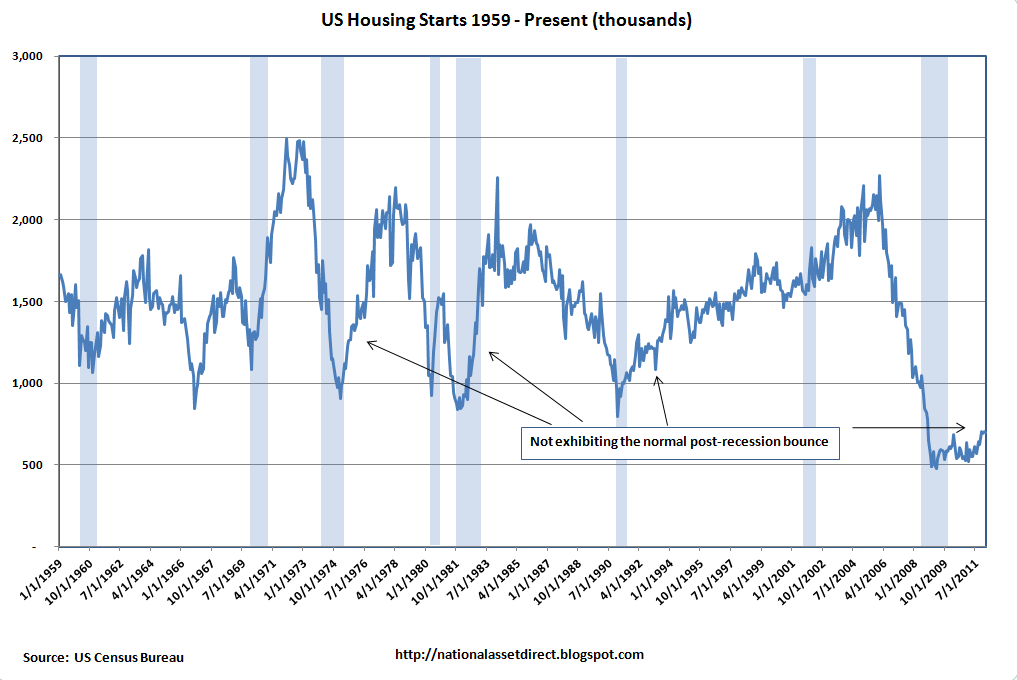
Housing starts came in at 700k, more or less in line with the levels for the past few months, and much lower than the 1.5 million or so that represents “normalcy.” Housing construction has been the achilles heel of the recovery and it looks like that will continue. The National Association of Homebuilders sentiment index continues to improve, but it has yet to be reflected in the numbers.

The FHFA released its fourth quarter Foreclosure Prevention and Refinance Report. HARP and HAMP activity has been declining after peaking in 1H10. Short sales and DILs are playing a larger role, while mods remain the focus. Recidivism rates (the knock on loan mods to begin with) have been steadily decreasing and are now in the 10%-15% range. Foreclosure starts have been falling since 3Q10, while foreclosure sales continue to run well below the start rate.  So while they haven’t been filling up the inventory of foreclosed homes as rapidly as they did in late 2010, they still are accumulating foreclosed property on a net basis. Someday, this inventory is going to hit the market. They provide a nice state-by-state analysis at the end that is worth checking out.

Chart:  Housing starts

Morning Report

Vital Statistics:

Last Change Percent
S&P Futures 1396.3 -2.2 -0.16%
Eurostoxx Index 2596.8 -11.5 -0.44%
Oil (WTI) 107.29 0.2 0.21%
LIBOR 0.4737 0.000 0.00%
US Dollar Index (DXY) 79.795 0.009 0.01%
10 Year Govt Bond Yield 2.26% -0.03%

Markets are quiet this morning after triple-witching last Friday. S&P futures are down a couple of points while bonds are up half a point. MBS are a up a tick.

Greek credit default swaps fixed at 21.75, which means sellers of protection owe 78.25%. So it appears that when all is said and done, that credit default swaps did in fact work as advertised.  Portugal, you’re up.

Merger Monday is back with a big deal in the logistics space – UPS is buying TNT for 6.8 billion, in a bid to create a Euro logistics company to rival DHL. UPS is paying a 54% premium to the undisturbed stock price, leaving some to question whether UPS is overpaying. But when companies are cash-rich and financing is cheap, you will see deal flow.

Speaking of cash-rich, supposedly Apple will disclose what they intend to do with their 100 billion in cash. Will Apple leave the trio of most-admired companies who don’t pay a dividend (Google, Berkshire Hathaway, and Apple)? The stock is currently halted.

The WSJ has an A1 article on the REO-to-Rental program. Ranieri is interested, as is Paulson.

Morning Report

Vital Statistics:

Last Change Percent
S&P Futures 1399.5 3.5 0.25%
Eurostoxx Index 2607.6 13.6 0.52%
Oil (WTI) 105.65 0.5 0.51%
LIBOR 0.4737 0.000 0.00%
US Dollar Index (DXY) 79.991 -0.159 -0.20%
10 Year Govt Bond Yield 2.32% 0.04%

Markets are slightly firmer after the consumer price index showed inflation is still behaving. The 10-year continues its slide and has backed up 40 basis points in the last two weeks. It feels like some major asset allocation trades are going on as investors sell bonds to buy stocks. For those keeping score, the 10 year yields 2.32%, versus a dividend yield of 2.27% on the S&P. So that move could have room to run.  Bloomberg is noting that the derivatives market is starting to price in Fed hikes in late 2013, nearly a year before the Fed’s current guidance of late 2014.

Industrial production was flat in Feb, below expectations, and capacity utilization was down slightly to 78.7% from 78.8%, also below expectations.

The NAHB Improving Markets Indicator predicts that 99 housing markets will improve in March, which is up from Feb.


Morning Report

Vital Statistics:

Last Change Percent
S&P Futures 1392.5 3.8 0.27%
Eurostoxx Index 2581.0 6.2 0.24%
Oil (WTI) 105.51 0.1 0.08%
LIBOR 0.4737 0.000 0.00%
US Dollar Index (DXY) 80.436 -0.129 -0.16%
10 Year Govt Bond Yield 2.33% 0.06%

Equity markets continue to rally as bonds sell off. The 10-year now stands at 2.33% after yielding around 1.9% last week. MBS are lower as well, with some lenders now best-exing at 4-1/8%. That is a big move in a short period of time.

The producer price index (a measure of wholesale inflation) and initial jobless claims came in as expected. Empire Manufacturing (a New York – based measure of business sentiment put out by the New York Fed) showed general business conditions are expanding at a moderate pace. Prices paid jumped as did average workweek. Sentiment is optimistic.

ISDA is going to hold its auction to set the payouts on Greek CDS. The early indications seem to be that 23 is going to be the price on the roughly $2.6 billion in swaps. According to Bloomberg, The Austrian government is holding the old maid here, and will have to inject 1 billion euros into KA Finanz AG (the “bad bank” of nationalized Kommunalkredit Austria AG) to cover losses on Greek swap payouts.

Foreclosures are set to increase, according to RealtyTrac, as some of the barriers are removed (especially the State AG settlement) According to Bloomberg, the shadow inventory of homes in foreclosures or about to become foreclosures is around 4.5 million units. I wonder what the economic effect will be when those people who have been living for free suddenly have to pay rent.

On the other hand, the NAR shows list prices and demand up, with inventory down in its latest Real Estate Trends report.  Total inventory is down 22% YOY, with list prices up 6.82% and age down 9.8%.  The recovery seems to be concentrated in the hardest hit areas – Florida and Arizona. Phoenix inventories are down 48% and list prices are up 21%. I have been hearing anecdotal evidence of strong investor interest in Phoenix property, and these numbers do bear that out.

Morning Report

Vital Statistics:

Last Change Percent
S&P Futures 1390.7 0.0 0.00%
Eurostoxx Index 2574.8 18.0 0.70%
Oil (WTI) 106.48 -0.2 -0.22%
LIBOR 0.4737 0.000 0.00%
US Dollar Index (DXY) 80.5 0.307 0.38%
10 Year Govt Bond Yield 2.28% 0.16%

S&P futures are flat this morning after yesterday’s furious rally on the back of the FOMC comments. Europe is playing catch-up. Bonds continue to sink as the market re-asses the probability of QEIII.  The 10 year has clearly fallen out of its 140-144 trading range, and it looks like 134 is the next stop. Mortgages are weaker as well.  As the 10 year sells off, it will be interesting to see if the Fed can hold up MBS.

The Fed left rates unchanged, but noted the recent economic strength and low inflation (since food and energy prices don’t matter). They re-affirmed their intention to maintain exceptionally low interest rates through late 2014. Operation Twist and the MBS re-investment will continue. People hoping for clues to QEIII didn’t get much except for a bland statement that the Fed will continue to review its securities holdings and adjust as necessary.

After the close yesterday, the Fed released the results of its stress-tests of the banking system. Citi, Suntrust, Ally and Metlife flunked.  The stress test was actually pretty tough – unemployment at 13%, a 50% crash in the stock market, and another 21% drop in house prices. 15 of the 19 banks examined would maintain capital ratios above regulatory minimums in that scenario. The detailed methodology is here.

This editorial from the NYT regarding Goldman reminds me of the way Michael Lewis described Salomon Brothers in Liar’s Poker.