Morning Report – Mortgage Applications dive 05/15/13

Vital Statistics:

  Last Change Percent
S&P Futures  1645.3 -2.7 -0.16%
Eurostoxx Index 2801.6 6.0 0.21%
Oil (WTI) 93.29 -0.9 -0.98%
LIBOR 0.274 0.000 0.00%
US Dollar Index (DXY) 83.94 0.343 0.41%
10 Year Govt Bond Yield 1.94% -0.03%  
Current Coupon Ginnie Mae TBA 105.2 0.3  
Current Coupon Fannie Mae TBA 102.7 0.2  
RPX Composite Real Estate Index 197.1 0.5  
BankRate 30 Year Fixed Rate Mortgage 3.65    

Markets are lower this morning after an earnings miss from John Deere (DE) and better than expected earnings out of Macy’s. The Producer Price Index fell .7% as commodity prices continue to drop. Bonds and MBS are up a quarter or so.

Mortgage Applications fell 7.3% in the last week, unsurprising given that rates have backed up so much. People will be looking at drier pipelines into early June. The purchase index fell by 4%, while the refi index fell 8%. 

The Empire State Manufacturing Survey showed manufacturing contracted in the May. The six month outlook weakened as well. Inflation remains muted. The employment-related indicators (number of employees and average workweek) declined slightly. The Fed and other economists had been predicting a second quarter slowdown, and this is evidence of it. The consensus is for a re-acceleration into the second half of the year. Certainly the stock market and the bond market are focusing more on the 2H acceleration than they are on the current slowdown.

Lots of good stuff in the latest CoreLogic Market Pulse. They discuss how residential construction has moved from a drag to a driver on the economy. While the red-hot Western markets like Las Vegas and San Francisco are seeing professional-driven buying, the markets of North Carolina and Texas are more balanced and are the healthiest new sale markets..On a price to income ratio, housing is still as affordable as it has been since the 90s. RTWT.

Morning Report – Housing Scorecard 05/14/13

Vital Statistics:

Last Change Percent
S&P Futures  1631.8 1.0 0.06%
Eurostoxx Index 2778.9 1.5 0.05%
Oil (WTI) 94.59 -0.6 -0.61%
LIBOR 0.274 -0.001 -0.36%
US Dollar Index (DXY) 83.34 0.065 0.08%
10 Year Govt Bond Yield 1.91% -0.01%  
Current Coupon Ginnie Mae TBA 104.9 -0.2  
Current Coupon Fannie Mae TBA 103 0.1  
RPX Composite Real Estate Index 196.6 0.4  
BankRate 30 Year Fixed Rate Mortgage 3.62    

Markets are flattish this morning on no real news. Appalloosa manager David Tepper said on CNBC that he is still bullish and the economy is getting better. Bonds finally catch a bid after a pretty brutal two week sell-off. MBS are up small.

The National Federation of Independent Business released their Small Business Optimism Survey this morning, which showed the index creeping up slightly to 92.1 from 90.7. Owners are still pessimistic about the economy, with a net negative 15% expecting business conditions to improve over the next six months. Hiring and raises are being done only grudgingly, and capital expenditures are only at maintenance levels. Yet the stock market is at record highs. So what gives? Part of it is that the big S&P 500 stocks have a lot of international exposure, which means they can offset US weakness elsewhere. Also, I think quantitative easing is playing a part. 

The Obama Administration released their monthly Housing Scorecard which showed home equity increased again last month. HAMP trial modifications jumped, while HAMP permanent mods fell. HARP refis were flat for the month. It is still looking like Mel Watt as the new FHFA Chairman is no sure thing, either. Even if he doesn’t get nominated, HARP 3.0 might still happen, which would extend the eligibility dates for HARP refis to include late 2009 and 2010 vintages. That would undoubtedly kick off another refi wave. 

Morning Report – Retail Sales impress 05/13/13

Vital Statistics:

  Last Change Percent
S&P Futures  1627.3 -2.3 -0.14%
Eurostoxx Index 2776.9 -8.4 -0.30%
Oil (WTI) 95.43 -0.6 -0.64%
LIBOR 0.275 0.000 0.00%
US Dollar Index (DXY) 83.31 0.165 0.20%
10 Year Govt Bond Yield 1.94% 0.04%  
Current Coupon Ginnie Mae TBA 104.8 -0.4  
Current Coupon Fannie Mae TBA 102.8 -0.3  
RPX Composite Real Estate Index 196.3 0.5  
BankRate 30 Year Fixed Rate Mortgage 3.58    

Markets are slightly lower after vaulting to new heights last week. Earnings season is largely over; the only ones left are the retailers who start reporting this week. We will hear from Wal Mart and Kohls later this week. Bonds and MBS continue to sell off – the 30 year fixed rate mortgage closed the week at 3.58% after bottoming at 3.4% a week and a half ago.

Does the back up in bond yields mean the refi boom is over? Perhaps. At any rate, since we have been in this range of interest rates for so long, the people who have the ability to refinance already have. This is called prepayment burnout. Now, it will take home price appreciation to drive refinances. That said, there is talk of a HARP 3.0, which would allow late 2009 and 2010 vintage underwater mortgages to refinance, and there is talk that the government may allow people who have already refinanced under HARP to do so again.  New government initiatives may help keep the refi boom alive for a little bit longer.

Retail sales increased .1% in April, higher than the -.3% estimate. The movement of the Easter holiday played some role in the increase. Ex autos and gasoline, the increase was .6%. Gasoline is usually stripped out, because simple price changes can move the index. Joseph H Banks (JOSB) missed earnings estimates this morning. It is an old saw that in weak economic times, the only apparel that is purchased is children’s clothing. As the economy improves, women’s apparel starts to pick up, and when the economy really starts heating up, men’s suits start being purchased. We’ll get a read on women’s apparel when Nordstrom reports on Thursday. Bonds sold off on the retail sales number, although equities didn’t really react.

I said it on Friday and I’ll say it again. This Obama / IRS thing could be market negative in a lot of ways – first, if there is something there, it will inevitably cause marginal foreign investment money to flee the dollar, which is equity negative. Plus it will make the debt ceiling negotiations all that more acrimonious. With the S&P 500 at record highs, it is worth bearing this in mind. You could also see a serious snap-back rally in the bond market.

Morning Report – CBO assumes a can opener 05/03/13

Vital Statistics:

  Last Change Percent
S&P Futures  1603.4 11.1 0.70%
Eurostoxx Index 2736.0 17.1 0.63%
Oil (WTI) 95.21 1.2 1.30%
LIBOR 0.275 0.002 0.73%
US Dollar Index (DXY) 82.43 0.204 0.25%
10 Year Govt Bond Yield 1.70% 0.07%  
Current Coupon Ginnie Mae TBA 106 -0.5  
Current Coupon Fannie Mae TBA 104.2 -0.3  
RPX Composite Real Estate Index 193.8 0.5  
BankRate 30 Year Fixed Rate Mortgage 3.42    

Markets are higher this morning after a better-than-expected jobs report. Bonds and MBS got whacked on the number.

Payrolls increased by 165,000 in April and the unemployment rate fell to 7.5%. March was revised upward from 88k to 138k. The labor force participation rate remained at 63.3%, the lowest since the 70s. Retail and business services added jobs, while construction was surprisingly flat. The average workweek fell, while average hourly earnings ticked up by 4 cents. 

The CBO has come out with a study saying that principal mods on Fannie and Freddie mortgages could save the taxpayer money by reducing delinquency and foreclosure costs and increasing economic growth. As far as the moral hazard issue – they dismiss the costs of moral hazard as “relatively low,” provided the government requires sufficient evidence of financial hardship. The study basically assumes that the government will thread the needle with drafting rules to prevent strategic defaults. The study reminds me of the old joke where an engineer and an economist are stranded on a desert island with an unopened can of soup. The engineer proposes to use a rock to open the can. The economist says “assume a can opener.” 

Lloyd Blankfein sees the current environment as a parallel of 1994. Borrowers had become so used to low interest rates that they weren’t ready when the Fed started hiking rates. Old timers will remember that was when Orange County blew up as mortgage backed securities got clocked. 


Morning Report – More Mel 05/02/13

Vital Statistics:

Last Change Percent
S&P Futures 1582.8 5.5 0.35%
Eurostoxx Index 2729.8 18.1 0.67%
Oil (WTI) 91.37 0.3 0.37%
LIBOR 0.273 0.000 0.00%
US Dollar Index (DXY) 81.75 0.263 0.32%
10 Year Govt Bond Yield 1.64% 0.01%
Current Coupon Ginnie Mae TBA 106.4 -0.1
Current Coupon Fannie Mae TBA 104.6 -0.1
RPX Composite Real Estate Index 192.8 0.3
BankRate 30 Year Fixed Rate Mortgage 3.4

Markets are stronger this morning after the ECB cut rates and initial jobless claims came in lower than expected. Productivity increased as well. Bonds and MBS are flat.

Yesterday’s FOMC statement turned out to be a “steady as she goes” statement. They mention that they are ready to increase or decrease asset purchases in response to changing economic conditions. ZIRP (meaning rock bottom interest rates) will continue as long as unemployment is above 6.5% and inflation remains at 2.5% or lower.

People are still trying to understand the implications of Mel Watt as Chairman of the FHFA. The biggest one is that Mel Watt was not nominated to preside over the dissolution of the government’s role in housing finance. Fannie and Fred will survive in some fashion. The elephant in the room is principal mods for people with underwater conforming mortgages. That will undoubtedly come up in the confirmation hearings. In his announcement, obama continued to press the left-wing narrative that “reckless lending” caused the financial crisis while studiously ignoring the fact that we had a housing bubble that was caused (or at a minimum enabled) by activist government policies and extremely loose monetary policy. I do think it is ironic that he talks about reckless lending when the government bears 50% of the credit risk of the entire US mortgage market. While people have hoped that the government will extricate itself from the mortgage market, this appointment suggests otherwise.

Challenger and Gray job cuts fell to 28,121 in April, a drop of 6% year-over-year. This is the lowest level since December 2012. Despite the sturm and drang over the sequester, the massive expected layoffs have yet to appear. Aerospace and defense did announce 1,928 job cuts that were related to the sequester. This is a far cry from the 900,000 jobs that were forecast by some studies.

Morning Report – New FHFA Chairman 05/01/13

Vital Statistics:

  Last Change Percent
S&P Futures  1591.2 -1.0 -0.06%
Eurostoxx Index 2712.0 0.0 0.00%
Oil (WTI) 91.87 -1.6 -1.70%
LIBOR 0.273 0.000 0.00%
US Dollar Index (DXY) 81.38 -0.367 -0.45%
10 Year Govt Bond Yield 1.65% -0.02%  
Current Coupon Ginnie Mae TBA 106.5 0.0  
Current Coupon Fannie Mae TBA 104.7 0.1  
RPX Composite Real Estate Index 192.5 0.4  
BankRate 30 Year Fixed Rate Mortgage 3.43    

Markets are slightly weaker ahead of the FOMC announcement later today. MBA mortgage applications increased 1.8% last week. The Markit Flash Manufacturing Purchasing Managers Index came in at 52.1, indicating that business conditions for manufacturers are more or less in line with historical trends. Bonds and MBS are up.

The ADP employment change (which is a forecast for Friday’s jobs report) came in lower than expected at 119,000. March was revised downward as well. Lately the ADP employment change has not been all that great or a predictor of the official jobs report, but we’ll see. 

The FOMC’s rate decision is expected to be released at 2:00 pm EST. Nobody expects any change in interest rates – the big question will be regarding asset purchases or QE. Late last year, there appeared to be a consensus that QE would end sometime this year. Subsequent comments from Federal Reserve governors however seemed to contradict that view. Now, we have some that have mentioned the possibility of additional measures. If anything that probably points to a “steady as she goes” type of statement, but we’ll see. 

Looks like Ed DeMarco is out at FHFA and Mel Watt is in. This probably means principal mods for conforming mortgages are on the way. Interestingly, Watt represented the Charlotte district, the same district as Bank of America. Principal mods are not a slam dunk however – the biggest MBS holders are pension funds and they are struggling to meet their obligations in this low interest rate environment. Watt’s confirmation will not be a slam dunk by any means. 

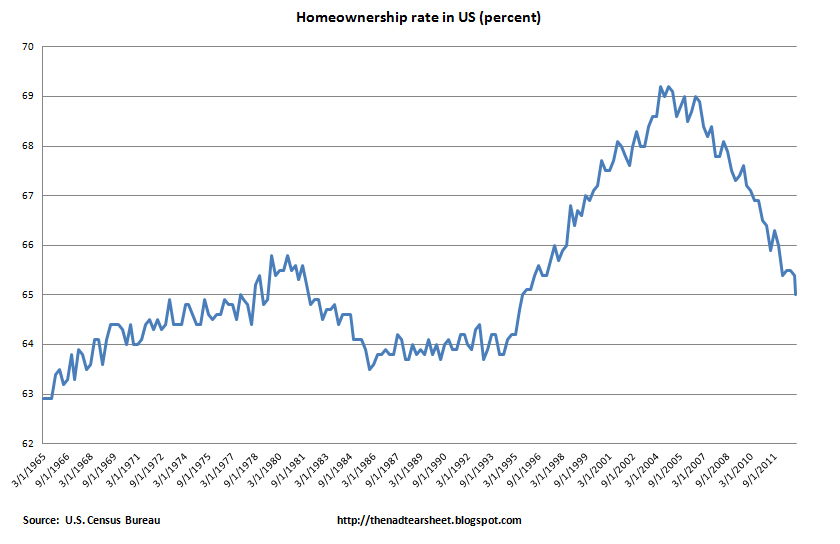
The homeownership rate declined to 65% in Q1, the lowest level since 1995. This speaks to the absolute dearth of household formation numbers in the last 5 years. While the number has dropped significantly from its peak in 2005, it is still more or less at historical averages. 

Chart:  Homeownership rate


Morning Report – Wanna lend some money to Apple? 04/30/13

Vital Statistics:

  Last Change Percent
S&P Futures  1587.3 -0.9 -0.06%
Eurostoxx Index 2720.1 2.7 0.10%
Oil (WTI) 93.73 -0.8 -0.81%
LIBOR 0.273 -0.001 -0.36%
US Dollar Index (DXY) 82.16 0.015 0.02%
10 Year Govt Bond Yield 1.65% -0.02%  
Current Coupon Ginnie Mae TBA 106.4 0.0  
Current Coupon Fannie Mae TBA 104.7 0.1  
RPX Composite Real Estate Index 192.1 1.1  
BankRate 30 Year Fixed Rate Mortgage 3.43    

Markets are lower this morning on no real news. The Employment Cost Index increased .3% in the first quarter and Q412 was revised down. Wages and salaries increased .5% while benefit costs dropped .1%. No inflationary pressures in the labor market. Today starts the two day FOMC meeting. Bonds and MBS are up slightly.

The S&P / Corelogic / Case-Schiller index of home values came in at + 9.32% year over year and + 1.24% month-over-month. This was the biggest increase since May 2006. Of course the real estate market is pretty bifurcated, with annual growth in the high teens out West and mid-to-high single digit growth elsewhere. They note that housing is now becoming a driver of GDP growth, although the mix still is skewed towards apartments and not single family residences.

Chart:  Case-Schiller indices

Apple is doing a massive bond issue – 6 different issues, including a 30 year bond. The proceeds will be used to fund dividends and buybacks and will help Apple avoid repatriation taxes on the over $100 billion in funds it holds overseas. The 30 year bond is supposedly going to be priced at a 115 basis point spread to Treasuries. That would be around 4%. The 5 year paper will be issued at 1.2%. Those are positively Japanese yields. Grandpa, tell me again about the days when companies would issue debt with yields lower than their dividend yield.


PIMCO’s Mohammed El-Arian thinks that the tone of the FOMC meeting will shift from “when do we end QE?” to maintaining it and possibly increasing stimulus. That would certainly be MBS bullish, which could start another refi wave, although prepay burnout has got to be pretty big at this point. He does note the risks of the record amount of stimulus: “The benefits of the Fed come with costs and risks. What I worry about is when you run a system at artificial price levels, you start creating damage, resources are misallocated, too much risk is taken.”  Exhibit (A):  Apple is borrowing money for 30 years at 4% to fund a stock buyback. 

Morning Report – Personal Spending up .2% 04/29/13

Vital Statistics:

  Last Change Percent
S&P Futures  1581.5 5.0 0.32%
Eurostoxx Index 2697.4 13.9 0.52%
Oil (WTI) 93.36 0.4 0.39%
LIBOR 0.274 -0.002 -0.54%
US Dollar Index (DXY) 82.12 -0.387 -0.47%
10 Year Govt Bond Yield 1.65% -0.01%  
Current Coupon Ginnie Mae TBA 106.3 0.1  
Current Coupon Fannie Mae TBA 104.6 0.1  
RPX Composite Real Estate Index 191 0.5  
BankRate 30 Year Fixed Rate Mortgage 3.43    

Markets are higher this morning after better-than-expected consumer spending data. Personal Income data was lower than expected. Bonds and MBS are up small

Personal Spending was projected to be flat, but actually rose .2%. The Bureau of Economic Analysis is claiming that it was primarily due to weather – a cooler than normal spring brought higher utility spending. Personal Income was forecast to rise .4%, and ended up at .2%. The PCE deflator showed inflation remains subdued.

Pending Home Sales increased 1.5% in March, according to the National Association of Realtors. Economists had forecast a 1% increase. Pending home sales are up 5.8% year-over-year.

Lender Processing Services reported that home prices increased 1% in February and rose 7.3% year-over-year. The West is experiencing the biggest gains, while the Northeast and Mid Atlantic continue to languish. This has been borne out by the earnings reports of the homebuilders as well – the ones primarily focused on California have knocked the cover off the ball, while those with an East-Coast / Midwest focus have reported gains, but nowhere near what the West Coast builders are reporting.

Lots of data this week, but the big driver will be the FOMC meeting. We will get the rate announcement on Wed. Investors will be looking for information concerning the end of QE. We will get the jobs report on Friday, which will have the biggest potential to move interest rates.

Lots of homebuilders reported earnings last week – pretty much everyone except NVR beat estimates. Anyone with exposure to the West Coast did well and backlog is up nicely at all of the builders. We will hear from Standard Pacific and Beazer Homes this week. The Homebuilder ETF (XHB) is on a tear and sitting right at resistance.

 U.S. News and World Report has a good piece on the state of the first time homebuyer.

Morning Report – disappointing GDP report 04/26/13

Vital Statistics:

  Last Change Percent
S&P Futures  1575.8 -5.9 -0.37%
Eurostoxx Index 2684.1 -20.3 -0.75%
Oil (WTI) 93.23 -0.4 -0.44%
LIBOR 0.276 0.000 0.00%
US Dollar Index (DXY) 82.61 -0.132 -0.16%
10 Year Govt Bond Yield 1.68% -0.03%  
Current Coupon Ginnie Mae TBA 106 0.0  
Current Coupon Fannie Mae TBA 104.5 0.2  
RPX Composite Real Estate Index 191 0.5  
BankRate 30 Year Fixed Rate Mortgage 3.47    

Markets are slightly weaker after Q1 GDP came in weaker than expected. D.R. Horton reported better than expected earnings. Bonds and MBS are stronger


Q1 GDP came in at + 2.5%. lower than the 3% estimate. This is the advance estimate – Q1 GDP will be revised twice in the next two months. Consumer spending increased at 3.2% and the savings rate declined. The back-to-back drop in defense spending was the biggest since 1954. Real disposable incomes fell 5.3% in Q1 on increased taxes. C = 3.2%, I = 3%, G = -4.1%. 

The Senate voted to end sequestration-related furloughs for air traffic controllers and the measure will be sent to the House today. President Obama has said he will consider whatever is sent to him. 

CoreLogic has acquired Case-Schiller.

The CFPB has proposed amendments to the QM rule.  The proposals are here.

Morning Report – Earnings from the homeboys 04/25/13

Vital Statistics:


Last

Change

Percent

S&P Futures 

1581.3

7.2

0.46%

Eurostoxx Index

2708.5

6.4

0.24%

Oil (WTI)

91.74

0.3

0.34%

LIBOR

0.276

0.000

0.00%

US Dollar Index (DXY)

82.47

-0.583

-0.70%

10 Year Govt Bond Yield

1.72%

0.01%


Current Coupon Ginnie Mae TBA

106

-0.1


Current Coupon Fannie Mae TBA

104.2

-0.1


RPX Composite Real Estate Index

191

0.5


BankRate 30 Year Fixed Rate Mortgage

3.47


Markets are higher after earnings continue to look decent. Initial Jobless Claims fell, although the data tends to be volatile this time of year. Bonds and MBS are down

Yesterday, the House Financial Services Committee held a hearing on the private label securitization market. Generally speaking the theme centered around regulatory certainty, and that until QRM issues get resolved, the private label market will still be a trickle. Everyone agreed that Fannie and Fred will remain doing what they do for quite some time. Interestingly, Ranking Member Maxine Waters expressed concern about the effects principal mods will have on investors – I wonder if CALPERs and PIMCO had a word with her. If Maxine Waters isn’t onboard with principal mods, maybe the whole push is losing momentum. Fun fact that came out of the hearing:  The U.S. government currently bears 50% of the credit risk of the entire mortgage market.

We have had quite a few homebuilders report over the past week, and it is generally a tale of two geographies. The builders that are in the West Coast markets have done great (KBH, MTH, RYL), while the ones with more East Coast exposure (NVR, PHM) are doing better, but nowhere near the others. NVR actually missed estimates and the stock was clobbered for 6% at one point, but it has clawed back its losses with the general strength in the market. Pulte reported this morning and is looking down a quarter. Ryland, which focuses on the first time homebuyer and the second-time move up buyer reported great numbers. Perhaps the long-awaited return of the first-time homebuyer is finally here.

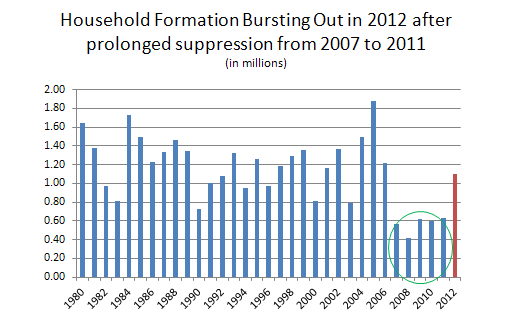
The connection between the first time homebuyer and household formation is something that I have been harping on for a while. CoreLogic talks about it in its latest Market Pulse. Household formation numbers have been depressed ever since 2006, and that has given the illusion that the homebuilders have been building enough starter homes. The problem is that the drop in household formation wasn’t due to demographics – it was due to a lousy economy. If a normal run rate is 1 million new households per year, and we average around 600 for five years, that means we have roughly 2 million new households in pent-up demand, along with the normal demand. Of course as the economy improves, many of these households will become renters first, and not first-time homebuyers. But what sort of housing start number will we see in the future to accommodate this demand? Remember, 1.5 million starts is “normalcy.” Certainly not the 1 million print we saw last week. Probably closer to 2 million. Think about the homebuilding stocks on double the activity…

Chart Household Formation:

Image