This is not lobbying

Taking advantage of the pension system

I’m quoting liberally here from the story:

Two lobbyists with no prior teaching experience were allowed to count their years as union employees toward a state teacher pension once they served a single day of subbing in 2007, a Tribune/WGN-TV investigation has found ….. The legislation enabled union officials to get into the state teachers pension fund and count their previous years as union employees after quickly obtaining teaching certificates and working in a classroom. They just had to do it before the bill was signed into law.

… His pay for one day as a substitute was $93, according to records of the Illinois Teachers Retirement System … based on his salary history so far, he could earn a pension of about $108,000 a year, more than double what the average teacher receives …. stand to receive more than a million dollars each from a state pension fund …. A spokesman for the Illinois Federation of Teachers emphasized that the lobbyists’ actions were legal and that they made “individual decisions.”

End quote.

Here are two guys who clearly took advantage of a situation. What I don’t get is the defense from the union. The tone-deafness of that quote is astounding to me.

Would you like a massive taxpayer subsidy with that?

The Post runs a “5-myths” feature in the Sunday Opinion section. I was excited to see this one on healthy eating, as it an issue that cross-sects health care policy and the dreaded nanny state stuff that gets people excited. I also wanted to link to a non-Reason source for a change. But then I noticed the writer works for Reason. Crap.

Seems like all the rage in the anti-obesity efforts are “food deserts” and encouraging exercise. For example, the First Lady’s “Let’s Move” campaign addresses both of those topics.

I think the impact of “food deserts” are overstated. And I think we won’t make any progress in having a more fit society until we deal with what is driving it: federal agriculture policy, subsidies and price supports.

We can spent loads of time, effort and resources in encouraging and promoting healthy food and exercise habits. When those efforts fail, and they will, we can take a different approach and start banning and taxing unhealthy foods, a tactic that tramples all over personal and parental responsibility and is more about about raising revenue than discouraging consumption. Because, as the man says:

So taxpayers are funding cheap food, which gets us fat, so we in turn get lectured to about better choices and exercise. And when that fails they ban the stuff or tax us more.

Based on some basic research and a few documentaries, it seems that back in the 1970s agriculture policy shifted to put an emphasis on cheap food, and more specifically, cheap calories. Obviously there are a lot of factors at play here, but I’d encourage you to take a look at this Health Affairs commentary from last year: Agricultural Policy And Childhood Obesity: A Food Systems And Public Health Commentary Elsewhere, the author was quoted as saying: “What we’ve done is create a generation of kids who are both overweight and undernourished because the calories they’re getting are not good ones.” Heckuva job, brownies*.

My knee-jerk reaction is to end the subsidies, but the author here offers a more balanced approach. That’s my answer for everything anyway, but I’m certain we aren’t entitled to artificially cheap beef and soda.

After all, it’s all things in moderation.

*If someone asks if there are nuts in the brownies, you can say no. There is price supported sugar or artificially cheap high fructose corn syrup.

iPad or Light Bulb?

The Post this weekend looked at the light bulb issue and the phase out of incandescent bulbs. What was interesting to me was the marketing campaign that is going to be deployed: convincing Americans that light bulbs are durable goods and not disposable items:

Philips is hoping to persuade consumers to view the LED bulbs as a durable good like an iPad, a TV or a car rather than a disposable good such as Kleenex, pencils or toilet paper. That way, people might be more inclined to pay $300 for 10 to 15 LED bulbs for a house energy and lighting upgrade, instead of just grabbing incandescents at $2 a box as needed.

“We’re used to thinking of light bulbs as a replacement business,” Crawford said. “Transitioning our mind-set is absolutely a business challenge.”

Or, you can do what I’m planning on doing. Stockpiling. And then, when the time is right, profiteering.

KW, the first one will be free of course. I know you’re already hooked.

See more at The Washington Post

Job Creation Ideas

I’m late on a bunch of stuff, but wanted to post this for the good of the order.

“‘Jobs’ are deals between workers and employers, and so ‘creating’ them out of unwilling parties is impossible. The state, though, can outlaw deals, and has,” Deirdre McCloskey is a professor of economics, history, English, and communication at the University of Illinois at Chicago

This, and other job improvement suggestions, available here for your review and discussion.

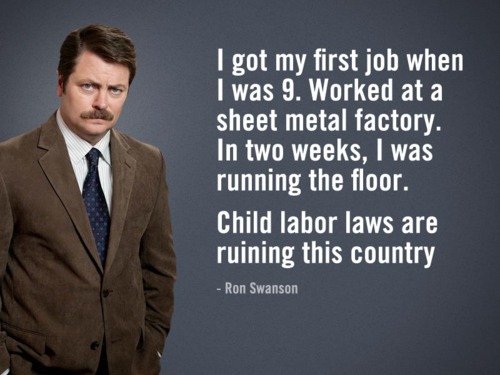
And for a little Friday fun, everyone’s favorite sit-com libertarian Ron Swanson:

The 4th and Cell Phones

California Gov. Jerry Brown has vetoed legislation that would have required police to obtain a warrant before searching a mobile phone belonging to someone they have placed under arrest. Wired is reporting that essentially anything on your phone — and by extension “the cloud” — is subject to search if you are arrested in California. See more at Wired

I’m not that tech savvy, but you better believe I keep my phone locked. And if you have nothing to hide? Three felonies a day: vague and broad federal laws have made honest citizens into federal felons.

This gives me the creeps. But I do know that this just reinforces my belief that I’ll never talk to the police without a lawyer present. Details on that here.

Update: For your holiday shopping

Procedure Rules!

A couple of years ago as part of my master’s program I took a parliamentary procedures course. It was taught by a guy who works for the Congressional Research Service, which is part of the Library of Congress. The staff there does policy and analysis work on behalf of individual members. It’s kind of an odd little shop in that they don’t post their reports publicly. They kind of become the property of the requesting member of Congress, who then can release them publicly. There’s a site, Open CRS, that posts the reports that it’s able to obtain. CRS believes its mandate is to serve members of Congress and not the public, so it has fought effort to publicly release it’s data.

So, the next time you’re looking for what GAO or CBO are saying about an issue, head over to Open CRS to see what they’ve done.

The other thing about CRS, is that quite a few staffers are parliamentarians. They know every procedure and rule inside and out and the history behind it. The class I took on procedure was fascinating, as was the man who taught it. I think he’s retired now, but he had been with the CRS since at least LBJ’s time in the senate.

I missed whatever happened on the senate floor last night with the so-called “nuclear” option so I can’t comment on that, other than I don’t think you can abuse the filibuster as a rule and I think minority rights are paramount.

But I’m positive each side had CRS whispering in its ear, like the offensive coordinator calling plays into to quarterback.

I’ll close with a little tidbit from the procedure’s class prof on getting legislation through Congress. “You take policy and I’ll take procedure. And I’ll kick your ass. every. single. time.”

MedPAC Tease

I’ve been promising lmsinca a post on MedPAC for quite some time. They’re meeting again next week and will have a session (benefit redesign) that I think will be of more interest. So I’m going to combine the two meetings into one post.

Until then, a little nugget:

Just like the rest of the program, a small percentage of Part D (the drug benefit) beneficiaries account for the majority of program spending. For Part D, 8 percent account for 40 percent of total spending and 20 percent of the total prescriptions. In 2009, on average the “high-cost” beneficiary filled 111 prescriptions over the year. Each prescription cost an average cost of $110. The lower-cost beneficiaries, by comparison, filled 41 prescriptions at a cost of $42 each during the same time period. “High cost” tended to use more brand-name drugs (as opposed to generics).

It’s the same story over and over. There’s a small percentage of beneficiaries who are the cost drivers. Until we figure out how to control costs in this area the rest is rearranging the deck chairs.

Also, Medicare is estimated to reach six percent of GDP by 2040, and the Hospital Insurance Trust Fund will be unable to pay full benefits after 2024. That’s 13 years from now. The growth in expenses means that a beneficiary’s average out-of-pocket costs will increase faster than Social Security benefits.

Update: Slight edit to answer lms’ clarifying question.

Update II: A lot of criticism regarding Part D is directed at the non-interference clause, which prohibits the government from direct negotiation. Repealing this would have a negligible effect, according to CBO. Part of the reason is that it would not be a true negotiation, because the biggest tool the government could use, a restrictive formulary, is left off the table because it’s a political nonstarter. Also, before the MMA was enacted various prescription drug bills were kicking around congress for many years. The vast majority of them — republican and democratic — included this provision. As it stands, drug manufacturer negotiate with the prescription drug plans, who have every incentive to get a good deal. But again, they’re hamstrung by the requirement to have very inclusive formularies. In some class of drugs they’re required by law to include the vast majority of the available prescriptions — in every therapeutic category its at least 2 drugs.

Regarding re-importation, the law gives HHS the authority to do it, provided that the department can certify it can be done safely. FDA is worried about counterfeit drugs, tampered drugs, etc. There’s also the R&D argument. Haven’t spent too much time on this issue, but the NIH looked at it a few years back. Personally, I think it’s a band-aid approach to more systemic problems in the overall health care system.

Rep. James Clyburn (D-SC) Gets It

“Because if you are not going to get it done, what’s wrong with going down swinging?”
– Rep. James Clyburn on President Obama’s recent address to the Congressional Black Caucus.

See more at FDL

Four Boxes of Liberty: Power of the Jury

I’m sure everyone here is familiar with the saying regarding the “four boxes” of liberty: soap, ballot, jury and ammo. I’ve been thinking a lot about number 3 and how it’s an under-utilized way to check government power. In fact, I think it might even be the best way. I’m specifically talking about the idea of jury nullification. The refusal of one’s peers to convict a fellow citizen if the law is unjust or the government abused its powers.

Obviously, the government doesn’t like this and is going everything it can to keep the idea from spreading, including dismissing from jury duty those who would question the law and arresting those who would distribute leaflets on jury rights. (I’ll edit this later with links).

I’m curious as to what others would do. If advocacy is ineffective and you’ve failed at the ballot box, to what extent should the jury box be used? Personally, absent violence, I’m not voting to convict someone on a drug possession charge. You can go beyond the war on drugs too. Prosecutors are bringing wire-tapping and related charges against those who record police officers. The only way around that, as I see it, is a string of acquittals, as no politician is going to run on a platform that is perceived to be “soft” on crime.

See more at Fully Informed Jury Association.

Billionaire Wants Ideas on Job Creation — Offering Cash

Saw this over the weekend. Basically, this billionaire wants to move beyond simple charity to put his money to use in efforts that will lead to job creation and a more lasting effort. I think it’s kind of a “teach a man” vs. “give a man” idea.

But, he’s got an email address and is soliciting ideas. Perhaps a group letter is in order?

See the column here

Late edit: Obviously he should pay us to post on this blog.