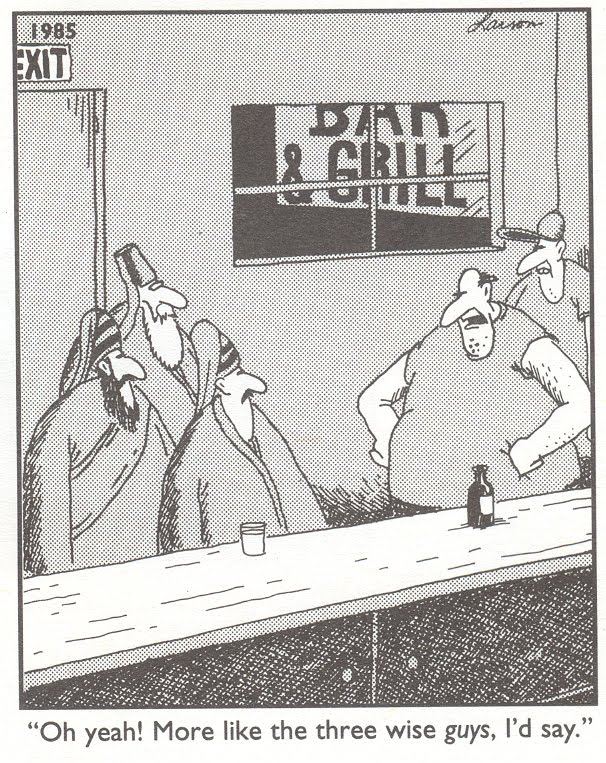
Supreme Court: No Nativity Scene


It’s a joke, but it’s making the rounds at the office today:

Supreme Court rules no Nativity scene in DC

This isn’t for any religious reason. 

They simply have not been able to find Three Wise Men in the Nation’s Capitol.

A search for a Virgin continues.

There was no problem, however, finding enough asses to fill the stable.

And with that, I’m off to pass the Occupy DC barricades to find my son at daycare and get home.

Minimum Pricing and Regulatory Caputure

This story has it all — protectionism and regulatory capture at the expense of honest-to-goodness free market competition. Big limo companies didn’t like the fact that some upstarts were offering the same service for the price of a cab ride. Can’t compete on price? Pass a law requiring the competition to charge more.

Here’s the key point: “Prior to the new laws, Tennesseans could purchase transportation from downtown Nashville to the airport in a limo or sedan for the same price as an average taxi ride. Nashville residents and visitors will now pay almost double for the same service. Nashville folks in need of an affordable ride, and drivers looking to earn an independent living in a sagging economy, join a long line of people caught on the wrong end of a nationwide effort by big car services to squeeze extra profit by regulating competitors out of business.”

Peruse the comments at the link below if you dare. What really, if you’ll excuse the phrasing, chaps my ass, is that this is viewed as a free market failure.

Example: “This regulation kills free market competitio­n from Limo companies who might be willing to do the job for less now doesn’t it. That is Capitalism at work, if you can’t compete or just control or manage a market, maybe increase profits you buy yourself some legislatio­n to kill competitio­n.”

Sigh.

More from Huffington Post

The Honorable Lindsey Graham


Sen. Lindsey Graham (R-SC) recently spoke in favor of the National Defense Authorization Act and its provision that allows for indefinite detention of American citizens that are deemed to be terrorist. If you have to ask what classifies you as a terrorist, that sounds like terrorist talk to me. Graham’s justification is that the “homeland” is a battlefield.

I didn’t realize that I live in a battlefield. If that’s the case, then I want to mount a belt feed machine gun on my front porch. And a want an M4.

Anyway, here’s Graham: “It is not unfair to make an American citizen account for the fact that they decided to help Al Qaeda to kill us all and hold them as long as it takes to find intelligence about what may be coming next,” Graham said. “And when they say, ‘I want my lawyer,’ you tell them, ‘Shut up. You don’t get a lawyer.’”

So all it takes to be detained without access to counsel is for the government to deem you a terrorist. They don’t have to prove anything. And Graham, and apparently quite a few, see this as a positive. So maybe I won’t “opt out” of the scan the next time I’m at the airport, because clearly only terrorists have something to hide or a reason to object. The Christian Science Monitor has more.

And don’t let Obama supporters tell you he’s on the right side of this issue. His veto threat is over an executive power issue, not a civil liberties one. He wants to determine the who, what, when, where and why of the detainment without congressional input. That the detainment will occur is not at issue.

When knowing your rights means you’re a criminal

I’m really not up on the legal situation involving medicinal marijuana in DC. My interest in the War on Drugs is more from the civil liberties/police abuse standpoint than any desire (none whatsoever) to actually use drugs.

Check out point four in the police affidavit that was covered by DCist in a recent raid on a local hemp shop that was selling Flex Your Rights, a DVD that addresses your rights during encounters with police:

“Affiant notes that while this DVD is informative for any citizen, when introduced into a store that promotes the use of controlled substances, the DVD becomes a tool for deceiving law enforcement to keep from being arrested. The typical citizen would not need to know detailed information as to US Supreme Court case law regarding search and seizure because they are not transporting illegal substances in fear of being caught.”

It’s the “if you’re innocent, you have nothing to hide” defense. So here’s an officer that consider the Bill of Rights to be a device used to deceive law enforcement. How reassuring for the good citizens of DC.

More on Jury Nullification

Story out of NYC where federal prosecutors have charged a man with jury tampering for handing out literature outside on jurors rights outside of a courthouse. The story explains that the defendant has requested a jury trial, but prosecutors have opposed it, arguing that we would likely ask the jury to nullify. Question for the lawyers … Can the prosecution do that? The defendant is claiming his actions are protected speech, which it obviously is in my opinion.

Story available at the New York Times

GPS is "Fair Game"

Here’s an alternative view on the GPS tracking debate.

“The intense debate the case has already elicited among legal scholars, civil rights and libertarian activists, and those particularly concerned with public safety and national security is largely focused on the question: what would the Founding Fathers have said about the case? As I see it, at least equal weight should be accorded to the question: How well are our public authorities doing in their dealings with criminals? Who needs more tools and who should be denied access to cyber-age technologies if we are to keep a balance between our profound and essential commitments to privacy as well as our security?”

The full editorial is on CNN.

As I have nothing nice to say, I’ll remain silent.

Libertarianism 101

A week or so ago, the Cato Institute launched a new website Libertarianism.org. It’s an introduction to libertarian history and theory. There are videos, essays, white papers and more. I haven’t spent much time on it yet. However, one of the things I found most interesting is that included a section on “Critics of Liberty,” which is a list of books that are critical of libertarian theory.

The site notes: “It’s not enough to be familiar with the major libertarian thinkers and their arguments. A well-informed advocate of liberty must also understand and appreciate the positions of those thinkers who disagree with libertarianism. The works on this list offer a comprehensive introduction to many of the most intriguing, enduring, and forceful attacks on libertarianism—as well as positive arguments for visions incompatible with the philosophy of liberty.”

My plan is to work through the list on the “critics” page. There was one that seems to address the conversation lms was having with Scott (maybe QB?) on the individual versus the community: Liberalism and the Limits of Justice by Michael J. Sandel. According to the blurb, this discusses communitarianism, which holds that individuals can only be understood as members of a community and that the community, not the individual, should be the focus of political theory.

I’m posting this because I thought it was an interesting site and I’ve never seen one that so openly acknowledges dissenting viewpoints … other that ATiM of course.

And, because it’s Friday, here’s Ron

Update: Come on lms, you know you want to come to the dark side.

MedPAC: Benefit Design Options

MedPAC met about a month ago and I’ve been promising a post since well before then. Out of all the sessions at that meeting I think the one on benefit redesign is of the most interest. The full agenda is here and if there’s another issue you’d like to know more about, let me know.

Under the current cost sharing system, in 2009, about 40 percent of Medicare beneficiaries had cost sharing liabilities of less than $500. Six percent of beneficiaries had cost sharing liabilities of more than $5000 and two percent of beneficiaries had cost sharing liabilities of $10,000 or more. These amounts represent the liabilities for the beneficiaries and not actual out-of-pocket expenses, which may have been covered in whole or in part by supplemental insurance. MedPAC will be presenting data on how Medigap effects cost sharing at its next meeting, which is Thursday.

The staff presented a number of alternatives benefit designs to address the flaws in the current benefit structure.

One alternative, called the “coinsurance package” would combine the Part A and B deductible into a single $500 deductible along with 20 percent coinsurance on all Medicare services, including hospital services. Based on a simulation that used data from more than 20 million beneficiaries, the staff concluded that such a benefit structure would raise the average cost sharing liability from $1350 to $1550.

A second option and third options presented are based on a copayment approach. The first approach based on Medicare Advantage features a $5000 out of pocket maximum and a $750 Part A and Part B combined deductible. The other option has a $5000 out of pocket maximum and a $500 deductible. Both of these packages include a $600 copayment per hospital stay, a $20 copayment for physician visits, a $100 copayment for outpatient visits, and a $100 per day copayment for skilled nursing. The options also include a 20 percent coinsurance on durable medical equipment and 5 percent coinsurance on home health.

Because of the out-of-pocket maximum, most beneficiaries would have their liabilities change by less than $500 compared to the current system, while some beneficiaries would have liabilities either increase or decrease by $1,000. For the next MedPAC meeting, the staff will present data on the effect of supplemental coverage on cost sharing liabilities for the alternative benefit models.

This is a key point and one the commissioners spent a great deal of time discussing. There was pretty broad support for changing the overall benefit structure and even more support for reforming Medigap, which is at both times incredibly popular with beneficiaries and typically held responsible for hiding and shifting costs.

It creates a catch-22. Beneficiaries are concerned about the potential for high out-of-pocket coinsurance requirements under the standard Medicare plan, so they buy supplemental policies that help hide that cost, but they pay for it in higher premiums. Paying more to save more — but maybe not.

The other interesting thing that happened was one of the commissioners made the point that health insurance is a financial product. This just isn’t really discussed. “If you’ve got nothing to protect … you don’t buy insurance.” He added that “nothing about insurance makes any sense if you don’t have anything to protect.” But, the reason people are buying these polices and paying the premium is that it gives them the ability to plan and some protection against the unlimited costs they could incur under the traditional fee-for-service Medicare benefit. This came up in focus groups that MedPAC conducted. People liked being about to plan their expenses and the theoretical unlimited cost sharing requirement is of concern. While only 2 percent of the Medicare population incurred liabilities of $10,000 or more, that’s almost 10 million people. I expect to have data on their actual expenses by the end of the week.

My thinking on this is that traditional fee-for-service Medicare is not a system worth defending. In the past one of the commissioners called it “chintzy.” By not offering true protection, it forces those with the ability to buy supplemental policies, which in turn shift care costs around and helps drive utilization. Those who would “end Medicare as we know it” should embrace that.

The slides used during this presentation are here.

Rant from a Gen Xer

Generation X says shut your pie hole.

I’m passing this along because I tend to enjoy generation generalizations. There’s some truth to them or they wouldn’t hit so close to home. If not, whatever.

And here’s the supposed Gen X anthem, like there’s anyone who really speaks for us.

GAO on Health Care Price Transparency

GAO is out with a report on the difficulty of making health care pricing transparent to consumers. I haven’t ready it yet, but I know this is of interest to several of you, so I’d thought I’d pass it along. I also know I’m way late on a MedPAC post, which I’m working on simultaneously with my client work.

GAO Report on Health Care Price Transparency