Note that police did NOT crush the protest…is Putin losing his stranglehold?

From The Economist:
Protest in Russia
A Russian awakening

AFTER several days of tension, clashes and arrests following Russia’s rigged parliamentary election (http://www.economist.com/node/21541455) on December 4th, yesterday something unexpectedly good happened. Tens of thousands of middle-class Muscovites held a peaceful rally in the centre of Moscow, the biggest such event since the early 1990s.

Astonishingly, there was not a single arrest. Indeed, some of the thousands of
policemen and interior-ministry troops showed sympathy for the protestors.
This was an uplifting display of both dignity and indignation. Citizens were riled not
only about the electoral fraud, but at being treated as imbeciles by their leader,
Vladimir Putin. There was anger at the Kremlin, calls for “Russia without Putin” and
against the ruling United Russia party (“the party of thieves and crooks”), but no
aggression. The crowd contained not only liberals but also Communists, anarchists
and some nationalists. But protestors were almost conspicuously polite towards each
other.

Some carried white flowers, which they tried to give to the police. They made jokes.
146% of Muscovites are for free elections one sign read. Another said: I did not
vote for these bastards. I voted for other bastards. I demand a recount.


The speakers included liberal politicians, such as Vladimir Ryzhkov and Boris Nemtsov,
but also Boris Akunin, a famous writer, and Leonid Parfyonov
(http://www.economist.com/blogs/easternapproaches/2010/11/russian_media) , a
celebrated television journalist. They demanded the immediate release of more than
1,000 political activists arrested during last week’s protests, a full investigation into
electoral fraud allegations, a new election, the sacking of Vladimir Churov (head of the
electoral commission) and the registration of all opposition parties, not just the ones
sanctioned by the Kremlin.

The government is unlikely to meet any of these demands. But the rally has already
achieved its most important result: the political awakening of Russia’s urban middle
class. Over the past decade these people have devoted their energy to making
money, consuming and travelling, allowing Mr Putin to consolidate unprecedented
power, eliminate alternative sources of influence and turn television into a tool of
propaganda.

But yesterday the protestors showed themselves to be a political force. “We exist! We
exist!” they chanted. They were educated and affluent—many of them carried iPads—
and were keen to make their voice heard. The protest had been organised on social
networks, but yesterday this Facebook crowd turned its virtual agitation into political
reality.

The rally was a rare example of all sides showing sense. The authorities allowed the
demonstration to go ahead and showed restraint in policing it. The organisers went
out of their way to stop provocations and keep the event peaceful. Even the statecontrolled media, which had completely ignored all previous demonstrations and
suggestions of electoral fraud, reported the rally in a balanced and accurate way.
A small group of radicals who tried to hold their own event at Revolutionary Square
were ignored by everyone, including the police. Their leader, Eduard Limonov, bitterly
complained that his revolution had been stolen. But for a few hours yesterday,
Russia’s capital felt democratic, despite the heavy police presence.

Similar, if smaller, rallies were held in some 90 cities across Russia. (Some ended with
arrests). Almost everywhere protestors chanted “Russia”. This is what United Russia
members were encouraged to do by Mr Putin at their recent party conference. But
yesterday it had a very different sound, and it was a very different Russia.

Gay Rights from some differing perspectives

Ruth Marcus tells us that gay marriage is good politics.   William Baude, in his maiden voyage at Volokh, gives us some insight into the complexity of purely legal issues regarding marriage, gay marriage, and DOMA.  Baude continues tomorrow for those inclined to follow legal arguments, as I am.

Were I a state legislator, I would vote to legalize gay marriage in my state.  As a federal constitutional issue, despite my idea of what good politics is, I would be very hesitant to impose an “equal rights” argument.  Not because that argument has no appeal for me, but because marriage itself is not a constitutional issue.  I full well know that Loving made it one in the case of race, and I think that was justified on 14th A grounds, from the historical perspective.  But that does not necessarily apply to all other conditions of distinction.

So now I will tell a funny story about an old war I lost in Austin.

In the late 70s and early 80s I represented Braniff’s then wholly owned Driskill Hotel.  Did their employment stuff, mainly.  Well, gay activists began dancing mano a mano and femme a femme in the 1886 Club, and Braniff wanted it stopped, because it pissed off the pilots who always frequented the club.

The hotel’s manager, to whom I directly answered, was gay, and had not thought about it until the big cheeses in Dallas came down on him.

Austin had just passed its first anti-discrimination law based on sexual orientation or preference.  I advised my client to quietly break up all same sex dancing couples and offer them a free drink or an escort out of the club, setting up the confrontation.

The City prosecuted.  We went to trial before a jury of 6.  The City was represented by its own attorneys and a volunteer from a SF, CA Gay Rights organization.

On cross examination, I elicited testimony from the dancing gays that each could have physically chosen to dance with someone of a different gender.  Some had done so – mano a femme gay dancing.  Thus I was able to obtain the admission that it was not their sexual orientation that kept them off the dance floor.

On my defensive case, I put on a gay dance instructor from Arthur Murray who explained that he was gay, but that he taught traditional dance, with steps, patterns, and a lead and follower role.  He said that in traditional ballroom dancing, a male and a female were the dancers.  I had set up the prosecution to ask more questions, and they did.  They crossed my “expert” by asking him to admit he would prefer to dance with a man.  He answered that he preferred sex with men, but formal ballroom dancing was not about sex, it had rules.  He preferred to dance with women, otherwise it was not dancing.  He  persisted in saying that same sex dancing was not about dancing, but about sex.  He allowed as how PDA is offensive.  The more he spoke, the more the jury giggled.  I thought that was a good sign – they obviously liked the guy. The prosecutors asked about Middle Eastern formal dancing, with men only.  My expert brightened up and said if that was what 1886 Club had prohibited they would be wrong, because that was traditional dancing.

They had no experts on dance.

Lost 6-0.  Liberal Austin jurors were not buying.  Politically, same sex dancing had come to  Austin.  I thought I had made a record for appeal, however, and told the manager.  He said he was happy to have put up a good fight but happy to have lost [not to tell that to Braniff, however].  And so it went.

If This is a Pander, to Whom, and Why?

I can’t figure this one out.

FDA says the morning after pill is AOK safe for fecund females under 18.  Sebelius overrules FDA and says that under 18 needs a scrip.

Pandering:
 to parents?
To pro-lifers?
To wanting to birth more unwanted children from single teenage mothers because 18 years later they might vote D?

The distinction between a customer for this product and non-customer is not age related, it depends on whether one thinks oneself pregnant.  That should not be age related, in a pragmatic world.  In a political world there are other considerations.

But what are they, and how do they redound to BHO’s imagined advantage with this decision?

One of you might hit on an answer that will seem obvious to me after the fact.  I have run through his voting blocs in my mind:  youth [no], affluent upper middle class females [no], Jews [no], African Americans [no], Latinos [?], indies who like his FP [no].  I do not think Chicano voters will be moved by this, but maybe other Latinos?

Who will be pissed off?  Women and yutes.

What am I missing?

When a Judge Nixes a Settlement on Principle…

he may buy a trial he did not want.  Usually the parties know what they are doing when they settle.  A Federal Judge should be very cautious in rejecting settlements.  Citigroup may turn out to be a case in point.

The SEC concedes its case against Citigroup is weak.

Florida denies resident college tuition to Americans whose parents are undocs

Sins of the Parents

Linda Greenhouse
Linda Greenhouse on the Supreme Court and the law.
In the current race to the bottom to see which state can provide the most degraded and dehumanizing environment for undocumented immigrants, Arizona and Alabama have grabbed the headlines. But largely unnoticed, it is Florida, home to nearly one million Cuban refugees and their descendants, that has come up with perhaps the most bizarre and pointless anti-immigrant policy of all.
Beginning last year, the state’s higher education authorities have been treating American citizens born in the United States, including graduates of Florida high schools who have spent their entire lives in the state, as non-residents for tuition purposes if they can’t demonstrate that their parents are in the country legally.
Yes, you read that correctly – although when I first came upon a description of the policy a few weeks ago, I was sure that I had misunderstood something. It’s a basic tenet of equal protection law that the government can’t single out citizens for disfavored treatment without a good reason. The Supreme Court is serious about this, even ruling unanimously a decade ago that an Illinois village violated an individual homeowner’s 14th Amendment right to equal protection by demanding from her a bigger easement than it required of her neighbors as the price of connecting her home to the municipal water supply.
A few feet of land more or less may not have made a life-changing difference to the plaintiff in that case. But consider the difference between in-state and non-resident tuition at the University of Florida: $5,700 a year versus $27,936. The disparity is similar at the state’s community colleges, although the price tags are lower. It is the difference between a college education and none.
It seems grossly unfair, as the Supreme Court acknowledged 30 years ago in Plyler v. Doe when it held that Texas could not deprive undocumented children of a free public K-through-12 education, to blame children for the wrongdoing of their parents. Unfair and, as Justice Lewis F. Powell Jr. observed in his concurring opinion, socially self-destructive, in creating a permanent underclass of uneducated people. (Alabama has observed the formalities of the Plyler opinionby simply trying to frighten undocumented parents into keeping their children out of school; if the decision were not on the books, that state would undoubtedly have shut the schoolhouse doors by now.)
The Supreme Court has never extended the Plyler opinion to give undocumented children rights to higher education. Alabama bars them entirely from its public universities and colleges, as does South Carolina. Other states permit them to enroll while denying the in-state tuition break, while a dozen states, including – famously—Texas, treat them as residents, entitled to in-state tuition rates.
That policy debate is ongoing, but the Florida situation is something deeper and uglier. Its victims are, after all, American citizens, as fully American as Rick Scott, Florida’s scary governor, who said last month that the state’s universities should focus on practical subjects that create jobs rather than on the study of such subjects as political science, psychology, or anthropology. (“We don’t need them here,” Governor Scott said of anthropologists. University students in Florida are circulating petitions to have the governor’s name kept off their diplomas.)
The students who filed a lawsuit last month challenging the policy are as American as Senator Lindsey Graham, the South Carolina Republican who is leading a campaign to amend the Constitution. He and his allies would repeal, for the children of undocumented immigrants, the 14th Amendment’s grant of “birthright citizenship” (“All persons born or naturalized in the United States, and subject to the jurisdiction thereof, are citizens of the United States and of the state wherein they reside”). The Florida policy – it’s not even a statute, but simply an interpretive rule adopted by the state’s Board of Education and its University System, taking many college administrators and enrolled students by surprise – amounts to repeal of birthright citizenship by regulation.
“Corruption of blood” was a familiar feature of the common law in England. A person found guilty of treason and certain other crimes would be barred from passing his estate on to his children, who would thus inherit nothing but the corrupted blood line. The framers of the United States Constitution considered and forcefully rejected the concept. Article III, the judiciary article, contains this sentence: “The Congress shall have power to declare the punishment of treason, but no attainder of treason shall work corruption of blood, or forfeiture except during the life of the person attained.” As James Madison expressed the thought more directly at the time, the purpose was to prevent Congress “from extending the consequences of guilt beyond the person of its author.”
Nor were the founding fathers content to leave the matter there. Going beyond treason, Congress enacted a law in 1790 to provide that “no conviction or judgment . . .  shall work corruption of blood or any forfeiture of estate.” Although not in so many words, the principle that guilt is not inheritable lay behind the modern Supreme Court’s gradual recognition of rights for children born out of wedlock, deemed by society to be “illegitimate.”
The lawsuit filed last month in Federal District Court in Miami by the Southern Poverty Law Center asks the court to do the obvious: to rule that Florida’s “policy and practice of classifying dependent United States citizen students who reside in Florida as ‘non-residents’ based on their parents’ federal immigration status denies these United States citizens equal protection of the laws in violation of the 14th Amendment to the United States Constitution.”
The lawsuit, which seeks class-action status on behalf of “all past, present, and future United States citizens” affected by the policy, names five individual plaintiffs. Two were forced for financial reasons to withdraw from Miami Dade College when the policy took effect. Two others can’t afford to take all the credits necessary to complete their degrees on time, and one, who would have received a full scholarship as a resident, couldn’t afford to enroll at all. Four were born in Miami and one in Los Angeles. All are eligible to be president of the United States.
The complaint hasn’t yet been formally served on the state, so it’s not clear what defense Florida will come up with. Bills to overturn the policy were filed within the last few weeks in both houses of the Florida Legislature. If the state is lucky, one will pass and take it off the hook. The State Senate sponsor, Rene Garcia of Hialeah, is a Republican and chairman of the Florida Hispanic Caucus. “When you’re an American citizen, you’re an American citizen,” he said.

CPA Sex – it’s not just for accountants!

From Herman Cain’s attorney, describing the new allegation:

This is not an accusation of harassment in the workplace – this is not an accusation of an assault – which are subject matters of legitimate inquiry to a political candidate,” said attorney Lin Wood, who Cain hired after several sexual harassment allegations surfaced against him earlier this month

Rather, this appears to be an accusation of private, alleged consensual conduct between adults – a subject matter which is not a proper subject of inquiry by the media or the public. No individual, whether a private citizen, a candidate for public office or a public official, should be questioned about his or her private sexual life.

I wanted WJC to resign because he diddled a WH clerk.  It was their relative power positions in that workplace that  motivated my thinking, not the infidelity itself, about which I had no opinion for public consumption, nor was I impressed with his misdemeanor false swearing under oath in a deposition about an immaterial subject.

In theory I agree with Lin Wood, but the news loves S-E-X and I am sure there will not be a public outcry to protect the privacy of anyone in public life, ever.  Of course, one party here made her conduct quite public, for whatever reason, so the genie is out of that box, so to speak.

In theory, do you agree with Lin Wood?  I am curious how many  of us think consenting private adult [cpa] sex is not a legitimate ground for inquiry.

Driving back from Santa Fe

We drove through the world’s largest windfarm after we left Sweetwater.  The 2.833 year old twins were fascinated.

Austin’s two lowest cost sources of energy are natural gas and wind, followed by coal.  The City is trying to replace all its coal based use.  Wind produces about 17% of Austin’s energy, I think.  Austin also has built a large solar facility but it can supply only about 1% of capacity and costs four times as much as gas or wind.

The City’s insistence on solar projects is controversial because they will produce energy over a twenty year period projected to drop in cost comparison from four times wind to twice wind, but never be as cheap as wind.  The City justifies solar projects on a few grounds – diversity of clean sources, a boost to tech companies in and coming to Austin, and the fact that the sunniest days are the least windy.   Further, Austin does not have local wind generation capacity and buys from wind farms either in the west or on the Gulf.  Austin does have enough sunshine, and the local City owned sun powered 30MW generation plant opens in a few weeks.

Austin owns land in west TX that I thought was going to get dotted with wind generators.  I now read in this morning’s paper that the city utility wants to build 3 huge solar arrays that will potentially provide 10% of capacity.  I assume that would be instead of wind generators.

The city utility subsidizes rooftop solar panels but is leery of them in the long term.

I am not an opponent of experimenting with solar on a small scale, albeit large enough to sustain slow development, until it becomes cheap.  The local solar plant made sense to me in that regard.  But wind is so cheap that for coal replacement nothing else makes current $$$ and sense [except NG].  Like Boone Pickens, I think NG is the mobile fuel of choice in the near future, so I would go for more wind in the stationary source market.

What are the down sides of wind farms?  The prop blades are tough on birds that do not adapt by flying higher.  The ground vibrates.  The props make some noise.  The high plains from Sweetwater, TX to N.Dak. are wind central but the transmission lines are not in place and must generally be routed hundreds of miles to population centers.  Wind speeds are high enough over the Great Lakes and the coastal waters for generators, and can be placed close to coastal or lakeside population centers.

A political note:  our Land Commissioner is the daddy of windpower in America.  A staunch conservative R, I vote for him every time.  He saw that it would be cheap, a boon for underutilized mesas in TX, and that it could help sustain the economy many years ago, and subsidized its development until TX now has far and away the most wind generated power in America.  I think we will have enough to support one third of the homes in TX within two years.

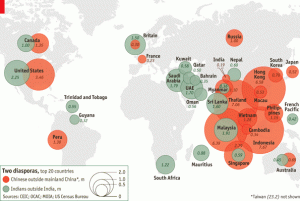
2 Diasporas

Courtesy of The Economist.

Do the Twins get SS Survivors’ Benefits? I Report, You Decide

Capato v. Commissioner was decided in favor of the twins in the Third Circuit and the Supremes have granted Certiorari.

This is again a case where science may be outrunning the law as written.  Here is what happened:  Mr. Capato was dying of cancer.  He and the Mrs. preserved his seed for later use.  He died.  She then conceived, 18 months after his death, by IVF, twins;  his biological children, no doubt.

On behalf of the twins, Mrs. C. filed for SS survivors’ bennies.
The claim was administratively rejected, then rejected by a USDC.
The 3d Circuit reversed and remanded for a fact finding.

This is a statutory, not a constitutional, case.   I believe the Supremes can reverse and render the Circuit, from my reading of the statute, and I am dubious as to the relevancy of the case law the Circuit cited.

The relevant part of the statute as quoted by the Circuit:

…the child (a) must have filed an application for benefits, (b) must be unmarried and less than eighteen years old (or an elementary or secondary school student under nineteen), and (c) must have been dependent upon the deceased individual at the time of his or her death. Id. §§ 402(d)(1)(A)-(C). [at p. 6].
************************************
The Circuit remanded to the District Court for a fact finding about dependency:

…are the undisputed biological children of a deceased wage earner and his widow children, within the meaning of the Act? The answer is a resounding ―Yes.‖ Accordingly, we will vacate the order of the District Court in part and remand for a determination of whether, as of the date of Mr. Capato‘s death, his children were dependent or deemed dependent on him, the final requisite of the Act remaining to be satisfied.6
********************************************

HOW can a fact finder deem the children conceived 18 mos. after his death to be dependent upon him at the time of his death, when they did not exist in any sense of the word?  Seems to me these twins are cut off as a matter of law.

This Court did seem to claim that these children were protected under a “liberal construction” of the law, and here that is not a political statement but a reference to a statute that is supposed to be interpreted liberally in favor of the beneficiary, in its own terms.  I quote:

The purpose of federal child insurance benefits is not to provide general welfare benefits, but to replace the support that the child would have received from his father had the father not died.  Jones ex rel. Jones v. Chater, 101 F.3d 509, 514 (7th Cir. 1996) (citing Mathews v. Lucas, 427 U.S. 495, 507-08 (1976)); see also Adams v. Weinberger, 521 F.2d 656, 659 (2d Cir. 1975) (the purpose of the Act is to provide support to children who have lost actual‖or anticipated‖ support). In general, the [Act] is to be accorded a liberal application in consonance with its remedial and humanitarian aims. Eisenhauer v. Mathews, 535 F.2d 681, 686 (2d Cir. 1976).
********************************************
To me, either they are protected under this liberal interpretation of the law as a matter of law, or they are not, as a matter of law.  I think they are not, but most important from my view is I do not think that there could be any relevant facts that bear on the decision.  It must be a matter of law, IMHO.

Ashot?  QB?  Any thoughts?  If the Supremes took this one, they must have something to say.

The Mortgage Electronic Registry System (MERS)

This investigative report points to a secondary crisis.

Here’s how MERS works: A lender that holds a mortgage can sell that loan to another lender. MERS does not make loans or service them, but only tracks the loan information.  No problem.


Here’s how the registration of real property ownership and liens work:   our entire real estate ownership system is based on public notice and the proper recording of documents.  No problem.


Title companies and lenders, investors, builders, sellers and buyers, and taxing entities depend on this county clerk based public filing system of land and mortgage transfers.  No problem.


Here’s how the two systems do not work together: MERS claims it is the agent for holding the loan regardless of which of its clients have bought and sold it, and in Travis County alone we now have hundreds of thousands of unrecorded mortgage transfers.  BIG PROBLEM.


MERS is said to have facilitated the financial system’s commoditization, packaging, securitization, and sale of tens of millions of mortgages.  That does not seem too likely to me.  But I do see the subversion of the filing process as taking years to correct, and many millions of dollars, and I see it as a brake on the return of a healthy real estate market until it is corrected.