

 Brent Nyitray
 Fairlington Blade
 Let the mutherfuker burn!
 jnc4p
jnc4p Kevin S. Willis
 Michigoose
 lmsinca
 markinaustin
 Arcanaut
 novahockey
 quarterback
 ScottC
 yellojkt
Our brains exist to enable motion. At least, that’s what Daniel Wolpert thinks.

Filed under: Uncategorized | 5 Comments »
Filed under: Uncategorized | 5 Comments »
What’s money really worth? The dollar value of the metal in coinage.
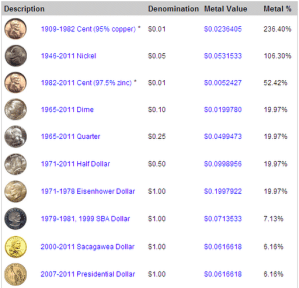
Yes, McWing, I picked this up from Ace of Spades. How much does it cost to print a dollar bill, and how much of what is in circulation? There’s a lot in circulation, and in 2011 it costs about 9.1 cents per note.
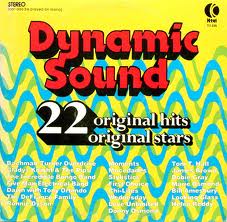
IN 1974, K-Tel released a compilation album (both on vinyl and 8-Track) called Dynamic Sound. I’ve got a Spotify list that reconstructs that album’s playlist, but not the fade and ka-chunk of the 8-Track switching tracks (there is an iPod/iPhone app that I believe does this). You have to have Spotify to listen to it, however. I don’t pay for the mobile and other features, but the free account is teh awesome.
Why did I do that? Because K-Tel’s Dynamic Sound has never been available, since original release, yet I listened to that eight track a hundred times between ages 5 and 10. It, along with the soundtracks to the broadway musicals Hair and Jesus Christ: Superstar, were as formative as any of my other music. And my sister listened to it a lot, and I thought it might make a nice Christmas gift to put it altogether for her. It’s interesting to listen to something you heard a hundred times as a kid, but includes songs that I literally have not heard since 1978 or so.
If you’ve got Spotify, I also recommend Planet P’s 1931. It’s a concept album dealing with the rise of Hitler. And Tony Carey is an awesome song-writer.

Filed under: Uncategorized | 14 Comments »
Science is awesome. And our brains are complicated. And it’s amazing that we can think with this thing.

Filed under: Uncategorized | 3 Comments »

Filed under: Uncategorized | 15 Comments »
The Chicago Climate Exchange is closing. Founded in 2000 in order to provide an exchange for carbon credits, a market they expected to exist, and amenable to becoming a hyper-inflated asset bubble, due to legislation that (sad to say) never came to be.
“Environmentalist” financiers will just have to find some other way to get filthy rich and leave the American tax payer holding the bag, after the bubble bursts.
Glenn Beck thinks Rick Santorum is the next George Washington. I feel about that assertion the way Lloyd Bentsen felt about Dan Quayle bringing up JFK in the debates. Mr. Beck, Rick Santorum is no George Washington.

Filed under: Uncategorized | 56 Comments »
Another on-set report from the Hobbit. Can’t wait for this film, yet I will be waiting–for another year. But maybe there will be teaser trailer soon?
 |
| Martin Freeman as the young Bilbo Baggins, standing with director Peter Jackson who, after having lost a tremendous amount of weight, is packing the pounds back on. Man, have I been there. |
I’m not sure if any of the theaters in my town will be able to do the 48-frames per second the film is being shot in. 48 frames makes a difference, though—especially with 3D.
Democrats and Republicans can come together and get along and work together in tandem toward a common goal. If that goal is lining their own personal pockets .
Why did Nancy “Republicans don’t believe in public safety” Pelosi block credit card reform? Might have something to do with all that Visa stock she was sitting on. How did Pelosi get in on this sweet deal? We’re not sure, but Big Government is suspicious.
Why is this all coming up now? Peter Schweizer wrote a book. He should be our era’s Upton Sinclair, and his book should be like a non-fiction The Jungle, prompting real and significant long term reforms. However, given that Upton Sinclair was dealing with meat-packers who did not write the laws that governed them, and Peter Schweizer is writing about the folks who write laws with their own convenience often in mind, I’m not holding my breath.
That’s it for tonight, for me. Peace, homeys! — KW

Filed under: Uncategorized | 30 Comments »
The following was written by John. Since he refuses to become an administrator, I must post it for him. But sometimes there are comments that ought to be above-the-fold posts.
 |
| AP Photo/Carolyn Kaster, via espn.go.com |
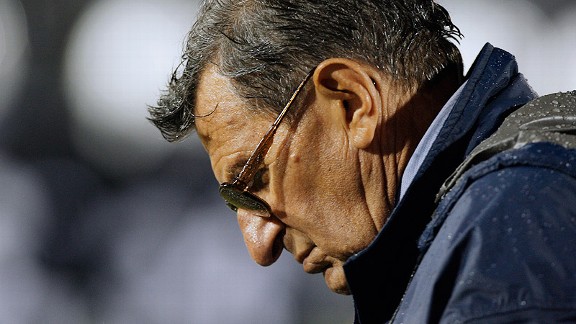
In an odd reversal universe, I will now become a Penn State fan again.
As an alumni from the late 70’s, I used to sit 4 rows behind Joe Paterno at Mass in Eisenhower Auditorium on Sunday. Back then he was just a terrific football coach, and good man all around. Something happened in the last 10-12 years or so, that had made me root against my alma mater though. It had ceased to be Penn State University, and had become Paterno State University.
It seemed at the time to be happening just on the football field, though now we know that much more was occurring elsewhere. When Sandusky “retired” in 1999 he was presumed to have lost some sort of internal power struggle. Tom Bradley took over the defense and essentially saved Joe’s reputation as Bradley produced quality defenses year after year producing the team’s winning records. Meanwhile on the offensive side of the ball where Joe ruled, ossification, nepotism and gerontology ruled the day. The coaching got less and less competent as prep stars came and went without ever achieving their potential. Joe’s son was given responsibilities clearly beyond his capability but was as untouchable as the ancient Galen Hall and Dick Anderson rounding out the oldest coaching staff in the NCAA, perhaps the oldest ever. Personal animosity seemed to rule the day as when QB Rob Bolden requested a transfer but was denied a release by Paterno.
I need not go into the by now well known details of how this were happening off the field as well as on. A lesser known tale perhaps though is that Graham Spanier the President and Tim Curley the AD tried to retire Paterno in 2004 but were rebuffed. So out of proportion had things become at the university that a then 78 year old head coach could simply refuse to leave and be upheld.
Never a material or acquisitive person Paterno loved the spotlight and cultic status bestowed on him more than anything else in the world. He perhaps knew better than anyone else that he could never have that adulation in pro football and decided not to go when the offers came.
To say he was drunk with power, is not exactly accurate. It was the “love” he craved, not the power per se, not even the victories. For you see any coach as good as Joe must have known that his insularity was sacrificing victories. He didn’t gather his sycophantic band of offensive stooge coaches around him because he thought they were good. He did it because they were no threat to him on any level. No one could ever say that the Penn State program had a lot of bright young minds that were REALLY responsible for the victories. To that extent also, the players were anonymous and purposefully so. Tim Tebow could never have happened at Penn State. Penn State is one of the last major programs where the players don’t even have their names on their jerseys or are be made routinely available for interviews.
While the particular cause of the ending is both shocking and horrifying, the fact that it could ONLY have ended this way, was inevitable. Paterno and Penn State University were locked in a death grip struggle that could only have ended when something pried one out of the cold dead hand of the other.

Filed under: Uncategorized | 1 Comment »
In my review of Stephen King’s Under the Dome, I wrote:
It might be interesting if King–a very good writer when he challenges himself—tried to write a Michael Crichton style novel, like State of Fear, which—to be fair—showed about the same nuance and subtlety in it’s characterizations of environmentalists that King does in Under the Dome regarding conservative Christians.
In 11/22/63, he hasn’t precisely done that, but he’s come a lot closer than he has in a while. King’s Crazy Christians™are nowhere to be seen, and the typical Evil Right Winger© that also makes frequent appearances in King’s work, is barely heard from. A segregationist billboard in 1962 Texas is attributed to The Tea Party Society (when, in fact, it would have more likely been the John Birch Society; I can’t find any indication that anybody referred to themselves as Tea Party anything in the early 60s) in a throw away, but that’s it. The central bad guy is Lee Harvey Oswald and a few of those who egged him on, and they’re rabid left-wingers and Marxists.
It may seem that I’m praising King with faint damns, but this was a really good book. I still think his best book is probably The Stand, but when he challenges himself he tends to produce some of his best work, and I think 11/22/63 falls squarely in that category (Eyes of the Dragon, King’s only real foray into a traditional fantasy, is another example for King challenging himself and creating a great little book).

The book deals with what might happen if someone found a tunnel in time in the back pantry of a greasy spoon, one that always leads out to exact same moment in 1958. History can be changed, but every time you go back, time is reset, and any changes you made the last time are wiped out. This leads to Jake Epping, a recently divorced high school teacher, attempting to interfere with history for personal reasons, and then attempting to prevent the assassination of JFK in order the save the world. While doing so, he gets a job, falls in love, and ends up making a mess of things in very interesting ways.
I found the ending very, very satisfying, especially after the anemic conclusion to Under the Dome. I was not surprised to read that King’s son, novelist Joe Hill, actually came up with the ending, one that largely replaced whatever King’s original ending was.
If you’ve read a lot of Stephen King, you’ve met all these characters before. Some of them literally–there are, as is typical in most of King’s books, cameos from previous novels, notably It, and a Plymouth Fury (probably not Christine, but maybe) makes more than one appearance. However, Jake Epping is reliably King’s ass-kicing alter-ego, Sadie Clayton has appeared numerous times as the True Love™who both too aware of what makes the hero special, and too easily convinced that the protagonist is magic, has experienced the impossible, has telepathic powers, or is from the future. Most of the other characters are now very familiar, although with different names, but I imagine any writer who produces as much as King does would fall back repetition. In an interesting turn, he acknowledges this in a way, by intentionally echoing character names, vocal tics, and events. The narrator refers to this repetition as harmonization, suggesting that his existence out of time causes frequent echos around him, and in the lives of those he touches.
Stephen King did more historical research on this novel than on any previous novel, and it shows. The one truly new character, for King, is the setting. From his own creations, such as Derry, to Lisbon, Maine to Dallas, Texas, he works hard to craft a sense of time and space. He’s clearly got a strong sense of what his imaginary town of Derry was like in the late 50s (more clear, I think, when he covered the same basic stretch of time, in the same imaginary down, in It). His depiction of the real Dallas and Fort Worth to his fictional Jodie, Texas enjoy a tremendous depth and clarity. It helps makes what could have been another typical King novel into an exception King novel—one that I plan to read again in a year or so, or at least listen to on audiobook. Two thumbs up from me. I highly recommend.
Finally, King mentions that, like Under the Dome, he originally had the idea for this book years ago (in this case, 1971; in the case of Under the Dome, it was the late 70s and early 80s). I find this an interesting approach. Stephen King retired from writing in 2002 (part of this may have been ongoing pain from his accident, which he may have found better ways to manage, since then), but has been almost as prolific since his retirement as he was before. Lately, he’s been mining the ideas of his youth to see what he can come up with, and he’s come up with some interesting things. As much as I disliked Under the Dome (and, to be fair, many loved it, I just thought it was a mess), the idea of going back to old ideas and tackling them anew seems to work, by and large, for Mr. King. It certainly works here.
For an opposing viewpoint, check out Rachel Cooke’s negative review in The Guardian. I think she misses the point, but then, of course I would think that.

Filed under: Uncategorized | 7 Comments »
John Wayne loved America:

Filed under: Veterans Day | Tagged: ronald reagan | 117 Comments »

edit:
Crazy science that will one day coercively affect our lives:
http://www.reuters.com/resources_v2/flash/video_embed.swf?videoId=217093066&edition=BETAUS

Filed under: Uncategorized | 33 Comments »
 All Things in Moderation