Morning Report – ISM and vehicle sales 4/1/14

Vital Statistics:


Last Change Percent
S&P Futures 1869.2 4.6 0.25%
Eurostoxx Index 3184.8 23.2 0.73%
Oil (WTI) 101.4 -0.2 -0.21%
LIBOR 0.228 -0.003 -1.08%
US Dollar Index (DXY) 80.03 -0.068 -0.08%
10 Year Govt Bond Yield 2.75% 0.03%
Current Coupon Ginnie Mae TBA 105.1 0.0
Current Coupon Fannie Mae TBA 103.8 -0.1
RPX Composite Real Estate Index 200.7 -0.2
BankRate 30 Year Fixed Rate Mortgage 4.38


Markets are higher after some decent economic data out of Europe. Bonds and MBS are down small.
The ISM Manufacturing Index rose to 53.7 from 53.2. While new orders rose slightly, the production index jumped from 48.2 to 55.9. The snippets from various business owners seem to agree that the first quarter is looking good, and that things are accelerating. If you annualize out the March reading of 53.7, it would correspond to a GDP growth rate of 3.5%. Of course manufacturing isn’t the entire economy, but it shows that there is at least one part that is working. Senator Barbara Boxer noted the nascent manufacturing boom and said that the U.S. needs to ensure an adequate supply of affordable energy in order to entice companies to re-locate production back to the U.S. “While everyone would like to see alternative energy companies prosper, we have to recognize that coal and natural gas will remain the mainstay of U.S. energy and we are shooting ourselves in the foot if we raise fossil fuel prices in order to encourage more green energy.”
February construction data is out, and it looks like it rose .1% month-over-month from January and is up 8.7% year-over-year. Private construction is up 13% year-over year, while public construction was flat. Residential construction was up 13.5%. Nobel Laureate Paul Krugman noted in his blog that private construction seems to be doing just fine and there is no need to push up public construction as it would only add to inflationary pressures.
Domestic vehicle sales are out today, with both Ford and Chrysler noting a bounce mid-March. GM was unable to release their March sales numbers due to a computer problem. Separately, GM CEO Mary Barra will be testifying before the House at 2:00 pm today regarding the recall issue. Representative Henry Waxman said that “The botched roll-out of the Affordable Care Act shows that mistakes will happen and perhaps the government should have a little humility before it second-guesses everything a company does.”
House prices rose 12.2% in February, according to CoreLogic. House Prices remain just under 17% lower than their peak in April 2006. Price Appreciation has been driven by limited inventory, and CoreLogic expects prices to moderate over the coming year as increases in home equity releases pent-up supply. That said, there is still the small matter of the first time homebuyer who remains MIA. Separately, Janet Yellen mused that the Fed may have kept rates too low too long which could have been a contributing factor to the real estate bubble. “It may be time to take a second look at the dual mandate” she said.
We are beginning earnings season next week and it looks like weather will be the excuse du jour over why companies missed their earnings targets. GM, McDonalds, and FedEx already warned, blaming the weather. Amazon.com CEO Jeff Bezos reaffirmed the company’s commitment to margin expansion over revenue growth at a recent Morgan Stanley retail conference. “You can’t make it up on volume” he reportedly said.

Morning Report – A look at the week ahead 3/31/14

Vital Statistics:


  Last Change Percent
S&P Futures  1861.1 10.7 0.58%
Eurostoxx Index 3178.3 5.9 0.18%
Oil (WTI) 101.6 -0.1 -0.06%
LIBOR 0.231 -0.003 -1.18%
US Dollar Index (DXY) 80.05 -0.124 -0.15%
10 Year Govt Bond Yield 2.76% 0.03%  
Current Coupon Ginnie Mae TBA 105.1 -0.2  
Current Coupon Fannie Mae TBA 103.8 -0.2  
RPX Composite Real Estate Index 200.7 -0.2  
BankRate 30 Year Fixed Rate Mortgage 4.34    


Feels like a little end-of-quarter window dressing as the SPUs are up 11 points on no real news. (No, a strong ISM Milwaukee report doesn’t count). Bonds are getting hit as well. 
 
The ISM Milwaukee report jumped from 48.6 in February to 56 in March. New Orders and production rose 19 points. Could this be a weather-related rebound? Perhaps. However, note that we are starting to see other data points (Kansas City Fed) showing that the Midwest may be waking up. 
 
Lots of important data this week, starting with the ISM and construction spending tomorrow. Then on Friday we get the jobs report. The Street is at 200k nonfarm payrolls, and an unemployment rate of 6.6%. Given the “six months” number thrown out by Janet Yellen, we could start to see the jobs reports begin to matter again for bonds, where a strong reports will be very bearish.
 
Following on that theme, investors pulled $10.3 billion out of bond ETFs in March, the biggest liquidation since December 2010. If the economy is in fact picking up some steam, then the bond market is about to become a very treacherous place. 


Morning Report – Little to no progress on foreclosure inventory in the Northeast 3/28/14

Vital Statistics:


Last

Change

Percent

S&P Futures 

1844.9

4.3

0.23%

Eurostoxx Index

3153.3

19.6

0.62%

Oil (WTI)

101.8

0.5

0.52%

LIBOR

0.233

0.000

-0.11%

US Dollar Index (DXY)

80.16

0.044

0.05%

10 Year Govt Bond Yield

2.68%

0.00%


Current Coupon Ginnie Mae TBA

105.2

-0.1


Current Coupon Fannie Mae TBA

104.2

0.0


RPX Composite Real Estate Index

200.7

-0.2


BankRate 30 Year Fixed Rate Mortgage

4.33


Stock markets in the US are following overseas markets higher. Bonds and MBS are flat


Personal Income and Personal Spending rose .3% month over month in February. January’s spending number was revised down. The core personal consumption expenditure growth rate was 1.1% annualized, showing inflation remains tame and gives the Fed leeway to keep interest rates low. For all the talk about “six months” and “considerable time” don’t forget that this Fed takes the dual mandate seriously and believes inflation can be too low. If inflation remains around 1%, they will want to pursue policies to push it closer to 2%. The Fed has been trying to create inflation for six years and the numbers remain stubbornly low. 


Note that in response to recent data, Barclays has trimmed its estimate for Q1 GDP to 2% from 2.4%. 


The latest CoreLogic Market Pulse is out, with a couple of good articles. First, it discusses how housing affordability differs between first time homebuyers and buyers with an existing home. Affordability has been declining, but it has been declining more for first time homebuyers, which may partially explain why the first time homebuyer remains on the sidelines. Until they return to the market, we are going to have this sort of abnormal market, IMO. 


Foreclosure inventory is down 31% nationally from a year ago to about 837,000 homes. or about 2.1% of all homes with a mortgage. In states like California, professional investors snapped up the foreclosure inventory and at this point supply is constrained and prices are rising. Not so in the Northeast, where very little progress has been made on the foreclosure inventory, and unsurprisingly prices have barely budged. 

Image

Morning Report – grim Q4 numbers out of the MB 3/27/14A

Vital Statistics:


Last Change Percent
S&P Futures 1841.2 -1.4 -0.08%
Eurostoxx Index 3116.2 -14.0 -0.45%
Oil (WTI) 101.2 1.0 0.96%
LIBOR 0.234 0.000 0.11%
US Dollar Index (DXY) 80.12 0.090 0.11%
10 Year Govt Bond Yield 2.70% 0.01%
Current Coupon Ginnie Mae TBA 105.1 -0.1
Current Coupon Fannie Mae TBA 104.2 -0.1
RPX Composite Real Estate Index 200.7 -0.2
BankRate 30 Year Fixed Rate Mortgage 4.33


Markets are lower after yesterday’s sell off. Bonds and MBS are down small. Initial Jobless claims came in at 311k, lower than expected.
The final revision to fourth quarter GDP is in – 2.6%. The advance estimate was +3.2%. Personal consumption was up 3.3%, which is a good number. The price index came in at 1.6%, which is still below the target level for the Fed.
Mortgage banking profits hit a low in Q4. Average per-loan profits fell from $743 in Q3 to $150 in Q4, according to the MBA. This is the lowest level since the MBA began tracking this in 2008.  Loan production expenses increased to $6.959 from $6,368 in the quarter. Loan production expenses are an “all-in” number that includes commissions, overhead, etc. Personnel expenses per loan averaged $4,385 in Q4 vs $4,130 in Q3. Average production volume was $367 million in Q4, down from $391 million in Q3. Secondary marketing income increased by 4 bps. Finally, the productivity rate was 2.0 loans per production employee per month, a decline from 2.5 loans in the third quarter. Lower volume + increased compliance costs = lower profits. And this is in Q4, before all the new rules kicked in.
Is the distressed REO-to-rental trade getting played out? According to RealtyTrac, we have reached a state of stasis in the distressed real estate arena, with a dwindling supply of homes, institutional investors beginning to balk at the higher prices, a lack of supply of new construction, and an MIA first time homebuyer. All cash sales were 43% of all U.S. residential sales in February. The historical number is closer to 20%. There is an incredible amount of pent-up demand for the first time homebuyer once the economy recovers. That dip in household formation was due to a lousy economy, not fertility rates 25-30 years ago.

Pending Home Sales dropped .8% month-over-month and 10.2% year-over-year. I’m sure weather played a role in this drop, but it confirms what RealtyTrac is saying above.
Maxine Waters has proposed a bill to wind down the GSEs and replace it with a system that regulates the mortgage industry like a public utility, where a co-op of lenders would issue MBS guaranteed by the government. I wonder if that would also mean that the government would dictate how much a lender is permitted to make on a loan. She would reduce the private sector’s first loss risk to 5% from 10%, and lower the required down payment to 5% (3.5% for first time homebuyers). Naturally, this is a bill the left is going to love because it ensure that “underserved” constituencies continue to be subsidized by other borrowers. This bill has a less than zero chance of ever becoming law, so it is basically just a political marker and nothing more.


Morning Report – The market continues to give weak data a pass 3/26/14

Vital Statistics:


  Last Change Percent
S&P Futures  1865.7 6.4 0.34%
Eurostoxx Index 3135.4 38.8 1.25%
Oil (WTI) 99.63 0.4 0.44%
LIBOR 0.233 -0.001 -0.43%
US Dollar Index (DXY) 80.1 0.157 0.20%
10 Year Govt Bond Yield 2.74% 0.00%  
Current Coupon Ginnie Mae TBA 104.8 -0.1  
Current Coupon Fannie Mae TBA 103.9 0.1  
RPX Composite Real Estate Index 200.7 -0.2  
BankRate 30 Year Fixed Rate Mortgage 4.35    


Markets are higher this morning in spite of a kind of weak durable goods number. The headline number was better than expectations, but once you strip out air and defense, they actually fell. The market seems to be handing out weather-related “get out of jail free” cards like candy these days. Bonds and MBS are flattish.
 
Mortgage Applications fell 3.5% last week. Purchases rose 2.8% while refis fell 7.7%. Rates rose 6 basis points which explains the drop. Refis dropped to 53.8% of all loans.
 
The buy and mod business remains robust, at least in NY, one of the most lender-unfriendly states out there. DQs loans in Northeast judicial states like NY and NJ trade for 60% of BPO, as opposed to California, where it is closer to 80%. Maybe this is what it takes to move the logjam of foreclosed properties in New York. 
 
Party like its 1999:  Candy Crush is worth $7 billion. Guess all of those annoying facebook push ads must be worth something.


Fed Head Lockhart tries to clarify the “considerable time = six months” comment by saying that six months is a minimum, and it will probably be longer than that. Apparently some market participants were taking Yellen’s comments to mean “as soon as April.”


Redwood just priced $180 million of top rated jumbo securities paying 4% at 101.30. The REIT had been simply selling loans outright to banks lately given their appetite. 


Morning Report – Home Price Appreciation is decelerating 3/25/14

Vital Statistics:


  Last Change Percent
S&P Futures  1856.7 7.3 0.39%
Eurostoxx Index 3094.9 42.0 1.37%
Oil (WTI) 100 0.4 0.44%
LIBOR 0.234 -0.001 -0.32%
US Dollar Index (DXY) 80.05 0.111 0.14%
10 Year Govt Bond Yield 2.75% 0.02%  
Current Coupon Ginnie Mae TBA 104.8 0.0  
Current Coupon Fannie Mae TBA 103.8 -0.1  
RPX Composite Real Estate Index 200.7 -0.2  
BankRate 30 Year Fixed Rate Mortgage 4.85    


US futures are following European markets higher. Bonds and MBS are down.
 
Some economic data this morning: New home sales fell 3.3% in Feb to an annualized 440k. Consumer Confidence increased from 78.3 to 82.3, while the Richmond Fed Manufacturing Index fell a point to -7. I suspect weather played a role in the new home sales and Richmond Fed numbers.
 
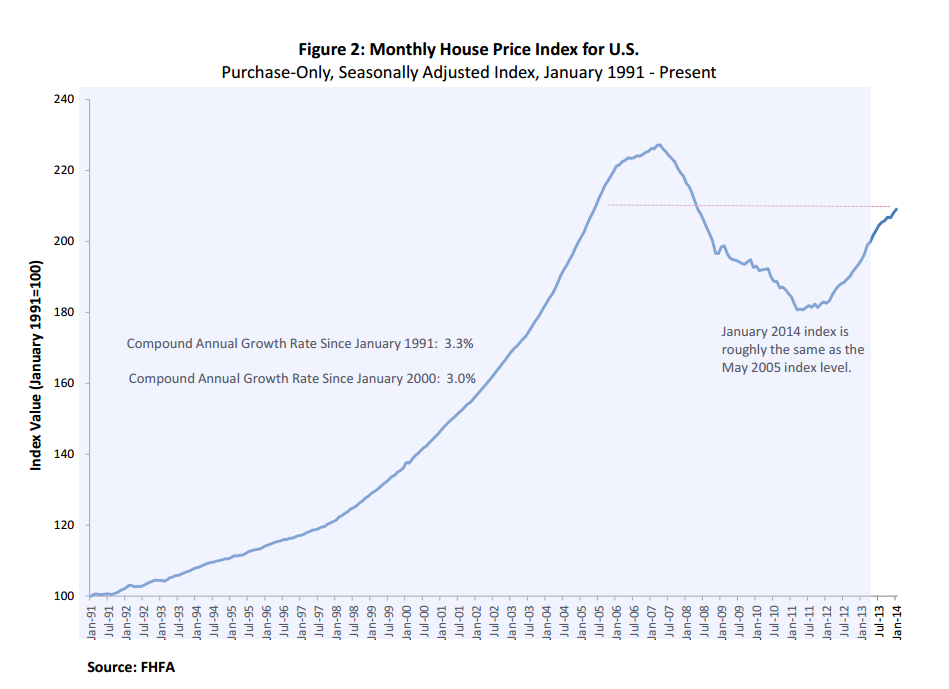
The FHFA house Price Index rose .5% in January, a little lower than expected. Case-Shiller rose 13.24% YOY, slightly below expectations. The Black Knight (formerly known as Lender Processing Services) home price index was flat in Jan, but up 8% year over year. They have home prices within 14% of the June 2006 peak. Note that in the Black Knight survey, the Northeastern states (NY, NJ) are starting to wake up.


Image
 
Charles Plosser was surprised by the market’s reaction to the FOMC statement. Punchline: We should be talking about economic conditions, not timelines. FWIW, I was surprised as well. 6 months after the end of tapering (which will presumably happen at the Dec FOMC meeting) puts you at the June FOMC meeting. Since most forecasts have the Fed funds rate increasing sometime in 2015, an early forecast of a June 15 hike doesn’t seem all that surprising. A lot can happen in 15 months. Plosser would like to see the Fed Funds rate over 2% for 2015 and over 3% for 2016. 
 
The American Enterprise Institute has weighed in on Johnson-Crapo (the replacement for the GSEs). Part of the issue is that the affordable housing mandates don’t disappear, but are moved underground, to be administered by the FMIC. The difference is that it won’t be funded by HUD, it will be funded by a tax on banks, which will ultimately get passed on to borrowers. Others have pointed out that while Johnson Crapo might have issues with the left, it is going to have big issues with the right. FWIW, Dick Bove comes out in defense of the GSEs

Morning Report – The Week Ahead 3/24/14

Vital Statistics:


Last Change Percent
S&P Futures 1861.9 4.9 0.26%
Eurostoxx Index 3080.6 -15.9 -0.51%
Oil (WTI) 100.2 0.7 0.69%
LIBOR 0.235 0.002 0.97%
US Dollar Index (DXY) 80.26 0.154 0.19%
10 Year Govt Bond Yield 2.78% 0.03%
Current Coupon Ginnie Mae TBA 104.8 -0.2
Current Coupon Fannie Mae TBA 103.7 -0.1
RPX Composite Real Estate Index 200.7 -0.2
BankRate 30 Year Fixed Rate Mortgage 4.39


Markets are higher this morning after some good manufacturing data out of Europe and the US. Bonds and MBS are down.
The Chicago Fed National Activity Index rebounded in February to a better-than-expected.14 after a downward-revised -.45 in January. The Markit US Manufacturing PMI came in light.
We have quite a bit of data this week, with the FHFA Home Price Index, Case-Shiller, and new home sales. On Wed, we get durable goods, Thursday, we get GDP and Personal Income / Spending.
Small cap stocks are back to bubble valuations.

Morning Report – Risk spreads back to bubble levels 3/21/14

Vital Statistics:

Last Change Percent
S&P Futures 1869.8 3.7 0.20%
Eurostoxx Index 3093.3 4.4 0.14%
Oil (WTI) 99.25 0.3 0.35%
LIBOR 0.233 -0.001 -0.32%
US Dollar Index (DXY) 80.17 -0.023 -0.03%
10 Year Govt Bond Yield 2.78% 0.01%
Current Coupon Ginnie Mae TBA 104.8 0.0
Current Coupon Fannie Mae TBA 103.6 -0.1
RPX Composite Real Estate Index 200.7 -0.2
BankRate 30 Year Fixed Rate Mortgage 4.42
Markets are up small on no real news. Bonds and MBS are down small. There is no economic data this morning.
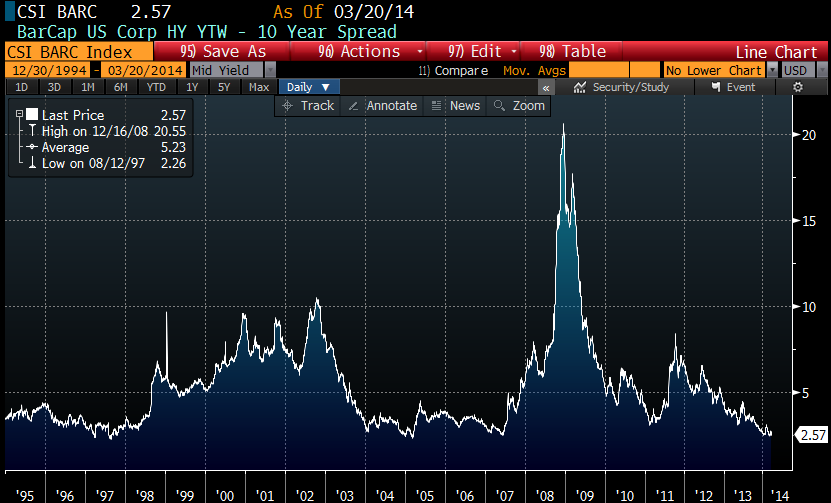
KB Home sold $400 million of 5 year senior notes at 4.75%. The proceeds are going to be used to acquire land. I think we can expect to see more bond issuance as companies take advantage of low rates and tight spreads. Bond investors are paying up for paper at the moment, as spreads are about as tight as they have ever been. This means that (a) the bond market is vulnerable to shocks and (b) we could experience some turbulence as rates start rising. Look at the chart below – high yield spreads are back at bubble levels.

Existing home sales fell yesterday, as professional investors begin to balk at high prices. According to RealtyTrac, institutional investors bought 44,087 properties in Q4, down from a peak of 60,648 in the second quarter of last year. As the labor market improves, we should see a return to a more normal level of cash vs mortgage buyers.

Morning Report – A considerable time 3/20/14

Vital Statistics:

Last Change Percent
S&P Futures 1848.1 -4.1 -0.22%
Eurostoxx Index 3053.4 -22.9 -0.75%
Oil (WTI) 99.67 -0.7 -0.70%
LIBOR 0.234 0.000 -0.11%
US Dollar Index (DXY) 80.26 0.268 0.34%
10 Year Govt Bond Yield 2.78% 0.01%
Current Coupon Ginnie Mae TBA 104.7 0.0
Current Coupon Fannie Mae TBA 103.6 -0.1
RPX Composite Real Estate Index 200.7 -0.2
BankRate 30 Year Fixed Rate Mortgage 4.36
Markets are lower after yesterday’s FOMC meeting sent rates higher and stock lower. Initial Jobless Claims came in at 320k, lower than expected, but higher than last week.
In other economic indicators, the Philly Fed Business outlook rebounded in March, and the index of leading economic indicators rose. Existing Home sales were virtually flat at 4.6 million units. The median home price rose to $189,000, a 9% increase year-over-year. The NAR notes that most of the price appreciation is at the higher price points – the lower price points (sub $250k) are actually falling. In fact, most of the price appreciation is in the $1 million + bucket.
Stocks and bonds sold off on the FOMC statement as investors re-calibrated their estimates as to when rates will begin to rise. The 10 year bond sold off about 6 basis points, but the real action was in the 2 year where rates jumped from 34.7 basis points to close at 42 basis points. In the press conference, Yellen threw out the (probably offhand) comment that “a considerable time” could mean “six months” and that was the catalyst for the bond market sell-off. You can read some of the parsing here. As expected, the Fed cut asset purchases by $10 billion a month. They also got rid of the 6.5% unemployment target and went to more qualitative guidance, as expected.
The Fed released their latest economic forecasts – unemployment and GDP were lowered, while inflation was increased. The forecast for when rates would rise shortened a bit, while the expected rate increased. We will have to wait for the minutes to get a better read on what is behind that.
Homebuilder Lennar is up a couple of percent pre-open after reporting first quarter numbers that beat expectations. Orders increased 10% in units and 25% in dollar value. ASPs rose 18%. and gross margins increased 300 bps. This was the highest first quarter margin in the company’s history. The company felt it was still a little too early to predict the strength of the spring selling season, but hopefully they will give some color on the 11:00 am EST conference call. The big question will be whether they can still push through price increases or have we reached the point where it is depressing traffic.

Morning Report – China’s bubble bursting? 3/19/14

Vital Statistics:


  Last Change Percent
S&P Futures  1866.7 2.9 0.16%
Eurostoxx Index 3084.8 11.0 0.36%
Oil (WTI) 100.3 0.5 0.55%
LIBOR 0.234 -0.001 -0.43%
US Dollar Index (DXY) 79.43 0.019 0.02%
10 Year Govt Bond Yield 2.69% 0.02%  
Current Coupon Ginnie Mae TBA 105.4 -0.1  
Current Coupon Fannie Mae TBA 104.3 -0.1  
RPX Composite Real Estate Index 200.7 -0.2  
BankRate 30 Year Fixed Rate Mortgage 4.31    


Markets are up small on no real news. Bonds and MBS are flat. Mortgage Applications fell 1.2% last week. Later on today we will get the FOMC rate decision. Expect to see another 10 billion reduction in asset purchases and a change in the language regarding the threshold for raising rates. The Fed is expected to de-emphasize a single number (6.5% unemployment) and move to a more holistic threshold. Right now, the futures are forecasting that the first rate hike will be in Q4 next year. Watch to see if that forecast changes after the meeting
 
Housing starts came in about as expected at 907k. January was revised upward from 808k to 909k. We are still running at pretty much depressed levels. Weather undoubtedly played a part, as starts in the Northeast fell pretty dramatically. Building Permits increased to just over 1 million, but most of the growth was multi-fam, not single fam.
 
KB Home reported better-than-expected first quarter numbers. Revenues rose 11%,while orders grew 18% and backlog increased 21%. Deliveries were down about 3% in units, and average selling prices rose 12%. Part of the increase in ASPs is due to a strategic change in KB’s business so you might not be able to draw many conclusions from that number. Gross margins continue to expand, and their 17.7% margins are the highest since 2006. No comments about traffic in the PR, maybe they will address the Spring selling season at the 11:30 EST conference call.
 
In a development that could impact rates here, a big Chinese developer has gone belly up and cannot repay $600 million in loans. We have known for some time that China has an epic real estate bubble and that it may finally be bursting. We are seeing a big drop off in commercial building sales, and that combined with a a historic investment rate topping 20% spells trouble. House price to income ratios in China are over 11. In Shanghai and Beijing that number is 23. To put that number in perspective, in Japan’s bubble in the 80s, the ratio topped out at 15 times income. In the US, it got to about 5x. Fast growing economies have these episodes (we did in the 1930s, Japan did in the 1990s, and China is having theirs now). 
 
What will be the spillover when it bursts? The biggest one will be economic – a burgeoning Chinese middle class had been a big component of global demand growth, and that will undoubtedly get depressed. This could be the catalyst that bursts the Canadian real estate bubble, as Chinese money is behind a lot of that as well. The biggest question will be what effect it has on rates in the US. Will Chinese investors dump Treasuries and MBS (remember, in crises, you sell what you can, not necessarily what you want to) or will there be a massive flight to safety which means rates go lower? My gut tells me that rates go lower because commodity price inflation is about to get slammed and China will attempt to export its way out of the predicament. This means even lower inflation in the US. That is something that will worry the Fed.