Morning Report – Mixed bag of economic data 8/13/13

Vital Statistics:


  Last Change Percent
S&P Futures  1688.5 1.4 0.08%
Eurostoxx Index 2837.4 10.2 0.36%
Oil (WTI) 106.3 0.2 0.20%
LIBOR 0.264 -0.001 -0.19%
US Dollar Index (DXY) 81.59 0.253 0.31%
10 Year Govt Bond Yield 2.68% 0.06%  
Current Coupon Ginnie Mae TBA 104.6 -0.2  
Current Coupon Fannie Mae TBA 103.5 -0.4  
RPX Composite Real Estate Index 200.7 -0.2  
BankRate 30 Year Fixed Rate Mortgage 4.29    


Markets are slightly better this morning after the NFIB Small Business Survey came in below expectations and a mixed report for retail sales. Bonds and MBS are down.
 
The National Federation of Independent Business Optimism Index rose to 94.1 from 93.5, just missing the Street estimate of 94.5. Generally speaking it was a glum report, although it was the 4th highest reading since 2008. (The index has averaged 100 in the 35 years prior to to 2008 so that gives you a bit of perspective). 9% of firms added workers while 12% shed workers. 20% reported job openings they could not fill, which is a good sign for the labor markets, I suppose. 19% reported increasing worker comp while 4% reduced it. Capital Expenditures fell. Credit appears not to be a problem. The report notes the bifurcation of the business environment, where the big S&P 500 names are doing great (energy, large manufacturers, agribusiness) due to strong exports and the rest, who are seeing prospects of earnings growth fade. 
 
The advance estimate for retail sales increased .2% month-over-month and increased .4% ex-autos and gasoline. Sales increased 5.4% year over year. Discretionary goods (sporting goods, apparel) seemed to lead the charge while autos were a drag. Given that consumption is 70% of the U.S. economy, we need to see more robust growth here if we want to see a recovery.
 
Have a borrower who is ineligible for FHA (or doesn’t want to go down that route) but is coming up shy on the down payment? A new equity sharing product from First Rex provides downpayment assistance. They will put down up to half the borrower’s down payment in return for 40% of the house price appreciation. Since it is an equity investment, there are no payments that the borrower must make. FHFA has recommended that the GSEs allow this product as a form of down payment, and SIFMA is considering a proposal to allow loans with subordinate financing product (which is what this is called) to be eligible for good delivery into TBAs. If you have the view that house prices are going nowhere for a while, this may be an interesting product. 
 
Ever wonder why GDP gets revised so much? Remember Q1, which was revised downward from 1.7% to 1.1%. The advance estimate for Q1 GDP was 2.5% in April. By the July, it was 1.1%. What accounts for the revisions? Zach Pandl at Columbia Management discusses all of the economic “sausage making” that goes into GDP estimates and how noisy they are. Which means that when you look at GDP numbers, they might not be giving you a good picture of how the economy is actually doing. 
 
Harry Reid is not onboard with ending Fannie and Fred. From the government’s perspective, F&F are FWB – they are spewing cash, which goes 100% to the government’s coffers, they control them absolutely, but there is still a 20% sliver of outside equity which allows them not to consolidate F&F’s debt on the government balance sheet. When you consider that the taxpayer bears 50% of the credit risk in the U.S. mortgage market, that is significant.

Morning Report – FHFA weighs in on eminent domain 8/12/13

Vital Statistics:

  Last Change Percent
S&P Futures  1678.5 -7.7 -0.46%
Eurostoxx Index 2818.5 -7.1 -0.25%
Oil (WTI) 105.7 -0.3 -0.25%
LIBOR 0.265 0.000 0.00%
US Dollar Index (DXY) 81.5 0.370 0.46%
10 Year Govt Bond Yield 2.58% 0.00%  
Current Coupon Ginnie Mae TBA 105 0.1  
Current Coupon Fannie Mae TBA 104 0.1  
RPX Composite Real Estate Index 200.7 -0.2  
BankRate 30 Year Fixed Rate Mortgage 4.31    


Markets are weaker this morning after Japanese GDP came in lower than expected. There is no economic data this morning, but we will have a lot of it later this week. Bonds and MBS are up small on the risk-off trade.
 
This week will be relatively data-heavy, with inflation numbers (which matter again) and industrial data. We also get housing starts this week.
 
The Office of the Inspector General has releases a mid-point assessment of the HARP program. So far, 2.4 million borrowers have refinanced under HARP, while it has been estimated that 4 to 5 million were eligible. Overly-tight restrictions in the beginning account for the slow start. Also, the report cites a lack of awareness. FHFA intends to launch a nationwide public education campaign. 
 
Separately, FHFA weighed in on eminent domain. They threaten to direct the agencies to restrict or cease business activities within the jurisdictions of any state or local authority that uses eminent domain to restructure mortgage loan contracts. SIFMA has already said that loans coming from such jurisdictions would be ineligible for TBA trading. Now FHFA is saying they are uninsurable. That should end the discussion on the use of eminent domain. Of course FHFA nominee Mel Watt has refused to take a stand on the use of eminent domain, which is another reason why he is a long shot to take over FHFA.
 
MBA reported that applications for new home purchases increased 14% compared to the previous month. This is not a seasonally adjusted number. MBA estimates that sales of new single family homes were running at a seasonally adjusted annual rate of 481,000 in July.

This day in history – August 12

1988 – Martin Scorcese’s film The Last Temptation of Christ is released. Based on a 1953 book of the same name, the film is hugely controversial for its departure from the Biblical account of Jesus’ life as told by the four gospels, and in particular a scene in which Jesus consummates his imagined marriage to Mary Magdelene. Sparking many protests, including some violence (most notably in France) several theater chains refuse to screen the film, and even after it is released on video, many video stores, including Blockbuster Video, will not carry it. Despite the controversy (or perhaps because of it) Scorsese receives an Academy Award nomination for Best Director.

1981 – IBM issues a press release announcing the introduction of its first ever personal computer. The IBM 5150 comes with 4.7 MHz CPU, 64k RAM, 0 MB fixed disk, and a floppy disk drive (remember floppy disks?!?!), and sells for about $3,000. By 2009, for the equivalent inflation adjusted price (roughly $7,000), you can get a 15,400 MHz CPU, 12,000,000 KB RAM, 5.5 million MP fixed disk, and a blue-ray DVD burner as a removable drive.

1978 – In a meaningless pre-season game between the New England Patriots and the Oakland Raiders, wide receiver Daryl Stingley is paralyzed from the neck down after getting hit by Jack Tatum when stretching for a pass on a cross pattern. The hit, which leaves Stingley unconscious on the field, broke his neck between the 4th and 5th cervical vertebrae, leaving him a quadriplegic for the rest of his life. Stingley died in 2007.
http://www.youtube.com/watch?v=a0vKO-sHZTY

1961 – On the night of August 12 and continuing into the morning hours of the next day, in an attempt to stop the flow of citizens to the west, East Germany begins stringing barbed wire and posting sentries at all points of entry into West Berlin from East Germany, completely isolating West Berlin. This marks the beginning of the building of what will come to be a classic symbol of the Cold War, the Berlin Wall. The Wall becomes the site of many iconic Cold War moments, including JFK’s “Ich bin ein Berliner” speech, Ronald Reagan’s “Tear down this wall” speech, and this classic photo of an East German border guard effecting his own escape:
east berlin escape

1944 – Joseph P. Kennedy, Jr., a Naval Aviator and son of former US ambassador to the United Kingdom Joseph Kennedy Sr., is killed over England when the bomb his plane is carrying detonates prematurely. Kennedy was being groomed by his father for a political career, with the White House being the ultimate goal. His death sets the stage for his younger brother, John, to become the standard bearer of Kennedy Sr.’s political ambitions.

1908 – The first production model of Henry Ford’s Model T automobile is produced. The Model T is the first automobile mass produced on an assembly line with interchangeable parts and marketed to the middle class. The first Model T sold for $850, the equivalent of approximately $20,000 today, and revolutionized transportation, making car travel accessible to the ordinary person for the first time.

This day in history – August 11

1999 – A very rare tornado rips through downtown Salt Lake City killing one, injuring 100, and causing over $170 million in damages. According to the National Weather service this is the first major tornado ever to hit a major urban downtown district, with buildings over 500 feet tall being effected. Vice President Al Gore blames global warming.
Salt Lake City tornado

1994 – Major League baseball players go on strike, resulting in the longest work stoppage in the history of MLB, the cancellation of the 1994 season, and the first time since 1904 that a World Series champion is not crowned. The stoppage extends until the eve of the 1995 season, but with owners preparing to field teams of replacement players, future Supreme Court justice Judge Sonia Sotomayor issues an injunction against the owners, and players subsequently agree to end the strike. I wonder if this was the kind of situation in which a wise Latina woman was positioned to make a “better” decision than those dreaded white males.

1988 – Osama Bin Laden and other mujahideen fighters from the Afghanistan war against the Soviet Union meet in Peshawar, Pakistan to discuss expanding their efforts to Islamist movements in other parts of the world. The result of the meeting is the formation of an organization called Al Qaeda.

1984 – While performing a microphone test prior to a radio address, President Ronald Reagan jokes that he “signed legislation that would outlaw Russia forever. We begin bombing in 5 minutes.” The joke is recorded and later revealed to the public. Portrayed as at best an embarrassing political gaffe and at worst an indication of Reagan’s warmongering inclinations, the American electorate doesn’t seem to care as Reagan goes on 3 months later to get re-elected, trouncing Walter Mondale and winning 49 of 50 states.

1973 – George Lucas’ American Graffiti, opens in theaters across the country. Transforming child actor Ron Howard into a legitimate adult star, it also launches the careers of Richard Dreyfus and Harrison Ford. Also notable for a cameo appearance by Suzanne Somers as the mysterious blonde in the T-Bird.

1965 – In Los Angeles a scuffle breaks out between a black motorist and a white police officer following a traffic stop for suspected DUI, sparking a reaction from the predominantly black neighborhood of Watts that grows into a six-day race riot, leaving 34 dead, over 1,000 injured and more than $40 million in property damage. The rioting eventually encompasses a 50 square mile area of South Central LA with over 30,000 people participating in looting, arson, and sniper shooting at police and firefighters. Peace is finally restored 6 days later after the National Guard is called in.
http://www.youtube.com/watch?v=B6PVzar8jw4

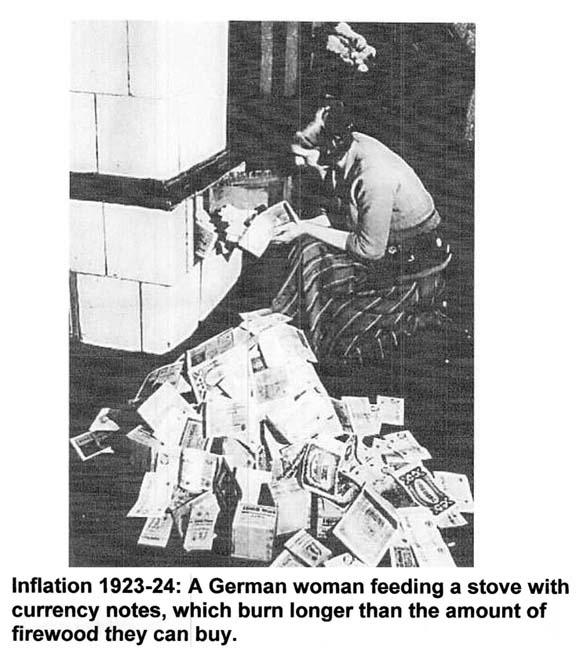
1919 – A new constitution is adopted by the national assembly in Weimar, Germany, beginning the 14 year existence of the Weimar Republic. Weimar is marked by great political turmoil including the rise of Adolf Hitler, but is perhaps most notable historically for its experience of hyper-inflation during its early years. Unable to pay its debts and war reparations, the government simply prints more and more money, resulting eventually in daily and even hourly hikes in prices of goods and services throughout Germany. Paper money becomes so worthless that it is cheaper to burn it in fireplaces and stoves than to use it to buy wood to burn.
weimar inflation

This day in history – August 10

1988 – 43 years after the end of World War II, President Reagan signs a bill providing payments of $20,000 to Japanese-Americans interned during the war. The payment is the equivalent of roughly $25 per day interned.

1984 – During the women’s 3,000 meter race at the Los Angeles Olympics, American and favorite Mary Decker trips on the heel of Britain Zola Budd, ending her quest for gold and producing an iconic photo of the agony of Olympic defeat.
Mary Decker

1984 – The movie Red Dawn is released, notable not only for its cast filled with young, future stars such as Patrick Swayze, Charlie Sheen, Lea Thompson and Jennifer Grey, but also for being the first movie ever released with a PG-13 rating. A Cold War classic, it was re-made last year.

1977 – Postal employee and serial killer David Berkowitz, aka Son of Sam, is finally arrested in Yonkers, New York after killing six and wounding seven in a series of shootings that took place over the course of a year. Berkowitz says his neighbor’s dog, possessed by a demon, told him to do it.

1948 – Allen Funt’s “Candid Camera” debut’s on ABC television. Originally a radio show called Candid Microphone, Funt’s television show would continue to be produced, either as a regular feature or as a periodic special, until 2004. When I lived in England the BBC broadcast an edgier Candid Camera-like show called Trigger Happy TV, which I thought was hilarious.

1846 – President James K. Polk signs the law establishing the Smithsonian Institution.

1792 – Mobs in Paris attack Tuileries Palace, home of Louis XVI and Marie Antoinette, forcing the King to take shelter in the Legislative Assembly. The attack marks the effective end to the Bourbon monarchy, as Louis was a arrested 3 days later, tried, and eventually executed.

This day in history – August 9

1988 – After 4 consecutive Stanley Cups, 8 consecutive MVP awards, and a list of scoring records that would make Michael Jordan envious, the reigning champion Edmonton Oilers shock the hockey world by trading Wayne Gretzky, the greatest player ever to play the game, to the Los Angeles Kings for $15 million. As part of the trade Gretsky demands that teammates Marty McSorley and Mike Krushelnyski be traded along with him. Marty McSorely – what a great name, and not just because of his namesake.

1976 – The USSR launches Luna 24, the last space craft to land on the moon to date, making the USSR responsible for both the first and last man-made crafts to land on the moon, both of which were unmanned. In the interim, however, the US managed a few successes of its own. And had more fun doing it.

1969 – Actress Sharon Tate (wife of Roman Polanksi), and 3 friends including Abigail Folger, heiress to the Folger Coffee fortune, are brutally murdered in Tate’s Benedict Canyon mansion. The murders are perpetrated by members of Charles Manson’s cultish “family” at his behest, in a bizarre attempt to spark a race war which, according to Manson, was prophesied in the songs of The Beatles. I first read about the murders as a young teenager in the book Helter Skelter by Manson prosecutor Vincent Bugliosi. I became totally fascinated with the story, and eventually with true crime stories in general.

1945 – U.S. drops the 2nd atomic bomb “Fat Man” on the city of Nagasaki, killing a reported 60,000 – 80,000 people. Following on the heels of the first use of an atomic bomb on the city of Hiroshima 3 days earlier, the bombing effectively puts an end to Japanese resistance, and within the week Japan surrenders unconditionally, finally ending WWII. Almost 70 years later debates continue to rage over whether the use of the bomb was justified.

1936 – Jesse Owens wins the last of his 4 gold medals at the Berlin Olympics, a well deserved poke in the eye of Adolf Hitler and his Aryan master race fantasies. Although apparently Owens did make good friends with one of his toughest German competitors.

1790 – The trading ship Columbia returns to Boston after a 3 year journey, the first ship to carry the U.S. flag around the world.

Leave the ‘Skins Alone!

Slate magazine today declared that the name of the Washington professional football team, the Redskins, is forever banned from its pages. The name, apparently, is simply too offensive and Slate is taking a stand.

Which is actually a bit weird. Slate admits that the name “is not an open-and-shut outrage” and that it “has a relatively innocent history.” It acknowledges that the name’s creator, original team own George Preston Marshall, “was almost certainly trying to invoke Indian bravery and toughness, not to impugn Indians,” and even that current team owner Dan Snyder probably “is[n’t] lying to us or to himself when he sees only the bright side of the name.” Why, then, is Slate so adamant about joining the bandwagon to get the Redskins to become, well, something else? Because, it says, times have changed.”[T]ime passes, the world changes, and all of a sudden a well-intentioned symbol is an embarrassment.”

Well, yes, time has passed, and the world has changed. But the only really relevant change is the fact that the term “redskin” no longer possesses whatever derogatory connotations it might once have had. Why? Precisely because it is the name of the Washington football team. When was the last time anyone heard the word used in a context outside of a sports team name, in a derogatory manner? Google the term “redskin” and the only results you will get…the only results, page after page…will be references to the football team. In fact the use of the term as a team name has pretty much eliminated its effectiveness as a slur, even if someone wanted to use it as such. To the average person in America the term means and brings to mind only one thing…the Washington football team.

It is rare to be able to take a slur (again, to whatever extent it ever was one) and eliminate the sting inherent in the word. Some critics of the name have tried to press their point by asking us to try to imagine using other ethnic slurs as the name of a sports team, like for example the Washington N-words. Absurd and offensive, of course. But imagine that just such a thing had been done in a long distant, less sensitive time, and imagine further that, as a result of its repeated and common use in that context, no one ever used the term as a racial epithet anymore. To use the word was to refer to a sports team, not to demean a black person. Wouldn’t that actually be a welcome change from our current situation in which the word – a simple word! – is so powerful and taboo that mature adults have to act like embarrassed grade schoolers reporting to the teacher that they heard someone cursing (“He said the f-word!!!”)? Of course we have no hope of that ever happening with the dreaded n-word, which will forever carry its historical implications and therefore will also always be banished from polite conversation. But that is precisely what has happened with the term redskin, even if not by design. Why shouldn’t that achievement be embraced?

Besides, consider the following:

Washington Redskins Fighting Irish

Now you tell me, which of these is a more offensive stereotype: the staid, dignified Native American of the Washington Redskins, or the impish, belligerent, and almost certainly itching-for-a-brawl drunk of the Notre Dame Fightin’ Irish? If the latter isn’t too offensive to be mentioned and seen in polite company, neither is the former. Leave the ‘Skins alone.

This day in history – August 8

I’ve been thinking about making an effort at maintaining a new ATiM daily feature…Today in History. Maybe it will spark a few conversations. With Brent on sabbatical for a couple days, now seems like a good time to start. We’ll see how long I last.

1988 – The Chicago Cubs finally succumb to modern times as the first night game ever is played under the newly installed lights at Wrigley Field. The game, however, is rained out in the 4th with the Cubs leading the Phillies 3-1. I like day games, and I really like Wrigley Field.

1974 – President Richard M. Nixon takes to the airwaves to announce his resignation, effective the next day at noon. I remember my parents gathering us kids in the family room to watch the announcement, telling us the removal of a President would be a once in a lifetime event. Clinton almost proved them wrong. I wish Obama would.

1966 – The future Mrs. ScottC is born.

1960Itsy Bitsy Teeny Weenie Yellow Polkadot Bikini hits number 1 on the Billboard charts.

1945 – President Harry Truman signs the United Nations Charter and the US becomes the first nation to ratify membership in the UN.

1942 – Six German saboteurs who had secretly landed on Long Island in June are executed after a military tribunal finds them guilty of spying. The case would later be cited by the Bush administration in support of trying unlawful combatants by military tribunals rather than in civilian courts.

1911 – The Apportionment Law (Public Law 62-5), setting the number representative in the House at 435, passes Congress. I think it is high time for the size of the House to be increased again. Too few reps representing too many people.

1882 – Snow falls on Lake Michigan, prompting Democrats to propose economy-destroying regulations in a panic over catastrophic global cooling. (OK, I made up that second part.)

Morning Report – Obama’s housing plan 8/7/13

Vital statistics


  Last Change Percent
S&P Futures  1700.7 -1.8 -0.11%
Eurostoxx Index 2811.4 2.4 0.08%
Oil (WTI) 107 0.5 0.44%
LIBOR 0.266 0.001 0.38%
US Dollar Index (DXY) 81.74 -0.138 -0.17%
10 Year Govt Bond Yield 2.63% 0.00%  
Current Coupon Ginnie Mae TBA 104.6 0.0  
Current Coupon Fannie Mae TBA 103.9 0.1  
RPX Composite Real Estate Index 200.7 -0.2  
BankRate 30 Year Fixed Rate Mortgage 4.37    


Stocks are lower this morning on no real news. August is usually a slow month, so you often see big moves on no real volume, or without any important reason. Bonds and MBS are up.
 
Mortgage Applications rose last week for the first time in two months. The purchase index was up small while the refi index fell slightly.
 
Obama laid out his housing plan in a speech yesterday. There was nothing major in it, with the exception that he wants to tax mortgage backed securities to fund low-income housing. Supposedly this would replace explicit goals for lending to low income borrowers. So basically, it is euthanize Fan and Fred, beef up FHA, make the government a mortgage reinsuer, and impose an additional tax on mortgage backed securities.
 
Freddie Mac may do something about eminent domain. 
 
No MR tomorrow of Friday

Free Riders

WalMart, arguably the largest employer in the United States, is frequently the target of criticism for its parsimonious pay and benefits package. And they know it. In a smoking gun type memo from 2005, they look hard at their health care benefits. While the memo is nearly a decade old, most of the observations and conclusions seem current. In particular, they know their reputation suffers:

Wal-Mart’s healthcare benefit is one of the most pressing reputation issues we face because well-funded, well-organized critics, as well as state government officials, are carefully scrutinizing Wal-Mart’s offering. Moreover, our offering is vulnerable to at least some of their criticisms, especially with regard to the affordability of coverage and Associates’ reliance on Medicaid.

They in part blame the health of their workforce. A couple of Plum Liners often note the WalMart is the employer of last resort. You work there because you can’t get a better job somewhere else.

Our workers are getting sicker than the national population, particularly with obesity-related diseases. For example, the prevalence of coronary artery disease in Wal-Mart’s population grew by 6 percent compared to a national average of 1 percent, and the prevalence of diabetes in our population grew by 10 percent compared to a national average of 3 percent. (That said, our workforce is no sicker at present in absolute terms than the national population.)

A segment of our workforce consumes healthcare inefficiently, in a pattern similar to a Medicaid population. Our population tends to over utilize emergency room and hospital services and underutilize prescriptions and doctor visits. This pattern is most evident among our low-income Associates, and one hypothesis is that this behavior may result from prior experience with Medicaid programs.

In remarkable self-awareness, they realize that healthcare is their Achilles heel in the public mind.

Healthcare is one of the most pressing reputation issues facing Wal-Mart. Survey work done last summer shows that people’s perception of our wages and benefits is a key driver of Wal-Mart’s overall reputation. Several groups are now mounting attacks against Wal-Mart focused on our healthcare offering. These increasingly well-organized and well-funded critics – especially the labor unions and related groups, such as Wal-Mart Watch – have selected healthcare as their main avenue of attack. Moreover, federal and state governments are increasingly concerned about healthcare costs, and many view Wal-Mart as part of the problem (a view due, in part, to the work of Wal-Mart’s critics). Medicaid costs are a major priority on most governors’ agendas; already a quarter of states are spending more than 25 percent of their budgets on Medicaid, and observers across the political spectrum assert that the current system – with spiraling costs, a large population of uninsured, and an increasing number of medical bankruptcies – is unsustainable (although there is little consensus on what should take its place). In this environment, we can expect efforts like those in Maryland (which is trying to mandate that companies spend a certain percentage of revenue on healthcare) and New Hampshire (which requires health services to track where Medicaid enrollees are employed) to accelerate. Proposals such as these, if successful, will bring added costs to Wal-Mart. Moreover, these battles with critics and governments are contributing to the decline of Wal-Mart’s overall reputation.

As for being free-riders, nearly half of their employees’ dependents are either on Medicaid or just going bare.

We also have a significant number of Associates and their children who receive health insurance through public-assistance programs. Five percent of our Associates are on Medicaid compared to an average for national employers of 4 percent. Twenty-seven percent of Associates’ children are on such programs, compared to a nation al average of 22 percent (Exhibit 5). In total, 46 percent of Associates’ children are either on Medicaid or are uninsured.

In their recommendations, the realize the need to make sure their position is heard. This memo was written before the word got out that individual mandates are Kenyan Socialism but it’s interesting that at one time they supported the concept.

Become more engaged in the national healthcare debate, to position Wal-Mart as a leader in healthcare in general and on access (e.g.,individual mandates…
{snip}
Public reputation risk. Healthcare enrollment will fall several percentage points due primarily to a shift to more part-time Associates, which could draw additional attacks from Wal-Mart’s critics. Also,despite the proposed efforts, the Medicaid problem will not be “solved.” A significant number of Associates and their children will still qualify for Medicaid. Because many of these programs will offer more generous health insurance than Wal-Mart provides, many Associates will still choose to enroll in Medicaid, leaving the door open for continued attacks.

For those that decry the welfare state, it seems that they easiest way to shrink it is to make sure the private sector is not part of the problem. Increases in the minimum wage and mandatory benefits increase employment costs. Possibly a lot. Labor costs are a particularly high percentage of food service and retail. But these are jobs that cannot be easily outsourced or automated.

We have a tragedy of the commons problem in that what is good for WalMart (and their customers) is not necessarily good for the nation as a whole. It’s good to know that WalMart recognizes the problems they face. It’s less reassuring that in the nearly past decade they have done little to alter the perception of them.