Morning Report – Why are the homebuilders blue? 03/19/13

Vital Statistics:

  Last Change Percent
S&P Futures  1550.2 3.4 0.22%
Eurostoxx Index 2696.2 -9.3 -0.34%
Oil (WTI) 93.9 0.2 0.17%
LIBOR 0.282 0.002 0.71%
US Dollar Index (DXY) 82.66 -0.032 -0.04%
10 Year Govt Bond Yield 1.94% -0.02%  
RPX Composite Real Estate Index 192.6 -0.2  

Markets are firmer this morning in spite of the continuing problems in Cyprus. The FOMC meeting starts today, with the rate decision expected tomorrow. The market will be focusing on the Fed’s body language regarding the strength of the recovery and the end of QE.  Bonds and MBS are up on the flight to quality trade.

Housing starts climbed to a 917,000 annual rate in February. Muti-fam starts continue to be in the 36% – 37% range as builders feed the red-hot rental market. Housing starts are still running at about 60% of historic levels (about 1.5MM units) going back to the late 50s. For the past 10 years, we have averaged 1.3 million units a year, which includes the meat of the housing bubble and the bust. We have been underbuilding for some time now.
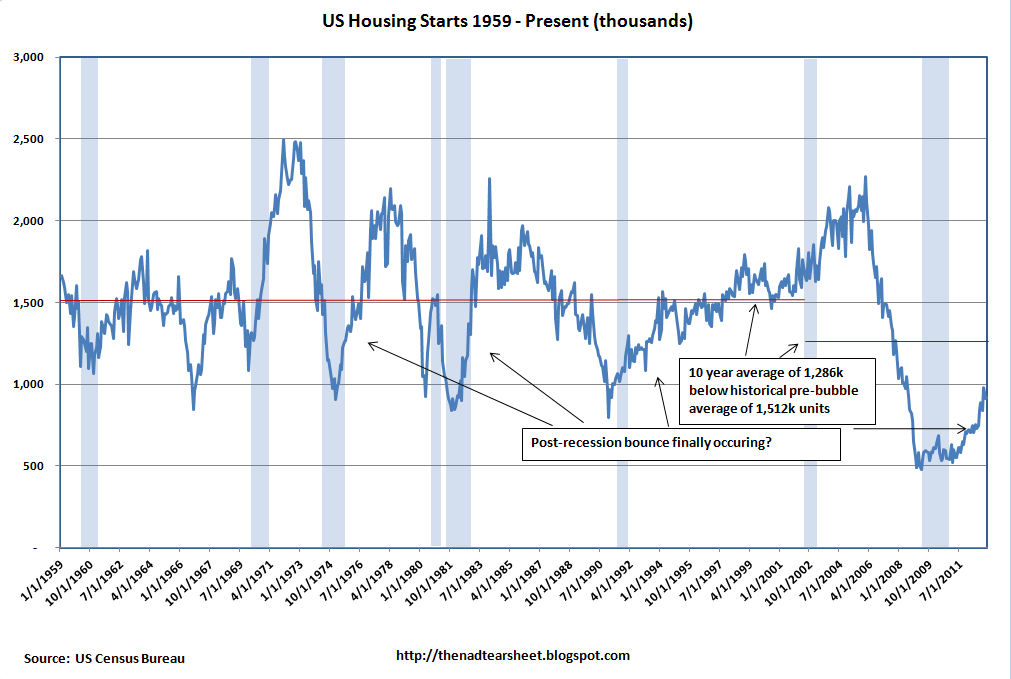
The fact that we have underbuilt for so long partially explains why the rental market is so hot. This demand was masked for quite some time due to the recession as household formation numbers plummeted. 
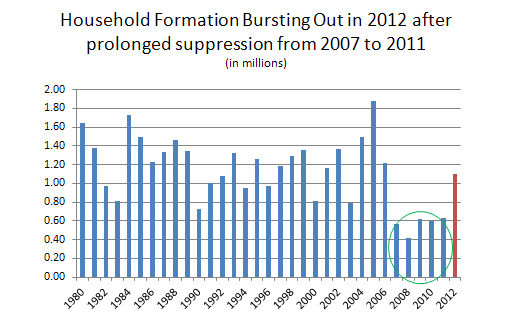
Many would-be first time homebuyers graduated college and returned to their parents’ house after an unsuccessful job search.  Others moved in with roommates to minimize costs. That drop in household formations does not represent a demographic shift, it represents a temporary economic phenomenon.  It also means there is a lot of pent-up demand that is going to be released as the economy recovers. While a lot of that will go into rentals, the first time homebuyer (creditors willing of course) is about to return to the housing market and that will allow the move-up buyer to sell. This has been one of the biggest sticking points for the market – a lack of first-time homebuyers.

So, with this economic backdrop, why did the homebuilders report a drop in confidence last month?  The National Association of Home Builders / Wells Fargo Housing Market Index of builder sentiment had been on a tear since early 2012 as the homebuilders began sticking their heads above the parapet. The problem is not demand for new homes; it is problems in the the supply chain, along with rising costs for materials and labor. In an earlier post, I talked about how the shortage of construction workers was making lives difficult for homebuilders. This is reflected in the builder sentiment survey. They also mention the gripe everyone else is making – appraisals – and a tough credit market for borrowers who don’t fit in the GSE / GNMA box.

Bottom line: if you have made a bit of dosh trading the homeboys or the XHB, it might be time to start ringing the register….


Morning Report – Risk off? 03/18/13

Vital Statistics:

  Last Change Percent
S&P Futures  1540.5 -13.1 -0.84%
Eurostoxx Index 2682.2 -43.6 -1.60%
Oil (WTI) 92.52 -0.9 -1.00%
LIBOR 0.28 0.000 0.00%
US Dollar Index (DXY) 82.68 0.419 0.51%
10 Year Govt Bond Yield 1.94% -0.05%  
RPX Composite Real Estate Index 192.8 -0.8  

Markets are sharply lower this morning on the news of Cyprus’s banking crisis. The fear is that financial contagion could spread the to other sovereigns who have been given a bit of a reprieve from the bond vigilantes. You are seeing a bit of a widening in the PIIGS this morning, but nothing dramatic. Needless to say, the 10 year is benefiting from the flight to quality trade and is trading comfortably below 2%.  MBS are up as well.

This week will have some important economic data points, with Housing starts to be released tomorrow. The Street is at 915k. The FOMC meeting starts Tuesday, with the decision to be announced Wed afternoon. Notwithstanding the Cyprus situation, investors will be looking for clues as to when the Fed ends QE. With the Fed dominating the MBS and Treasury markets, “me-too” traders may find the exit much more narrower than they imagined. The FHFA House Price Index comes out on Thursday, along with existing home sales and leading economic indicators. 

This month’s CoreLogic Market Pulse discusses the mortgage market in transition, as we move from a market dominated by serial refinances to one driven more by purchase activity. Assuming that the Cyprus situation doesn’t trigger another Euro crisis, we can probably say we have seen the bottom of interest rates for this cycle (and maybe for a generation or two).  The good news is that purchase activity will be replacing refi activity; the bad news is that it will take longer to ramp up than refis, which can turn on a dime.

The key to the return of the purchase market is the first-time homebuyer, who has been dormant since 2007.  Household formation has been depressed since the crisis began and is only now beginning to turn around. Unfortunately, it looks like most of these people are becoming renters. Unless you qualify for a FHA mortgage, it is very difficult to get financing these days without a sizeable down payment. Institutional investors have picked up some of the slack, with their market share purchases increasing to 27% from 16% two years ago in places like Phoenix. These properties are most likely going to rentals. Institutional investors like Blackrock have raised billions for this activity since real estate bottomed over a year ago. I suspect they are going to find that the activity less profitable than they modeled and this demand will turn to supply as they ring the register on some of these properties.

Relative to incomes, real estate is the cheapest since the 1970s and the late 90s.  RTWT.  Lots of good stuff in this issue.

Over the past few months, the back up in rates has been quite dramatic, with the 10-year going from 1.6% to over 2%. How has this affected mortgage rates?  It turns out that MBS / Treasury spreads have stayed relatively consistent since last November.  Note: These are yields on the securities themselves, not actual borrowing rates. 


Ron Swanson, Capitalist Hero

The NBC comedy Parks and Recreation stars Amy Poehler as a hyper-enthusiastic civil servant. The head of the titular department head is one Ron Swanson a manly meat-loving wood-working anti-government zealot who happens to suck on the government teat. Mostly played for laughs, Ron Swanson as understatedly played by Nick Offerman has become a conservative icon on the level of Stephen Colbert.

In the most recent episode, Leslie Knope, now a city councilwoman has pushed through the council a government handout to a failing video store only to have it converted to a porn store. In this scene, Leslie offers to eat crow for failing to listen to Ron’s warnings.

(It seems the embed code doesn’t play well with WordPress, so use the link below):
Ron Swanson

Leslie laments:

There has to be a way for government to help places that add community value but don’t necessarily rake in the money.

Ron says:

There is not. The free market is a jungle. It’s beautiful and brutal and should be left alone. When a business fails, it dies and a better one takes its place. Just let business be business and government be government.

It’s done sincerely without any snark or comeuppance for Ron.

For the full episode, go here

My point is that while Ron Swanson is a caricature, he also has character. And he has a pyramid of greatness.

pyramid

Morning Report – Capex around the corner? 03/15/13

Vital Statistics:

  Last Change Percent
S&P Futures  1556.5 0.5 0.03%
Eurostoxx Index 2732.2 -12.5 -0.46%
Oil (WTI) 93.69 0.7 0.71%
LIBOR 0.28 0.000 0.00%
US Dollar Index (DXY) 82.27 -0.334 -0.40%
10 Year Govt Bond Yield 2.04% 0.01%  
RPX Composite Real Estate Index 193.5 0.0  

Markets are flattish this morning after a week of strong gains. The CPI came is a little higher than expected mainly due to higher gasoline prices. Since the Fed is pretty much solely focused on the unemployment rate, this is not going to be a market-moving number. Industrial production rose, while capacity utilization increased to 79.6%. Bonds and MBS are flat.

Chart:  Capacity Utilization Rate:

The Empire State Manufacturing Survey reported that conditions for manufacturers in the NY area continued to improve modestly. The 4 month outlook showed increasing optimism. Input prices rose, while selling prices remained flat. The employment indices remained sluggish. Manufacturers indicated that they were increasingly willing to take on debt and for the first time since 2008, reported that they expected their cash holdings to decrease. Capital Expenditures have been in maintenance mode since the crisis, and this may portend a shift. As we have seen in the chart above, capacity utilization rates are approaching “normalcy,” which means that businesses are starting to plan capital expenditures for better days ahead. All in all, things are starting to line up for a normal expansion.

The Senate has released their report on the JP Morgan’s London Whale loss. “The Subcommittee’s investigation has determined that, over the course of the first quarter of 2012, JPMorgan Chase’s Chief Investment Office used its Synthetic Credit Portfolio (SCP) to engage in high risk derivatives trading; mismarked the SCP book to hide hundreds of millions of dollars of losses; disregarded multiple internal indicators of increasing risk; manipulated models, dodged OCC oversight; and misinformed investors, regulators, and the public about the nature of its risky derivatives trading.” The “misinformed” charge is a hefty one and will certainly be a focus at the hearing this afternoon. Separately, the Fed said it had found “weaknesses” in JP Morgan’s capital plans, which means JP Morgan won’t be able to pay any special dividends or conduct stock buybacks. 

President Obama met with Republican leaders and offered them entitlement cuts:  Chained CPI for Social Security and means-testing Medicare, but insisted they cough up new revenues. We’ll see if any grand bargain comes out of it. 

Morning Report – Glass Steagall Redux 03/14/2013

Vital Statistics:

  Last Change Percent
S&P Futures  1554.0 4.0 0.26%
Eurostoxx Index 2739.8 35.1 1.30%
Oil (WTI) 92.27 -0.3 -0.27%
LIBOR 0.28 0.000 0.00%
US Dollar Index (DXY) 83.05 0.158 0.19%
10 Year Govt Bond Yield 2.05% 0.03%  
RPX Composite Real Estate Index 193.5 0.0  

Stock index futures are up (again) after initial jobless claims came in lower than expected, and inflation readings at the producer level showed inflation well contained. Initial Jobless claims came in at 332k, better than the street estimate of 350k.  Bonds and MBS are down.

Since the early Feb, the US dollar has been on a tear, as nascent US economic strength is drawing assets from overseas and the Bank of Japan attempts to devalue the Yen. We have yet to see manufacturers complain, but at some point, they will. It will be interesting to see if Jack Lew expresses support for a strong dollar or damns it with faint praise. 

proposal by the Dallas Fed would cap assets at deposit-insured divisions of the largest US banks at $250M and force them to separate investment banking and traditional lending. It isn’t a full re-institution of Glass-Steagall – it would require separate capitalization and funding for the investment banking and trading units, but would not formally force them to break up. That said, for all practical purposes, it would effectively re-instate Glass Steagall.  The reason why we repealed Glass Steagall in the first place was because the US investment banks (Goldman, Merrill, etc) couldn’t compete with the big international banks in the US derivatives business because the overseas giants had such a huge funding advantage. The big international giants like Barclay’s, UBS, and Nomura could borrow at depositor rates (which were often 0%), while the US investment banks were forced to borrow at higher, market-driven LIBOR rates. This meant that Barclay’s etc. could offer much better financing rates on derivatives than Goldman or Merrill. The rest of the world does not separate commercial and investment banking, or even draws a distinction between the two.

This proposal would eliminate the reason why investment banks and commercial banks joined up in the first place – cheap financing. Since the big giants are trading with a holding company discount, they will undoubtedly face shareholder pressure to spin off their investment banking operations to eliminate the discount. The reason why the Fed is doing this is to make it easier for the FDIC to close down a failing unit of a big bank. It isn’t a systemic risk issue. That said, I have always been highly skeptical of the Glass Steagal theory of the financial crisis. Residential real estate bubbles are the Hurricane Katrinas of banking, and it doesn’t matter if you were long real estate through a mortgage loan on your balance sheet, through a holding of mortgage backed securities, or because you sold protection on a basked of CDOs, you were still long real estate and still got crushed when it dropped.  People forget the rationale for Glass Steagall, which was to prevent investment banks from using their captive commercial banks or insurance companies as a “back book” for holding soured underwritten bond offerings. The financial crisis did not occur because JP Morgan was stuffing bad paper onto Chase’s balance sheet – it happened because we had a real estate bubble.  And because we are in “do something, anything” mode, we are attacking the wrong reason (Glass Steagall) while ignoring the real reason – the Fed.

RealtyTrac reported that foreclosure filings increased 2% MOM in February, but are down 25% YOY. “At a high level, the U.S. foreclosure inferno has been effectively contained and should be reduced to a slow burn in the next two years” according to Daren Blomquist, VP at RealtyTrac. Nevada, Maryland, Washington, and New York are the states with more work to do, and they have reported big increases in foreclosure starts. 

Exercise

I started Crossfit a few weeks ago. Really liking it. It’s a team environment, which is a lot more fun that just going to a gym. It’s a bit intense, but we have all ages. There’s guy in my class in his 60s and some women who can’t be more than 110 soaking wet.

The “box” (the lingo for gym) that I go to is owned by a Marine. He tends to name his workouts. This one is named after a 1LT who was killed in Afghanistan. It’s strangly motivating. I find myself working harder, like it owe it to her. Here’s the workout:

U.S. Army First Lieutenant Ashley White, 24, of Alliance, OH, assigned to the 230th Brigade Support Battalion, 30th Heavy Brigade Combat Team, North Carolina National Guard, based in Goldsboro, NC, died on October 22, 2011 in Kandahar province, Afghanistan, from wounds suffered when insurgents attacked her unit with an improvised explosive device. She is survived by her husband Captain Jason Stumpf, her parents Robert and Deborah, brother Josh, and sister Brittney.

“White”
5 Rounds of the following.
3 Rope Climbs
10 Toes to Bar
21 OH (overhead) Plate Walking Lunges (45/25) use a 45 or 25 pound plate, hold it above your head, and do lunges
Run 400m

LII — level 2, so not as hart as the “White”
5 Rounds
1 Rope Climb
7 Toes to Bar
21 OH Plate Walking Lunges (45/25)
Run 400m

LI
4 Rounds
3 Rope Pull to Standing
7 Knees to Wherever
21 OH Plate Walking Lunges (25/15)
Run 400m

Morning Report – The war over the CFPB 03/13/2013

Vital Statistics:

  Last Change Percent
S&P Futures  1546.7 -0.1 -0.01%
Eurostoxx Index 2696.2 -15.7 -0.58%
Oil (WTI) 92.97 0.4 0.46%
LIBOR 0.28 -0.001 -0.36%
US Dollar Index (DXY) 82.61 0.029 0.04%
10 Year Govt Bond Yield 2.03% 0.01%  
RPX Composite Real Estate Index 193.5 -0.6  

Stock index futures are flattish after a good retail sales report. Retail sales increased 1.1%, higher than the .5% estimate. January was revised upward. While retail sales is a notoriously volatile number, it does provide another data point that the economy seems to be picking up speed, not slowing down. Mortgage applications fell. Bonds and MBS are down.

HARP refis are accounting for the lion’s share of refinancings in the hardest hit states.In Nevada, they account for 68%.  In Florida, it is 58%.  This has had the effect of taking inventory off the market, which is driving price increases and helping create a virtuous circle of price appreciation and easier credit. The MBA is projecting that lending will fall 21% this year as higher interest rates cool the refi market according to Fannie Mae. Refis will still account for 58% of all origination. 

The battle over the Consumer Financial Protection Board continues. Republicans are threatening to block Richard Cordray’s nomination to head the agency unless changes are made in its charter to make it more accountable to Congress. Republicans are pushing for the Chairman of the CFPB to be replaced with a bipartisan board and for the agency to be subject to the normal Congressional appropriations process.

Ally has sold a large MSR portfolio to Ocwen for $585 million, covering $85B of unpaid principal balance. No word on what percent were performing, etc. 

Morning Report – NFIB Small Business Optimism 03/12/13

Vital Statistics:

  Last Change Percent
S&P Futures  1548.6 -1.9 -0.12%
Eurostoxx Index 2715.7 -3.0 -0.11%
Oil (WTI) 92.49 0.4 0.47%
LIBOR 0.281 0.001 0.36%
US Dollar Index (DXY) 82.6 0.030 0.04%
10 Year Govt Bond Yield 2.04% -0.02%  
RPX Composite Real Estate Index 194.1 -0.1  

Markets are taking a breather after a string of gains over the past week and a half.  The Dow Jones Industrial Average is at a record high, and the S&P 500 is within striking distance of its 2007 high. Bonds are catching a bounce after a lousy week. MBS are up as well.

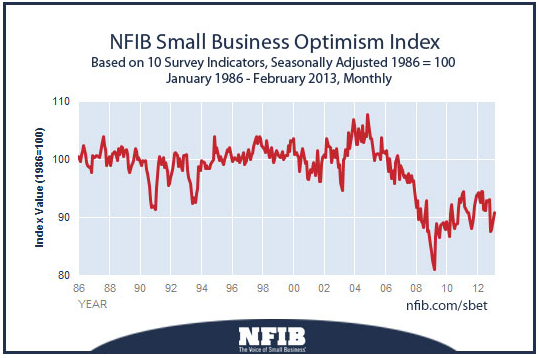
The National Federation of Independent Businesses reported that small business optimism increased small in February to 90.8, and is returning to its post crisis norm.  It is still well below its historical average, and even below the lows of the 91-92 recession and the 01-02 recession. The report makes an interesting study in contrasts – while the stock market indices are approaching record highs, and earnings are at or near record highs, the small business sector is still stuck in the morass that began in 2008.  The reason for that international sales account for a bigger percent of the S&P 500, and that has been doing better than the US (Europe notwithstanding). On the other hand, restaurants and retailers, the backbone of small business in the US, are still having a tough go of it as consumers continue to de-leverage. Construction, energy, and manufacturing were the bright spots of the report.

Given Friday’s positive jobs report, how long will it take us to get to full employment? Of course it depends on the labor force participation rate.  The low labor force participation rate is what has been holding down the unemployment numbers, as people who have been unemployed over 6 months but are not actively looking for a job are no longer counted among the unemployed. If those people started looking for jobs again, they would start counting as unemployed and the unemployment percentage would increase.  If the labor force participation rate remains stuck at the current lows, it would take 49 months.  If it went back to historical norms, it would take 73 months. 

With the continuing resolution approaching, Paul Ryan and Patty Murray will submit dueling budgets. Expect both budgets to be on the partisan side before real negotiating begins.  The sticking point will be the sequester, which the Left wants eliminated and the Right wants to use as the baseline for future budgets. The debt ceiling still needs to be dealt with at the end of the summer. 

Mary Jo White promises to get tough on Wall Street if she is confirmed as head of the SEC. Finishing rulemaking under Dodd-Frank is an “immediate imperative” as well. High Frequency Trading will also be a focus. She is expected to be confirmed.

The PIB Argument

A long article in Slate by John Corvino takes on the tendency for opponents to marriage equality to insist that people who support gay marriage must also be in favor of polygamy, incest, and bestiality (or PIB as he calls it). One paragraph in particular jumped out at me.

But why would anyone think that supporting same-sex relationships logically entails supporting PIB? The answer, I think, is that some people misread the pro-gay position as resting on some version of the following premise: People have a right to whatever kind of sexual activity they find fulfilling. (emphasis in the original) If that were true, then it would indeed follow that people have a right to polygamy, incest, “man on child, man on dog or whatever the case may be.” But no serious person actually believes this premise, at least not in unqualified form. That is, no serious person thinks that the right to sexual expression is absolute. The premise, thus construed, is a straw man.(emphasis added)

It’s an amazingly open-minded essay well worth reading but unlikely to change many minds.

Morning Report – Shortage of construction workers 03/11/13

Vital Statistics:

Last Change Percent
S&P Futures 1542.5 -2.0 -0.13%
Eurostoxx Index 2712.8 -16.0 -0.59%
Oil (WTI) 91.9 0.0 -0.05%
LIBOR 0.28 0.000 0.00%
US Dollar Index (DXY) 82.75 0.057 0.07%
10 Year Govt Bond Yield 2.05% 0.01%
RPX Composite Real Estate Index 194.2 -0.6

Markets are slightly weaker this morning after Fitch downgraded Italy’s sovereign debt. This week is light data-wise.  We have retail sales on Wed, and industrial production / capacity utilization on Friday. Bonds and MBS are up small.

Legal and business experts have weighed in on the government’s case against S&P and have found it, well, wanting. Turns out they don’t have any witnesses who will support allegations that S&P intentionally defrauded banks and the credit unions that are the victims in this case. In reality, the victims are not widows and orphans, but sophisticated institutional investors. And it is hard to argue that S&P were the smartest guys in the room and knew that the financial system was about to collapse when everyone else (Moody’s, the Fed, etc) did not.

Fed Governor Elizabeth Duke gave a speech to the Mortgage Bankers Association where she predicted that the housing recovery is real and is poised to accelerate. She does note that inventory is very low, and credit standards are very tight which is making it difficult for the first time homebuyer who is going to drive demand in the housing sector. Apparently the fraction of mortgages going to first-time homebuyers is half of what it was in the early 00s. The low housing formation numbers of the past few years represent a lot of pent-up demand and the Fed is forecasting that it should reach 1.5 million a year. Of course some of those people will rent, but still it will drive home prices higher, especially when you consider housing starts had been stuck around 600k – 800k since the bubble burst. Finally, the Fed is watching liquidity in the MBS market and is prepared to slow purchases if it thinks that it is dominating the market.

On the back of last Friday’s jobs report, it turns out that there a shortage of construction workers. Builders in some areas are finding it difficult to find workers and are having to raise wages to attract them. It turns out a lot of them left the residential construction industry after the bust and took jobs in trucking and energy. Interestingly, housing starts are up 24% or so YOY, while construction employment is up only 3%. In some ways, the weak housing market probably exacerbates this problem as many workers are stuck in an underwater house and cannot move to where the jobs are.  As house prices rise, this effect should dissipate and could portend a rapid drop in unemployment. Which also means that margins are going to be under pressure for the home builders if they cannot pass the higher labor costs onto home buyers.  Food for thought as the XHB bounds to post-crisis highs.