Monday Administrative Thread

I thought I would take the liberty of putting up at least a draft administrative thread because I want to mention a couple of things … administrative.

I am going to work on several posts and leave them in draft for a day or two (or longer) until they are ready to go. If you look at the drafts, you’ll see that I started one this morning, but it will take a little research to plug in some references and the like. It occurred to me over the weekend that starting and holding drafts that aren’t time sensitive might be a good practice for some of us to use so that we can percolate them and post them when there’s a need for some new content. I know some others have already been doing this a bit, so perhaps I’m just slow on the uptake, but there has been some discussion before of spacing out posts, and using draft status is a good way for us not only to work on items that we can’t knock out in a few minutes in one sitting but to have a little inventory of working items to drop in at the right time to keep things moving. Just a thought.

I don’t know whether others have been using labels, but I suggest we do start using them, creating new ones as needed and using labels others have already created when they fit. With a laissez-faire, collaborative blog, I suppose we might end up with label proliferation, but labels are good.

Also, I wonder whether anyone else has the same problem I have with the text editing window positioning itself so that about 3/4 of the editing buttons (font, ital, etc.) at the top is blocked by gray. Is this another IE7 thing? It’s very annoying, and I can’t even see what the two gray, rectangular buttons on the far left are. If I knew how to take a screen shot to show what my screen looks like, I would, but I am too inept. — QB

The Monday Morning Opening

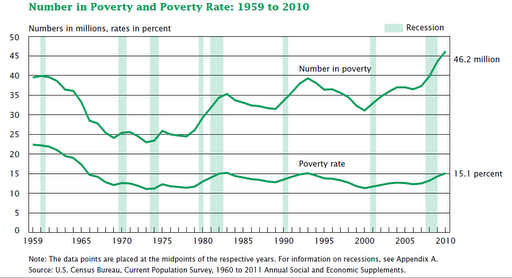
There were some interesting discussions of poverty in the US over the weekend and for some reason I thought it might be helpful to see the trajectory of poverty rates over the last 50 years. The chart also overlays the statistics over past recessions which I think is helpful. Content below is from EconMatters. (lmsinca)

By EconMatters

In yet another sign that the Great Recession cuts deep and long–the number of Americans living below the official poverty line reached 46.2 million, the highest in 52 years since the Census Bureau started tracking the figures in 1959.

The overall poverty rate also climbed to a 17-year high at 15.1%, which means 1 in 6 Americans are living below poverty line largely due to the high unemployment and underemployment rate. The official poverty line for 2010 is defined as an annual income of $22,314 for a family of four, and $11,139 for an individual.


Chart Source: The Census Bureau

The Census Bureau’s annual report released on Tuesday, Sept. 13 gives a very grim snapshot of American households in 2010. As the U.S. economy expanded 3% in 2010, and corporations reported good profits, the gains are not trickling down to workers. The median household income in 2010 dropped to $49,445, which is virtually unchanged from the level in 1997. Overall, household income has fallen by 6.4% since the recession began in December 2007. (Ok, who was the one declared that the recession “officially” ended in June 2009?)


Note from lmsinca

So we’re one week in and it has been interesting to say the least. The site is both stable and usable as a forum for discussions. We’ve attracted a great group of commenters and authors so far but I would suggest we need to at least double our list over the next couple of weeks to keep things interesting. There were some great posts with both controversial and non-controversial comments and even a few heated arguments……………welcome to blogging. We’ve already seen a few people leave or decide not to participate for various reasons, which I don’t find unusual in the least. We keep working, discussing and improving, building on success and learning from our mistakes. The more people take ownership of this space the more successful it will be. Are we having fun yet?

Welcome to week two.

(Posted Sunday night from the West Coast for East Coast early birds)

Testing, Testing


Here I shall insert an inbred cat:


And here is a video with a surprise ending:

http://www.youtube.com/get_player


And here is just a little bit of text so that I can see what it looks like.


line by lms

"Republicans Criticize Tax on Millionaires Idea"

Well, gee, there’s a surprise. Paul Ryan on the Buffett Tax, “It adds further instability to our system, more uncertainty and it punishes job creation and those people who create jobs,” Ryan said on Fox News Sunday. “Class warfare may make for good politics but it makes for rotten economics.” And, of course, Mitch chimes in.

Instability? Uncertainty? Punishes job creation? I call BS on this. Righties here, are you on board with the Republican leadership line on Buffett Tax? If so, on what basis?

Republicans criticize tax on millionaires idea

Update: Edited for clarity at 3:06PM MST/

Sunday Morning Open Thread

I’ll throw this up to start the day since I happen to be up and about.

Kevin has an interesting piece up on the role of Robin Hood in modern life that he posted late in the day/early in the morning last night. You should go check it out in yesterday’s archive.
Yesterday’s college football games went well for all of us, since Mark’s ‘Horns trounced UCLA, okie’s Sooners crushed Florida, and the Utes won the Holy War with BYU quite handily. Oregon also won, but I don’t know if shrink or bernie care.
I hope to have the FAQ sheet ready to throw up as the end-of-the-day Bits & Pieces for you all to look at, discuss, and edit.
As Greg would say, what else is happening? And do you have a joke for us, Scott?
Update: Kevin! You sly dog, you–you’ve already created the tab for the FAQ! Look up there next to the “Rules of Engagement” tab, guys.

One Thing Is Needed to Ease Poverty . . .

Tax the rich.

Well, technically, says the author, they need more disposable income, which you will get for the poor by taxing the rich. At least I think that’s what he’s saying.
But the more interesting point (to me) that he makes is this: 

Yet most people I know don’t want to trade their slick smartphones for “Matrix”-era Motorolas. The people I know are happier now than they were in the ’90s. They do not see a 15.1 percent poverty rate as a cause for panic. Their wages are not lower than they were 14 years ago. Today’s high poverty rate is not, as far as I can tell, a mainstream concern. This is one of the reasons the American economy is in such trouble.  

The Great Recession found most of its victims among the least educated Americans. The unemployment rate for Americans who lack both high school and college degrees is 23.9 percent. But these are not the people you will typically hear from in the mainstream media; they’re not a major force in popular culture or in the policy world. Among people with bachelor’s degrees or higher, the unemployment rate is 4.3 percent — close to the number that the Federal Reserve would accept as “full employment” if it applied to the country as a whole. I hate to use the phrase “skilled labor,” as it seems like a pretty haughty thing for a guy with a degree in theater who can’t change a tire to say, but the truth is that the economy has been unforgiving to those who tried to go right from high school into a trade.  

The result is that we have 46 million people living below the poverty line — and for the most part, living there quietly.

And then he says: “America can’t afford 46 million poor without raising taxes on the rich.”

As many no doubt know, I’m open to more progressive taxation on the wealthy, and especially the super-duper-wealthy. But is wealth redistribution the answer to poverty? Could we ever, even in the most optimistic light, expect to be able to tax the wealthy enough to make up the gap, and bring the poor above the poverty line? Is a model that creates economic growth by taxing the wealthy, subsidizing the poor, and seeing economic growth proceed from there one that could possibly be sustainable?

I am very dubious. Not that I don’t think the rich can afford, and maybe should be paying, more money for more government projects, money to the space program, infrastructure, and maybe even expanding medicare or shoring up Social Security.

One more thing: I commonly argue that context matters, and that it’s a worthwhile thing to consider modern American poverty in the light of worldwide poverty, both present day and historically. The common response to this is the same one the author brings up. That is, yes, poverty in America may be much better than poverty in Nigeria, but “is ‘better than Nigeria’ really a standard we want to adopt in judging American economic conditions?”

Of course not. But if you never stop to appreciate what you have achieved, and what few successes you’ve won, how do you know you are making any progress at all? Moreover, what’s the point in trying to make progress? No point in fighting a war on poverty, because as long as anybody has less than anybody else, you’ve accomplished nothing.

I’m rambling. It’s late. I should go to bed. I just happened to read that Op-Ed in The Daily, and I thought I would share it.

Good night to all, and good morning to many.

Bits & Pieces-Open Thread for Sat. Night

Kevin Drum had this poll up today which I found interesting. It’s no wonder Republicans can swing the debate their way by not compromising. This will coincide nicely with a post I’m working on making the case that conservatives, at the far right end of the spectrum at least, or what we all call the base, stick to their ideology with the zeal of religious faith. I wonder if after seeing this poll anyone can really argue against that.

“We’ve seen this result before, but here’s some confirmation from a recent CBS poll. If you ask Democrats if their politicians should stick to their guns come hell or high water, virtually no one thinks that’s a good idea. Compromise reigns supreme. Ask Republicans, and you get a very sizeable chunk who are ready to die for every hill — and, undoubtedly, ready to punish any politicians who doesn’t. I’m not sure that a single poll question can explain Washington all by itself, but if there is one, this is it. Republicans are scared of their base; Democrats aren’t.”

Posted by lmsinca (I just typed the line in unless someone has a better idea)

________________________________________________________________________

Apropos of Nothing: Merrie Olde England

I have London on my mind this weekend. Niece #3 heads there this evening for her semester abroad experience. So I thought I’d read up to see what she’ll land in come Sunday morning.

PM David Cameron seems to be competing with French president Nicolas Sarkozy as to which European leader gets the bigger rock star welcome in Libya.

http://www.dailymail.co.uk/news/article-2037693/David-Cameron-Libya-visit-PM-Nicolas-Sarkozy-compete-glory.html?ito=feeds-newsxml

Does the term ‘mission accomplished’ and all it came to represent mean nothing to these men?

–Unlike many conservative pols on this side of the pond, Cameron is “emphatically in favour of gay marriage.”

http://www.pinknews.co.uk/2011/09/16/david-cameron-emphatically-in-favour-of-gay-civil-marriage/

–Unemployment in the UK is at 7.9%. I’m not clear yet on the specifics, but there seems to be evidence of a national jobs effort in the UK. Unlike in the US, where there seems to be evidence of more political gridlock.

http://www.fx-mm.com/8513/trading-commentaries/trading-commentary-currencies-direct/uk-unemployment-rises/

–I’m hoping my niece doesn’t run into these creepy dudes. Hopefully they will remain out of sight until next summer.

http://sports.yahoo.com/olympics/blog/fourth_place_medal/post/London-unveils-creepy-looking-mascots-for-2012-O?urn=oly-242206

–The exchange rate is moving slightly in my niece’s favo(u)r. A month ago, one pound sterling was worth about $1.65. Now it’s about $1.58. Not a lot, but better than the other way around.

Bank Deposits Should Be At Risk

Suppose you own a store and want to protect your inventory from shoplifters.  You probably pay to install video cameras, and may even hire a security guard to wander around.  Suppose you are a celebrity, and want to protect yourself from adoring and perhaps not so adoring fans.  You probably pay to hire a bodyguard to travel around with you.  Suppose you own a cache of diamonds and want to protect it from theft.  You probably either pay to have a safe installed in your house, or you pay for a safe deposit box in someone else’s safe.


The common thread here is that, if you want to protect something, you generally have to pay to get someone else to protect it.  Oddly, however, when we want to protect our money, what do we do?  We deposit it in a bank and, rather than pay them to protect it, we expect them to pay us for the privilege of protecting it.  This makes no sense whatsoever.


The truth is that the only reason that banks are able to pay interest on deposits with them is because, far from protecting our money, they are putting it at risk.  That is precisely what interest represents…a premium received as payment for taking the risk that one may not get back one’s money.  And that is precisely the service that banks perform when they take deposits.  They do not protect your money.  They help you earn more money by putting what you already have at risk.


The federal government has obscured this fact, and through its federal guarantees on bank deposits led people to believe that they should be able to earn money with their money without ever taking any risk.  FDIC offers up the possibility of a free lunch.  This is a nonsensical view of reality.


There are some real economic benefits to FDIC insurance, but they derive mainly from tricking people into taking risks with their money, through the promise of a free lunch, that they wouldn’t otherwise take.  If you really wanted to protect your money, you should rent a safe deposit box at a bank.  This is a service that banks do provide, and you have to pay for it.  But if you put your money on deposit with the expectation that it will grow, you should be prepared to take the risk that your money might be lost.

The Financial Crisis was a Perfect Storm whose Elements are Known

One of the elements of that storm was the partial repeal ofGlass-Steagall, coupled, however, with the partial repeal of the BankHolding Act [both in Gramm-Leach], and made deadly by the CommodityFutures Modernization Act of 2000 and the subsequent vacuum intowhich fell Enron’s “off the books” activities, the burgeoning ofunregulated credit default swaps backed by zero insurance reserve, andthe unregulated “securities” called collateralized debtobligations. See the various press releases from SEC, especially2001-2002, and their joint releases with the Commodities FuturesTrading Commission, to get the sense of “oh, wow, this is gonna begreat” that was pervasive.
Oneresult was government insurance of deposits in commercial banks thatcould then be leveraged in very risky and unregulated transactions. “What does seem impractical, however, are the current arrangements.Anyone who proposed giving government guarantees to retail depositorsand other creditors, and then suggested that such funding could beused to finance highly risky and speculative activities, would bethought rather unworldly. But that is where we now are.” MervynKing, Bank of England, October 2009.  

Thereare other historical elements. When we gave Citibank thevariance – the “temporary” approval – to merge with TravelersInsurance years earlier in contravention of the existing Bank HoldingAct we were playing with this fire. When we began the incrediblebipartisan push for 100% mortgages to barely qualified borrowers wewere creating tinder to be fed into the unregulated CDOs that were inheavy demand because of a tidal wave of cash looking for a home. When FanFred participated in the Goldman-Sachs model of wealthcreation we further implicated the future governmental response.
Irecognize some compelling arguments for looking elsewhere. See
Again,consider the banks in western countries that were NOT shaken to theirroots, that were not crying for bailouts. “Canada’s experienceseems to support those who say that the way to keep banking safe isto keep it boring — that is, to limit the extent to which banks cantake on risk.” The dreaded Krugman, 2-1-10
Iconcede that is an argument for regulating risk taking, not forregulating the wall between “commercial” and “investment”banking, per se. However, the contribution from tearing down thatwall is that investment banking runs a far chancier, and more global,set of risks than is required for good lending practices. The set ofrisk averse regulations historically applicable to lendinginstitutions would stifle an investment banker. Even now we see theindustry fighting against maintaining mere ten per cent in reserves. I remember when 18% was typical for a local bank.
Ipose that separation would be a net good and reduce future risk inthe way suggested by Mervyn King.
Fora world class primer on line refer to:
This is conveniently found through the “baselinescenario” link on the right of your page.

 I’m outta here!  At least, for now.  Hook ’em Horns!